
Why Your Foursquare Tips Age Like Fine Wine: A Deep Dive into Micro-Review Dynamics
Popularity dynamics of foursquare micro-reviews
This paper investigates the popularity dynamics of Foursquare micro-reviews (tips), defining popularity by the number of "likes" received. Utilizing a dataset of 10 million tips, the authors analyze temporal evolution and social influence, proposing a multivariate regression model to predict future popularity rankings of tips.
TL;DR
Unlike a viral tweet that dies in hours, a Foursquare "tip" takes months to reach its full potential. This research analyzes 10 million tips to prove that micro-reviews follow a "slow-burn" popularity curve. By leveraging user reputation and venue data, the authors developed a model that predicts which tips will be the most popular half a year before they actually peak.
Context: The Persistence of Location-Based Content
Most research on social media popularity deals with "ephemeral" content—news, photos, or tweets that have a massive burst of attention and then vanish. Foursquare tips are different. Because they are pinned to a physical venue, they are rediscovered every time a new customer walks through the door.
The authors identify a critical research gap: we don’t know why some tips become "legendary" at a venue while others are ignored. Is it the content? The author’s fame? Or simply because the tip was there first?
The "Slow-Burn" Discovery
The most striking finding is the temporal evolution of popularity. While Flickr photos or Digg stories get their views in the first 48 hours, Foursquare tips are just getting started.
- The 2-Month Mark: Between 41% and 48% of a tip's likes are received after the first two months.
- The Social Boost: Friends and followers are "ignition" agents. They provide over 60% of likes in the first hour, essentially giving the tip enough visibility to eventually be found by strangers visiting the venue.
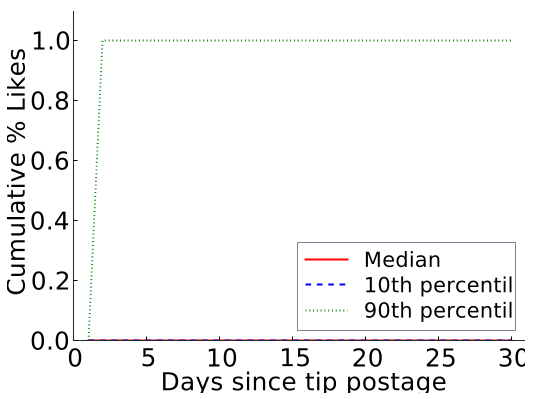 Figure: The cumulative fraction of total likes shows a steady, non-viral growth over six months.
Methodology: Can We Predict the Future Top 10?
The authors moved beyond simple "what is popular" statistics to "what will be popular." They compared a baseline (current ranking) against a multidimensional regression model.
The 53-Feature Engine
To beat the baseline, the model examines:
- User Authority: Not just follower counts, but "Mayorships" and past tip success (Expertise).
- Venue Vitality: How many check-ins does the place get? Is it a "verified" venue?
- Content Nuance: Sentiment scores (Positive/Negative/Neutral) and linguistic structure (POS tagging).
Challenging the "Rich-Get-Richer" Myth
In platforms like YouTube, the popular stay popular (Preferential Attachment). However, this paper found a weaker rich-get-richer effect in tips (). This means a high-quality tip from a reputable user can still unseat an older, more liked tip—a sign of a healthy information ecosystem.
Experimental Battle: Baseline vs. Model
The team tested their model on New York City data, predicting rankings up to 6 months in advance.
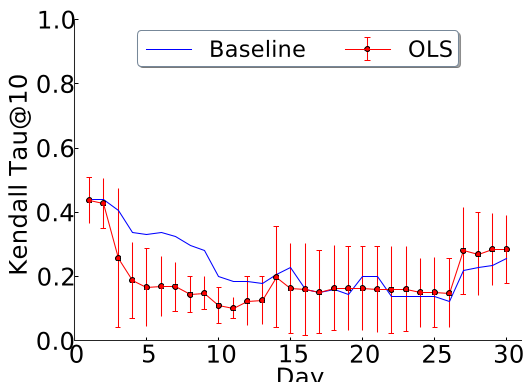 Figure: Comparing Kendall τ (lower is better). The OLS model (darker bars) consistently outperforms the baseline as the time horizon () increases.
Key Insights from Experiments:
- The Baseline Fails Over Time: Using current popularity to predict popularity 6 months from now is unreliable. The ranking is highly unstable.
- Text is Secondary: Interestingly, textual features were less important than user features. In micro-reviews (under 200 characters), who says it matters more than how it's phrased.
- Data Scarcity Matters: In smaller categories (like specific "Food" niches), the complex model struggled because there wasn't enough training data, making the simple baseline nearly as effective.
Takeaways & The Future of Reviews
This study proves that for location-based platforms, "popularity" is a marathon, not a sprint.
- For Developers: Recommendation engines should wait for "slow" signals. A tip that is ignored on day 1 might be the best tip on day 100.
- For Business Owners: Pay attention to the "Social Boost." Influential users give your venue visibility that pays dividends months later.
Limitations: The study relies on likes as a proxy for quality, which doesn't always account for "hate-liking" or ironic engagement, though this is rare in micro-reviews. Future work should look at the geographical distance between a user's tips to see if "local experts" are more predictive of popularity than "tourist" reviewers.