
CoupledGNN: Decoupling the Cascading Effect for Social Popularity Prediction
Popularity Prediction on Social Platforms with Coupled Graph Neural Networks
This paper introduces CoupledGNN, a novel graph neural network architecture designed for network-aware popularity prediction on social platforms. It addresses the cascading effect by employing two specialized, interdependent GNNs to model the iterative interplay between node activation states and the spread of interpersonal influence, achieving SOTA performance on Sina Weibo datasets.
TL;DR
Predicting whether a tweet or a post will go viral is notoriously difficult because it depends on the "cascading effect"—the chain reaction of one user activating their neighbors. CoupledGNN breaks new ground by using two intertwined Graph Neural Networks to separately model who is active and how influence spreads. This approach outperforms previous SOTA models (like DeepCas and SEISMIC) by over 10% on real-world Sina Weibo data.
The Motivation: Why Simple GNNs Aren't Enough
Most existing models for popularity prediction treat the problem as either a simple regression based on early adopter features or a representation learning task on the subgraph of early adopters.
The missing link? The explicit cascading mechanism. In a social network, influence isn't just a static property; it's a dynamic interplay. A user becomes active because their neighbors influenced them, and their newly active status then amplifies their influence on others. Standard GNNs mix these two signals into a single vector, which dilutes the "physics" of the cascade. The authors argue that we need a structure that mirrors this iterative biological-like spread.
Methodology: The Dual-Engine Architecture
CoupledGNN operates through two specialized channels that communicate at every layer:
1. The State Graph Neural Network
This module tracks the activation state () of every user. Instead of a simple sum, it uses an InfluGate to weight how much influence user actually has on user .
- Intuition: Just because my neighbor is active doesn't mean I'll follow; the strength depends on our specific relationship (interpersonal influence).
2. The Influence Graph Neural Network
This module updates the influence representation (). Crucially, it is gated by a StateGate.
- Intuition: Influence only "flows" through active users. If a user isn't active, their potential to trigger the next hop in the cascade is zero.
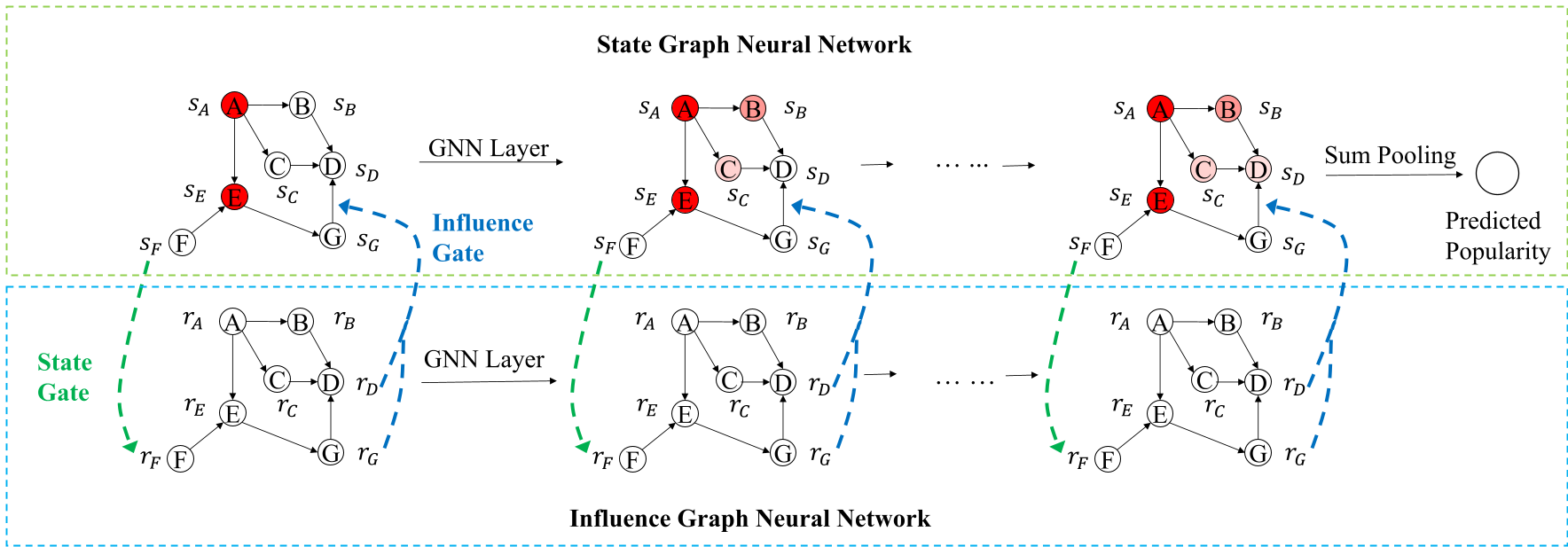 Figure 1: The CoupledGNN framework showing the interplay between State () and Influence () representations.
By stacking layers, the model naturally captures -hop cascades. Interestingly, the authors found that 3 layers work best for Weibo, which aligns perfectly with the empirical data showing 99.76% of activated users fall within 3 hops of early adopters.
Experimental Results: Dominating the Baseline
The researchers tested CoupledGNN against three main types of competitors:
- Feature-based: Linear regression on hand-crafted graph metrics.
- SEISMIC: A point-process model based on Hawkes processes.
- DeepCas: A deep learning model that samples paths using random walks.
Across all metrics (MRSE, mRSE, MAPE), CoupledGNN emerged as the clear winner.
 Table 1: Performance on Sina Weibo. Note that as the observation time increases, CoupledGNN's error drops significantly faster than baselines.
Key Insight from Ablation: The study compared CoupledGNN against "Single-GNN" variants (GCN and GAT). The Coupled version consistently performed better, proving that separating State and Influence into two "coupled" channels is more effective than concatenating them into one vector.
Critical Analysis & Takeaways
- Robustness: One of the most impressive findings is that the model maintains its lead even when 20% of the network edges are unknown. This makes it highly practical for real-world scenarios where social graphs are rarely fully observable.
- Efficiency: Unlike Hawkes processes that require expensive Monte-Carlo simulations, CoupledGNN utilizes efficient neighborhood aggregation, making it scalable to large networks using mini-batch techniques.
- Limitations: Currently, the model focuses on the network and early adopters but doesn't explicitly integrate the content (text/image) of the post or high-resolution temporal patterns.
Future Outlook
CoupledGNN provides a blueprint for modeling "influence physics" on graphs. Future iterations could integrate Temporal GNNs to capture exactly when each user was activated, potentially unlocking even higher precision in predicting the exact peak time of a viral trend.
Senior Editor's Note: This work successfully bridges the gap between traditional epidemiological diffusion models and modern deep representation learning. It moves GNNs from being "structural encoders" to "process simulators."