
SoVP: Why Your Viral Predictor Fails in Social Networks (and How to Fix It)
On popularity prediction of videos shared in online social networks
This paper introduces SoVP (Social network assisted Video Prediction), a novel framework for predicting video popularity within Online Social Networks (OSNs). By shifting from traditional time-series forecasting to a propagation-based model, it effectively captures high-dynamics and access bursts, outperforming standard views-based models.
TL;DR
Most video popularity models assume a linear relationship between early views and long-term success. While this works for YouTube searches, it fails miserably for videos shared on platforms like Facebook or RenRen. This paper introduces SoVP, a propagation-aware model that looks under the hood of social links to predict "bursts" and "peaks" with far greater accuracy than standard time-series models.
The Motivation: The "Social" Difference
In traditional Video Sharing Sites (VSSes), users find content via browsing or searching. Here, a video's popularity typically follows a predictable decay. However, in Online Social Networks (OSNs), videos spread through "News Feeds" and "Friendship Links."
The authors discovered a critical discrepancy: the correlation between early-day views and late-day views is significantly lower in OSNs than in VSSes. This means that if you only look at how many people watched a video yesterday, you will likely miss the viral explosion happening tomorrow.
Methodology: Beyond the View Count
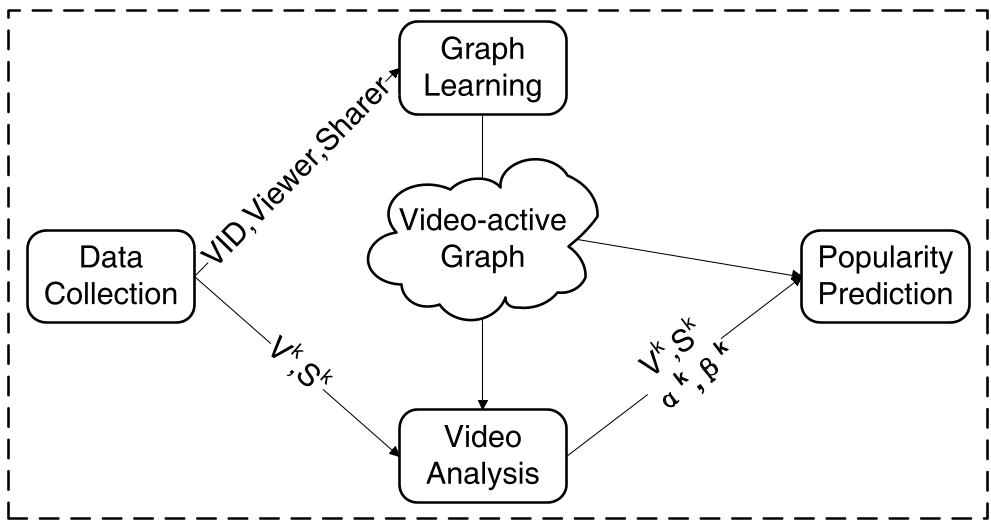
SoVP moves away from treating popularity as a simple time series. Instead, it treats it as a biological contagion moving through a social graph.
1. The Video-Active Graph
Instead of a static friendship graph, SoVP builds a weighted "video-active graph." It measures:
- ViR (Viewing Rate): How likely is User B to watch what User A shares?
- ShR (Sharing Rate): How likely is User B to reshare a video after watching it?
2. Modeling the Propagation
The core logic resides in a set of differential equations that track the "Waiting Viewers" (). The model balances the intrinsic attractiveness of the video (factors and ) with the influence of the spreader.
Experiments: Crushing the Baselines
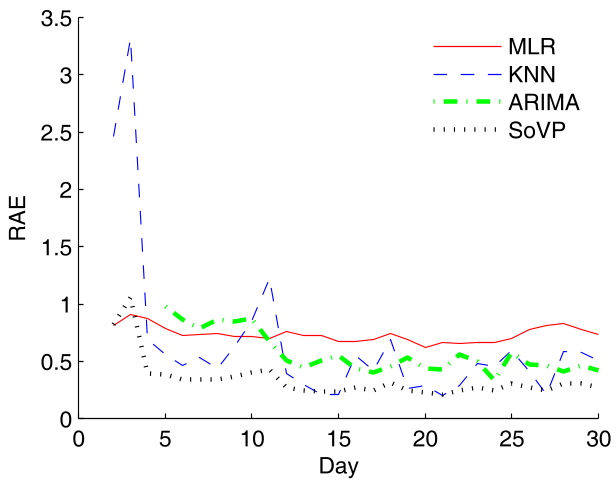
The researchers tested SoVP against three heavyweights: ARIMA (statistical forecasting), MLR (Regression), and kNN (Pattern matching).
The results were stark. While conventional models struggled with "Type-3" videos (those that stay dormant before exploding), SoVP accurately predicted the surge.
Key Result: Burst Prediction
In the burst phase of a viral video, SoVP's error rate remained stable (approx. 10-20%), whereas models like kNN saw error rates spike to over 200%. This is because SoVP accounts for the potential reach of the current sharers, not just the history of the viewers.
Critical Analysis & Conclusion
The Takeaway: If you are an advertiser or a CDN provider, counting views isn't enough. You need to understand the topology of the social "fuse" that leads to the explosion.
Limitations:
- Complexity: SoVP requires access to user-level interaction data, which is often a "black box" locked behind platform APIs.
- Computation: Building a weighted video-active graph for millions of users is significantly more intensive than running a simple ARIMA forecast.
Future Outlook: The integration of SoVP’s propagation logic into real-time edge caching could revolutionize how we handle traffic spikes in the era of TikTok and social-first content.