
Hier+Pop: Solving the Transportability Crisis in Healthcare AI via Causal Invariance
Population-aware hierarchical bayesian domain adaptation via multi-component invariant learning
This paper introduces a "Population-aware Hierarchical Bayesian Domain Adaptation" framework for healthcare prediction tasks, specifically influenza detection from symptoms. It combines environment-specific learning with multi-component invariant learning across population subgroups to achieve SOTA performance on four real-world datasets with limited target labels.
TL;DR
Predicting diseases like influenza is difficult because "fever" reported via a smartphone app isn't the same as "fever" recorded by a doctor. This paper introduces a Population-aware Hierarchical Bayesian framework that treats data collection environments and population demographics as structured components. By identifying causal invariants, the model achieves superior accuracy even when target datasets have very few labels.
Background: The Instability of Observational Health Data
In the world of medical machine learning, we face two daunting hurdles:
- Feature Instability: The context of data collection (e.g., citizen science vs. hospital visits) changes the meaning of features.
- Representation Bias: A model trained on a population of young adults fails when transported to a population of seniors.
Most current Domain Adaptation (DA) methods treat these shifts as a black box. This paper argues that if we understand the Data Generating Process (DGP), we can separate what stays the same (invariants) from what changes.
The Core Insight: Causal Selection Diagrams
The authors use causal diagrams to localize "Mechanisms of Instability." They posit that while the relationship between symptoms () and infection () might change due to the recording environment (), the biological susceptibility of certain age groups () to the virus () remains more stable across environments.
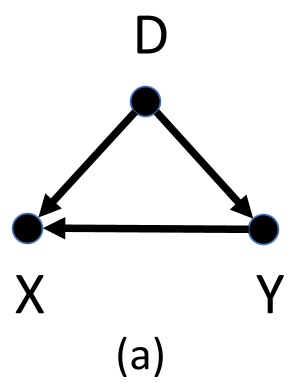 Figure 1: Selection diagrams identifying where environmental shifts and selection biases occur.
Methodology: The Hierarchical Bayesian Approach
Instead of a "one-size-fits-all" model, the authors propose an undirected hierarchical model.
1. Multi-Level Hierarchy
The model architecture links local parameters () to:
- Environment Parents: Capturing whether data came from "Citizen Science" or "Healthworkers."
- Population Parents: Capturing invariant traits for specific Age and Gender groups.
- Global Root: Representing universal priors across all data.
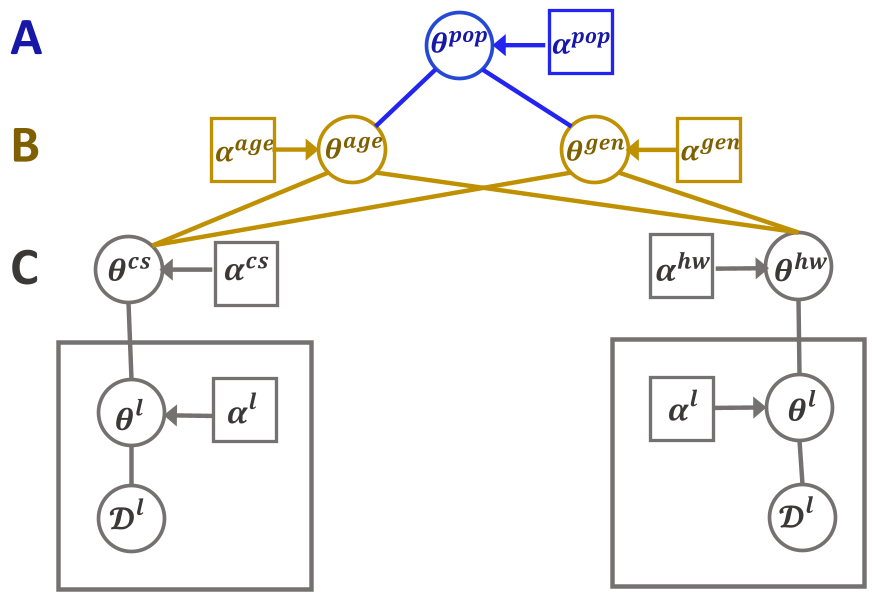 Figure 2: The multi-component hierarchy for parameter sharing.
2. Licensing Conditions
The paper doesn't just blindly share information. It introduces Theorem 1, which provides "licensing conditions." It mathematically determines when a local dataset has enough information to override global invariant parameters, preventing "Aggregation Bias."
Experimental Battleground
The model was tested on four diverse influenza datasets (Goviral, Fluwatch, Hongkong, Hutterite).
- Goviral: Self-reported, small sample.
- Hongkong: Healthworker-facilitated, large-scale.
Results: Winning with Less Data
The results were clear: Hier+pop consistently outperformed standard Logistic Regression and the popular "Frustratingly Easy Domain Adaptation" (FEDA).
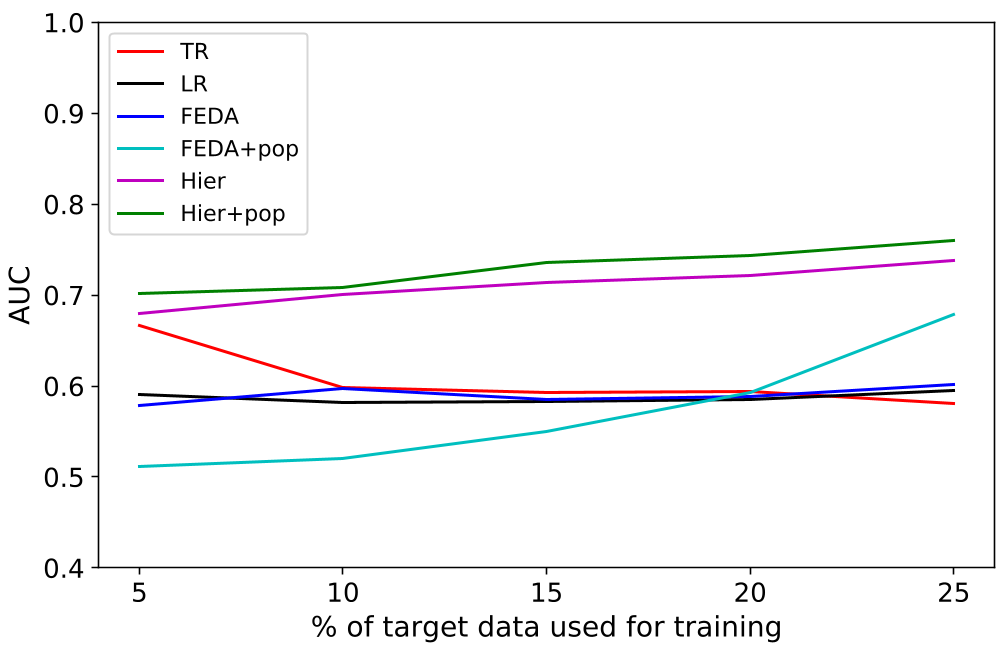 Figure 3: Performance vs. Amount of Labeled Target Data. Note how Hier+pop dominates at low label counts.
| Method | Goviral AUC | Fluwatch AUC | Hutterite AUC |
|---|---|---|---|
| Target Only (LR) | 0.594 | 0.584 | 0.712 |
| FEDA | 0.588 | 0.521 | 0.651 |
| Hier+pop (Ours) | 0.744 | 0.754 | 0.814 |
Deep Insight: Fairness and Social Impact
By decoupling classifiers for each subgroup, this method naturally aligns with the "Non-Maleficence" (do no harm) principle in AI ethics. It ensures that minority populations (e.g., the 65+ age group in a predominantly young dataset) still receive accurate predictions by borrowing strength from the same age group in other environments.
Conclusion
This work demonstrates that domain adaptation is not just a statistical trick; it's a causal one. By explicitly modeling population structures through a Bayesian hierarchy, we can create healthcare models that are both robust to environmental changes and fair to diverse sub-populations. For practitioners, this means a significantly lower cost for data labeling without sacrificing safety or performance.