
Hybridizing Immunity and Evolution: A New Frontier in Population-Based AIS Clustering
Population-Based Artificial Immune System Clustering Algorithm
This paper introduces a Population-Based Artificial Immune System (AIS) Clustering Algorithm that enhances the Humoral-Mediated Immune System (HAIS) by integrating macro-level evolutionary processes. By combining local hyper-mutation with global crossover operators across a population of solutions, the method achieves improved cluster quality and stability on benchmark datasets like Iris and Wine.
Executive Summary
TL;DR: This research tackles the inherent instability of Artificial Immune System (AIS) clustering by introducing a population-based evolutionary layer. By combining the Humoral-mediated Artificial Immune System (HAIS) with genetic operators like crossover, the authors transform a stochastic, order-dependent process into a robust optimization framework.
Background: In the landscape of nature-inspired computing, AIS has often played second fiddle to Swarm Intelligence or Genetic Algorithms. This paper elevates AIS from a simple micro-level simulation of B-cell mutation to a macro-level evolutionary strategy, asserting its place as a high-performance candidate for unsupervised clustering.
The Problem: The "Order" Curse of AIS
The Humoral-mediated Immune System (HAIS) is biologically elegant but computationally fickle. Because it processes "antigens" (data points) sequentially, the final cluster centroids are heavily dictated by the presentation order.
- Prior Work Limitation: Standard HAIS relies on hyper-mutation at the individual antibody level. If the initial data points are outliers, the entire "immune response" (cluster formation) can be skewed.
- The Insight: The authors realized that the immune system doesn't just need better mutations; it needs a population of diverse potential solutions that can share successful traits (clusters) through crossover.
Methodology: The Two-Phase Immune Response
The proposed algorithm operates in a distinct two-step workflow, bridging the gap between micro-interactions and macro-evolution.
Phase 1: Structural Discovery
Using the standard HAIS, the model identifies the natural number of B-cells (clusters) within the dataset. This phase defines the "architecture" of the solution.
Phase 2: Evolutionary Optimization
This is where the core innovation lies. The algorithm maintains a population of clustering solutions.
- Crossover: Two parent clustering solutions are randomly selected, and their B-cells (clusters) are swapped. This allows the system to recombine the most "fit" clusters from different runs.
- Incremental Reinforcement: Knowledge is preserved through "Memory Cells." Unlike standard GA, this model uses a 10% incremental transfer rate—more memory is retained as generations progress, forcing the system to converge on a stable local optimum.
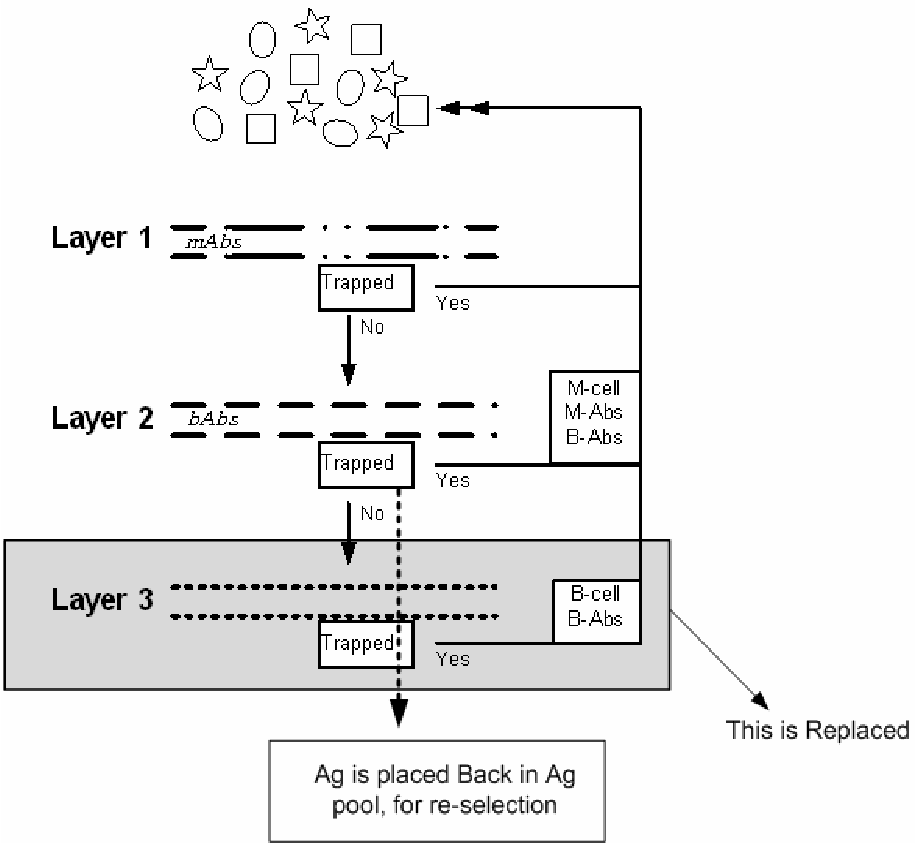 Fig 1: The revised three-layer architecture showing how antigens interact with memory-cell antibodies (m-Abs) and B-cell antibodies (b-Abs).
Experiments & Results: Stability and Precision
The researchers tested their hybrid model against several UCI benchmarks. The results demonstrate a clear "survival of the fittest" trajectory.
Performance Gains
In the Iris dataset, the standard HAIS oscillates wildly between 7 and 27 errors (average 16.46). The Population-Based HAIS stabilized at an average of 3.2 errors—a massive leap in precision.
The Power of Crossover
An ablation study comparing the algorithm with and without crossover confirmed that while mutation helps, crossover provides the "jump" needed to find better global structures.
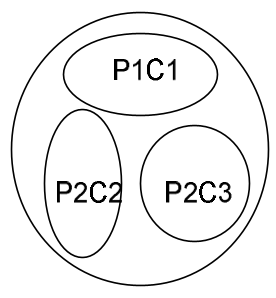 Fig 2: Single-point crossover between two parent solutions (P1 and P2) exchanging cluster configurations.
Convergence Analysis
As shown in the error curves, the "Best Solution" error drops sharply in the first few generations, while the "Whole Population" error follows a steadier decline, indicating healthy exploration of the search space.
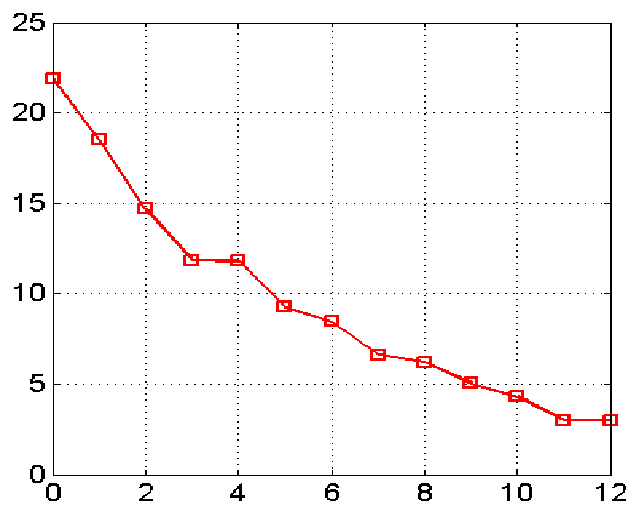 Fig 3: Error reduction across 12 generations for best individuals (left) vs. the entire population (right).
Critical Insight & Conclusion
The true value of this work lies in its Self-Organizing Reinforcement. By increasing the transfer of memory cells over time (from 10% to 100%), the authors created a "cooling" effect similar to Simulated Annealing, but driven by biological memory.
Takeaway: This paper proves that AIS is not just a niche biological metaphor but a powerful tool when combined with evolutionary population dynamics. Limitations: The computational overhead of maintaining a population of 100+ solutions is higher than k-means. Future research should investigate how to scale this to "Big Data" contexts where the number of antigens is in the millions.