
Accelerating Bayesian Inference: Solving Parallel Tempering MCMC with Custom-Precision FPGAs, GPUs, and CPUs
Population-Based MCMC on Multi-Core CPUs, GPUs and FPGAs
This paper presents highly optimized hardware accelerators for Population-Based Markov Chain Monte Carlo (MCMC), specifically focusing on Parallel Tempering (PT). It implements and compares three parallel platforms—multi-core CPUs, GPUs, and FPGAs—and introduces novel custom arithmetic precision methods (WPT and MPPT) that achieve SOTA performance, with FPGAs reaching up to 114x speedup over CPUs and 53x over GPUs.
Executive Summary
TL;DR: Population-based MCMC methods like Parallel Tempering (PT) are essential for sampling from complex, multi-modal distributions but are computationally grueling. This paper introduces a breakthrough by leveraging custom arithmetic precision across various hardware. By using as few as 14 bits for mantissa calculations in specific parts of the algorithm, the authors achieved an staggering 114x speedup on FPGAs compared to multi-core CPUs, all while maintaining 100% sampling accuracy.
Background: Within the academic landscape, this work transitions PT from "software-bottlenecked" to "hardware-optimized," moving beyond simple parallelization to fundamental architectural redesign for stochastic algorithms.
The Problem: The Curse of Multi-Modality and Data Scale
MCMC is the gold standard for Bayesian inference, but it has a "speed limit." When a probability distribution has multiple "modes" (peaks), standard samplers get stuck in one area. Parallel Tempering (PT) solves this by running a population of chains at different "temperatures" (smoothed versions of the distribution).
However, PT is incredibly heavy:
- Data Volume: Every step requires a full pass over the dataset.
- Multi-Chain Overhead: Running 32 or 64 chains instead of one multiplies the workload.
- Precision Waste: Using 64-bit Double Precision (DP) for auxiliary chains that are only there to help the main chain "jump" is a massive waste of silicon and power.
Methodology: High-Performance Pipelining and Precision Engineering
The authors propose two novel methods to break the precision barrier without introducing error:
- Weighted PT (WPT): Conducts the entire simulation in low precision but calculates an Importance Sampling weight to correct the bias at the end.
- Mixed-Precision PT (MPPT): A more sophisticated "hybrid" approach where the main chain stays in high precision (DP), but the auxiliary chains run in custom low precision. The authors mathematically prove that as long as the exchange logic is modified, the final output remains statistically unbiased.
Hardware Architecture: The FPGA Advantage
While GPUs are great for SIMD (Single Instruction, Multiple Data), FPGAs allow for deeply pipelined probability evaluations.
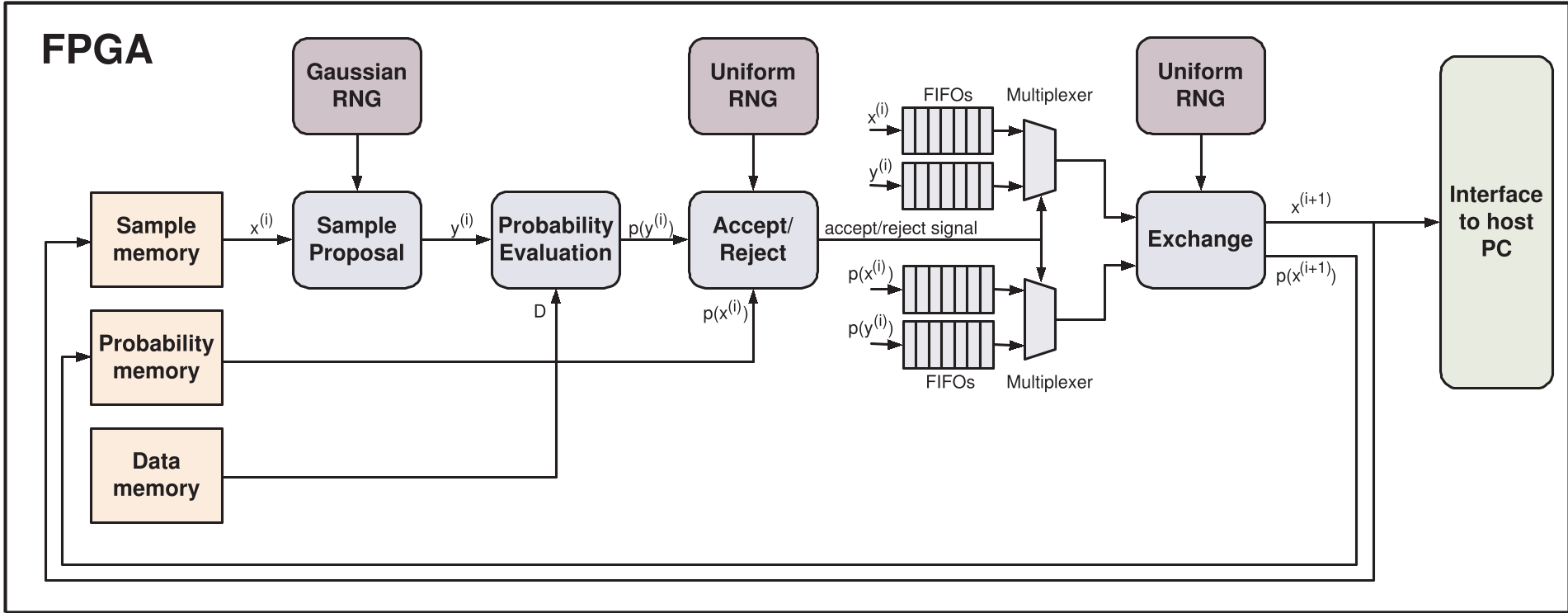 Figure: The baseline FPGA architecture showing the pipeline from sample proposal to acceptance logic.
The FPGA's true power lies in its on-chip memory bandwidth. By storing the dataset in local BRAM, the "Probability Evaluation" block can process data at a much higher rate than a GPU constrained by global memory latency.
Experiments: SOTA Battle (FPGA vs. GPU vs. CPU)
The evaluation focused on Bayesian inference for mixture models, comparing an Intel Xeon (20 cores), Nvidia GPUs (GTX480), and Xilinx FPGAs (Virtex-7).
1. Scaling with Chain Population
The FPGA reached peak performance with as few as 32 chains, whereas the GPU needed 32,768 chains to stay fully occupied. In real-world PT, we rarely use more than 100 chains, making the FPGA significantly more practical.
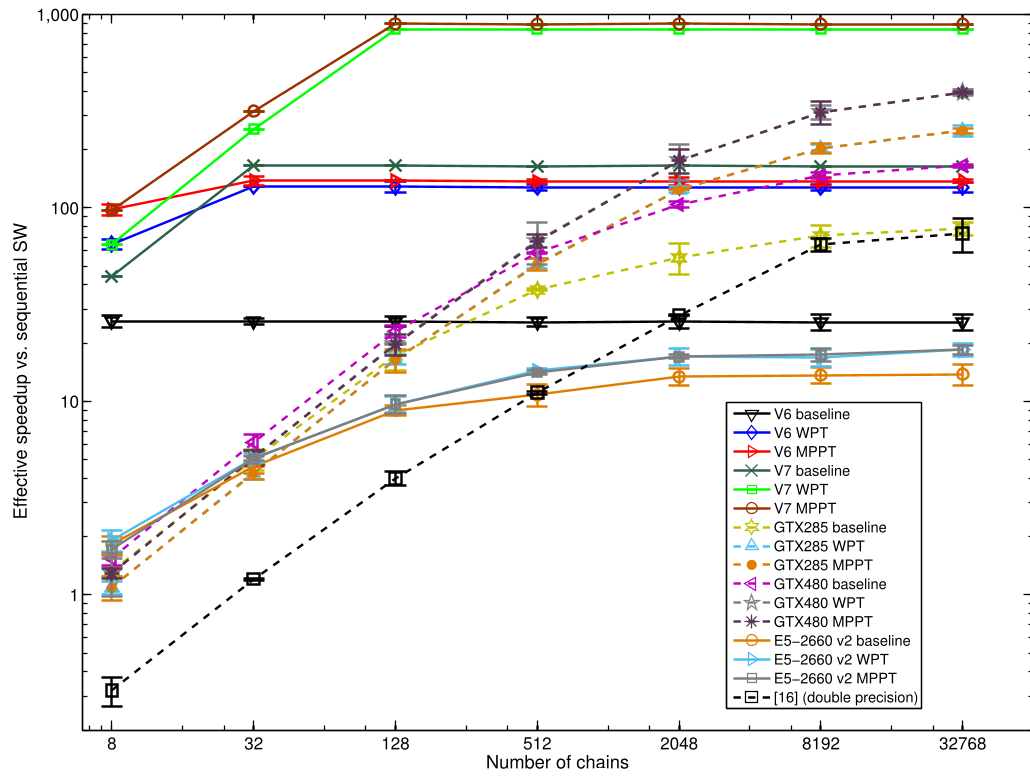 Figure: Effective speedup across platforms. Note how FPGAs (VX1140T) dominate in low-chain counts.
2. Efficiency Gains from Precision Optimization
By reducing the mantissa bits, the authors could fit more "pipelines" on the FPGA.
- Baseline (DP): ~44x Speedup
- MPPT (Optimized Precision): ~1,143x Speedup (on Virtex-7)
The Energy Efficiency comparison was even more lopsided: the FPGA generated 362x more effective samples per Joule than the GPU.
Critical Insight & Conclusion
Takeaway: The "physics" of this acceleration works because MCMC is inherently stochastic. We don't need 64 bits of precision to tell a sampler to "move left or right" in a rough probability landscape.
Limitations: The primary drawback of WPT/MPPT is that as the dataset grows, arithmetic errors accumulate faster, requiring a slight increase in bit-width to maintain efficiency.
Future Outlook: This paper paves the way for "Stochastic Hardware"—chips designed not for deterministic logic, but for probabilistic sampling, which could be the key to scaling LLM uncertainty estimation and complex biological simulations.