
MOPSO: Revolutionizing Fire Evacuation via Intelligent Population Classification
7737_Population Classification in Fire Evacuation A Multiobjective Particle Swarm Optimization Approach.
This paper introduces a Multiobjective Particle Swarm Optimization (MOPSO) approach specifically designed for mining classification rules of evacuee populations in fire emergencies. The method leverages a comprehensive learning strategy and a unique solution encoding to generate IF-THEN rules that optimize both precision and recall.
Executive Summary
TL;DR: In the chaos of a fire emergency, knowing who is trapped and who can help is the difference between life and death. This paper presents a Multiobjective Particle Swarm Optimization (MOPSO) framework that automates the discovery of simple, interpretable IF-THEN rules to classify evacuees. By optimizing the trade-off between precision and recall, the system provides "white-box" decision support that is both fast and robust against incomplete data.
Positioning: This work transitions PSO from a theoretical optimizer to a practical, life-saving data mining tool, specifically addressing the high-dimensional challenges of emergency response.
Problem & Motivation: The "Incomplete Data" Trap
In disasters like the 2010 Shanghai high-rise fire, responders must make split-second decisions with imperfect information. Conventional classification models (like Decision Trees or Naïve Bayes) often face a "bottleneck" when:
- Data is Noisy: Sensors fail and communication is patchy.
- Dimensionality is High: With 30+ attributes (age, location, smoke levels), the search space for rules is astronomical ( combinations).
- Interpretability is Mandatory: Commanders need to understand why a group is classified as "High Risk."
The authors' insight was to treat rule discovery as a multiobjective search problem, where the "fitness" of a rule is defined by its ability to be both accurate (Precision) and comprehensive (Recall).
Methodology: The Mechanics of MOPSO
The core of the approach lies in how the swarm "thinks" and "encodes" rules.
1. The "Presence-Absence" Encoding
To handle the vast number of attributes, the authors used a clever normalization trick. Each attribute in a particle occupies a dimension in the range [0, 1].
- [0, 0.5]: The attribute is active in the rule (e.g., "If Age < 10").
- (0.5, 1]: The attribute is ignored. This allows the PSO to naturally "prune" irrelevant variables during evolution.
2. Comprehensive Learning (CL) Strategy
Standard PSO can suffer from "premature convergence" (getting stuck in a local optimum). The authors implemented a Comprehensive Learning mechanism where a particle doesn't just follow the "Global Best." Instead, for each dimension, it can choose to learn from different solutions in the Pareto archive.
 Note: The workflow demonstrates the transition from particle initialization to Pareto-optimal rule generation.
Experiments and Real-World Impact
The MOPSO algorithm was benchmarked against several SOTA evolutionary algorithms (EMOGA, MOANT) and the popular ADTree.
Performance Highlights:
- SOTA Superiority: On the UCI "Primary" dataset (highest missing values), MOPSO achieved an HV score of 64.30, significantly higher than EMOGA (55.85) and MOANT (57.15).
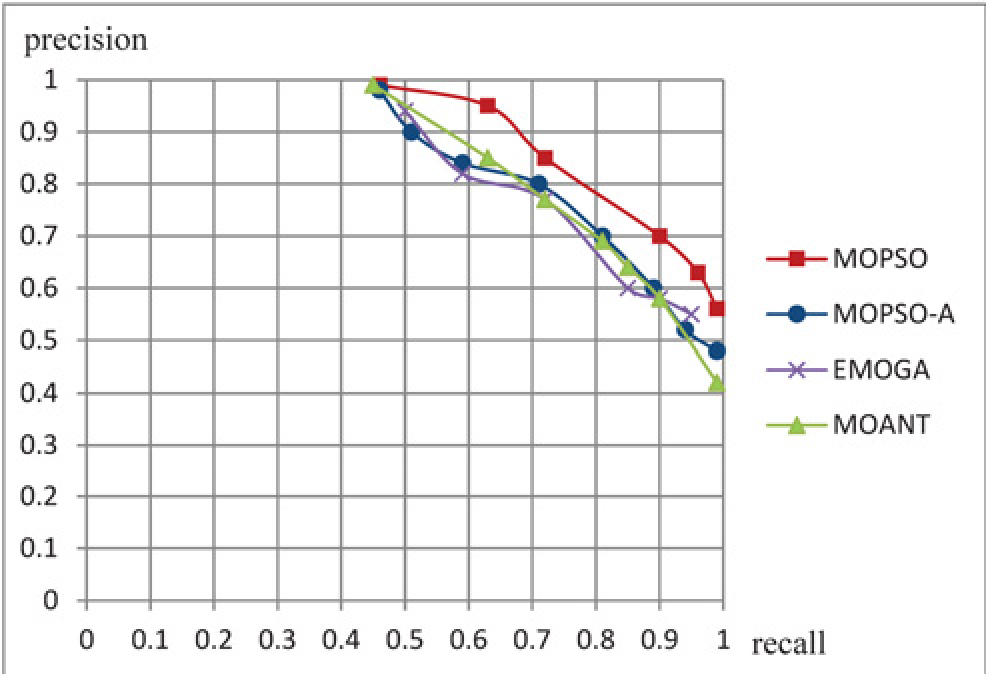
- Pareto Front Quality: In fire evacuation tests, MOPSO consistently produced rules that dominated those of other algorithms, meaning it found better rules across all classes (C1-C7).
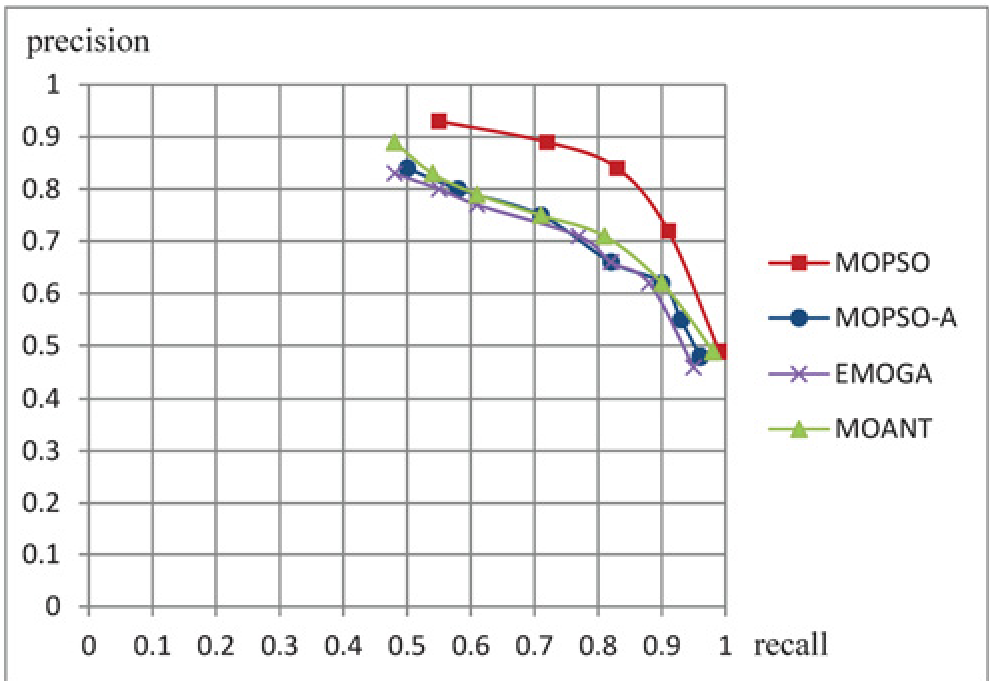 The figure illustrates the Pareto fronts for classification rules, highlighting how MOPSO solutions (solid lines) consistently outperform competitors.
Real-World Deployment
The paper cites a successful application in China where the system classified evacuees into stages.
- Stage 1: Identified 33 evacuees across 6 classes.
- Dynamic Response: As new data (e.g., SMS, cellular location) arrived, the MOPSO retrained the rules in under 90 seconds to reflect deteriorating environment conditions (smoke and temperature increases).
Critical Analysis & Conclusion
Takeaway
The strength of this work lies in its interpretability. Unlike deep learning models, MOPSO produces IF-THEN rules that fire chiefs can verify. The use of a comprehensive learning strategy specifically for multiobjective archives is a major technical contribution to swarm intelligence.
Limitations
- Rule Conflict: While the paper mentions merging rules, a more robust conflict-resolution strategy for overlapping rules in real-time could be beneficial.
- Population Sensitivity: The authors admit the rules are sensitive to evacuee density, suggesting the need for Fuzzy Rules in future iterations to handle "borderline" cases.
Future Outlook
This work paves the way for "Integrated Disaster Intelligence," where swarm agents not only classify populations but concurrently optimize the paths for robotic rescuers.