
LoCost: Leveraging Locust Swarm Density for Superior Multi-Objective Optimization
The effect of population density on the performance of a spatial social network algorithm for multi-objective optimisation
This paper introduces LoCost, a novel Multi-Objective Particle Swarm Optimisation (MOPSO) algorithm based on spatial social networks and the biological behavior of locusts and crickets. It specifically investigates how population density affects the convergence and Pareto-front coverage of MO algorithms.
TL;DR
The LoCost algorithm rethinks Particle Swarm Optimisation (PSO) by ditching global guides in favor of local, biologically-inspired interactions. By mimicking the "cannibalistic" social pressure of locust swarms—where movement is driven by attraction to the successful and repulsion from the failing—LoCost achieves better Pareto-front coverage. Crucially, the research proves that population density, not just total computation, is the "hidden variable" behind swarm intelligence success.
Background: Why Biology Matters for SOTA Optimization
Standard MOPSO algorithms rely on choosing a "best" particle to guide the swarm. However, in multi-objective spaces, "best" is subjective and often leads to premature convergence or "patchy" results. The author looks to the biological transition from disorder to order in marching locusts. In nature, these swarms maintain cohesion through local interactions that only trigger when a specific critical density is reached.
Methodology: The "Cannibalism" Logic
The core of LoCost is its reformulated velocity equation. Instead of following a global leader (), a particle interacts only with its nearest Euclidean neighbor :
- Attraction: If the neighbor is Pareto-dominant, move toward it (nutrient seeking).
- Repulsion: If the neighbor is dominated, move away (avoiding "starvation" or predation).
This creates a spatial social network where the "vanguard" of the swarm naturally explores the Pareto-front without needing a centralized guide selection strategy.
 The LoCost movement logic: Pareto dominance determines the direction of the social vector.
Experiments: The Density Effect
The most striking discovery of this paper is that swarm size matters more than evaluation count. The author compared a swarm of 25 (80 iterations) against a swarm of 100 (20 iterations). Despite evaluating the same total number of points, the larger, denser swarm consistently found a more complete and converged Pareto-front.
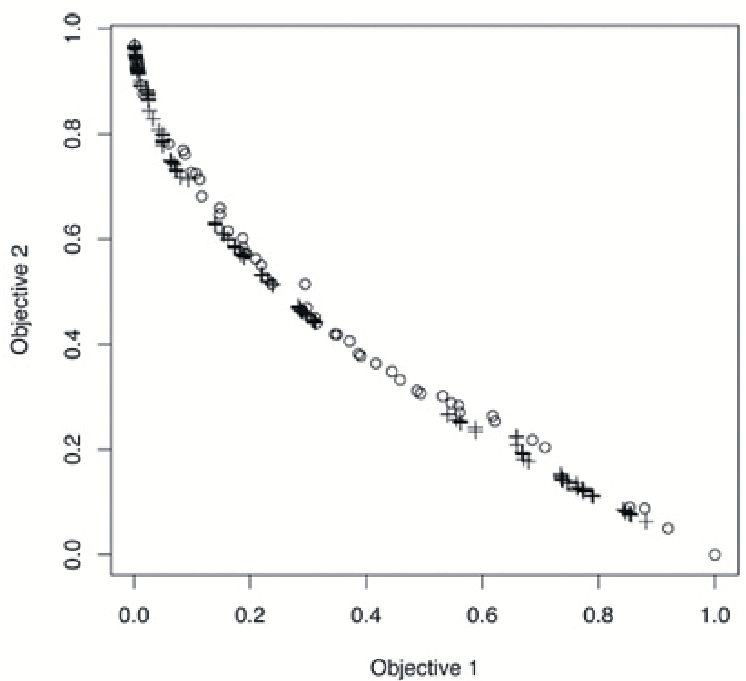 Performance on ZDT1: With 100 particles (o), LoCost provides a near-perfect approximation of the convex front compared to smaller populations.
Key Performance Insights:
- Coverage Metric (): LoCost consistently outperformed standard MOPSO in "filling the gaps," especially on convex (ZDT1) and non-convex (ZDT2) fronts.
- The "Crowding" Threshold: Performance jumps significantly when moving from 25 to 50 particles, suggesting a phase transition similar to biological swarms.
- Distribution: While MOPSO tends to cluster points densely in small regions, LoCost maintains a more uniform spread across the objective space.
Critical Analysis & Conclusion
The Distributed Computing Warning
The paper offers a vital warning for practitioners using Distributed PSO: If you split a large swarm into many small "Islands" (individual nodes) to save time, you may inadvertently drop below the critical density required for the algorithm to work effectively. You might get results faster, but those results will be of significantly lower quality.
Takeaway
LoCost demonstrates that complexity isn't always about better "math"—sometimes it's about better "social rules." By restricting interactions to local neighborhoods and respecting population density, we can achieve emergent optimization that is both more robust and better distributed across competing objectives.
Future Outlook: The next frontier for LoCost is understanding how these density requirements scale with the dimensionality of the parameter space (), and whether self-regulating population sizes can further optimize the search efficiency.