
The Physics of Virality: Why Opportunistic Users Are Your Best Marketers
A Population Dynamics Approach to Viral Marketing
This paper introduces an agent-based model to simulate Marketing Referral Programs (Growth Hacking) within social networks. Using a population dynamics approach (SIR-inspired), it demonstrates that "Opportunistic" agents—those seeking rewards without brand loyalty—are paradoxically the primary drivers of brand dissemination and firm profitability across various network structures.
TL;DR
This research shifts the paradigm of viral marketing by proving that "Opportunistic" users—those only in it for the rewards—are actually the secret sauce of a successful referral campaign. Using agent-based modeling on scale-free networks, the study reveals that higher service costs ironically drive faster growth, as reward-seekers are forced to invite more friends to subsidize their own consumption.
Academic Context: This work sits at the intersection of Mathematical Epidemiology (SIR models) and Behavioral Economics, providing a formal framework for "Growth Hacking" strategies used by tech giants like Uber and Dropbox.
The "Spurious Loyalty" Paradox
In traditional marketing, firms crave "Loyal" customers—those who buy the product because they love the brand. "Opportunistic" players are often dismissed as "low-quality" leads. However, the authors argue that these players provide the necessary kinetic energy for a brand to jump across social clusters.
The core friction: If the reward is too high or the cost too low, the Opportunistic agent stops inviting people. To maximize growth, a firm must maintain a specific level of "tension" between the product cost and the referral reward.
Methodology: Mapping Referrals as an Epidemic
The authors treat brand adoption like a viral outbreak. An agent is:
- Susceptible: A non-user.
- Infected: An active user (either Loyal or Opportunistic).
- Recovered: An individual who has exited the program (churned).
The Growth Engine
For Opportunistic agents, the decision-making logic is purely mathematical: Where is the reward and is the cost. If increases, the agent must increase the number of successful invites to keep using the service for free.
Key Findings: Costs, Hubs, and Profitability
1. The Inverse Cost-Growth Relationship
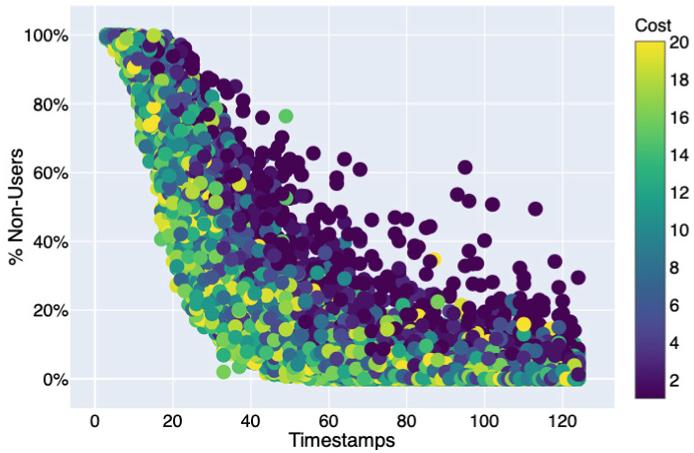
Counter-intuitively, as the cost of the service increases, the total number of active users grows. This is because Opportunistic agents act as high-frequency "spreaders" to cover their costs. By limiting the number of allowed invites, a firm risks killing this growth engine, especially when the service is expensive.
2. The Power of the Hub
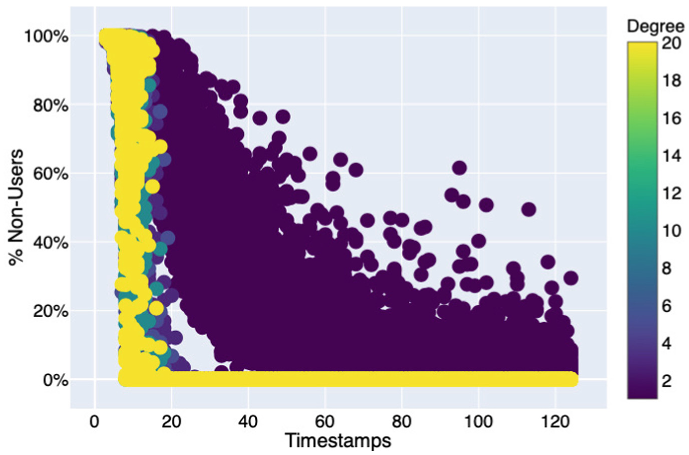
Testing the model on Barabási-Albert scale-free networks (which mimic real social media structures) showed that the "First Infected" node determines everything. Starting with a high-degree node (an Influencer) leads to an exponential collapse of the "Susceptible" population.
3. Increasing Returns to Scale
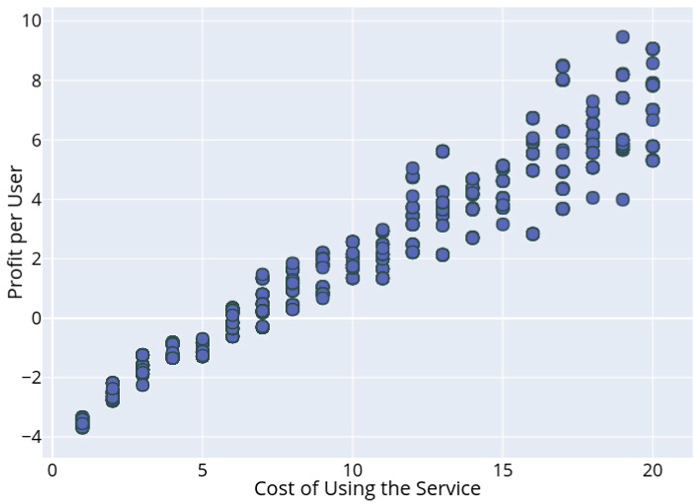
The referral program becomes more profitable as it grows (increasing returns to scale). The study identifies a "Break-even" ratio: If the reward is 5 units, the cost must be at least 7 units for the campaign to stay in the black.
Critical Analysis & Conclusion
Takeaway
The research confirms that viral marketing is not just about brand love; it's about incentive alignment. Opportunistic behavior is a feature, not a bug. It provides a bridge for the brand to reach distant network clusters that a "Loyal" user might never interact with.
Limitations & Future Work
- Zero Competition: The model assumes a monopoly. In reality, a price hike might drive Opportunistic users to a competitor (e.g., from Uber to Lyft).
- Reputation Costs: The model doesn't account for the "social cost" of being that friend who constantly spams referral links, which might decrease conversion rates over time.
- Behavioral Plasticity: Agents are locked into "Loyal" or "Opportunistic" roles, whereas real users often shift between these states based on product quality.
Final Thought: If you are launching a referral program, don't fear the "reward hunters"—they are your most efficient transmission vectors.