
Predictive Analytics in Population Health: Moving Beyond Reactive Medicine
Population Health Management Exploiting Machine Learning Algorithms to Identify High-Risk Patients
This study validates multiple Machine Learning algorithms (Random Forest, LASSO, etc.) to identify high-risk patients in Tuscany, Italy, using administrative and socio-economic data. The Random Forest model achieved a Positive Predictive Ratio (PPR) of approximately 40, significantly outperforming the statistical methods currently employed in the region.
TL;DR
With aging populations straining healthcare systems, the shift from "treat-when-sick" to proactive management is critical. This study demonstrates that Machine Learning—specifically Random Forest and LASSO—can analyze administrative databases to identify high-risk patients with a Positive Predictive Ratio (PPR) of 39.83, outperforming current statistical methods by nearly 600%.
Background & Motivation: The Complexity Crisis
The healthcare landscape is facing a perfect storm: by 2060, 30% of the population will be over 65, and the prevalence of multimorbidity (patients with multiple chronic conditions) is skyrocketing. Traditional models are reactive—General Practitioners (GPs) respond to symptoms after they appear.
The authors argue that this model is inherently inefficient. To move toward proactive care, we need tools that can handle "Big Data" determinants of health—not just diagnoses, but socio-economic factors, pharmaceutical history, and administrative flows.
Methodology: High-Dimensional Feature Engineering
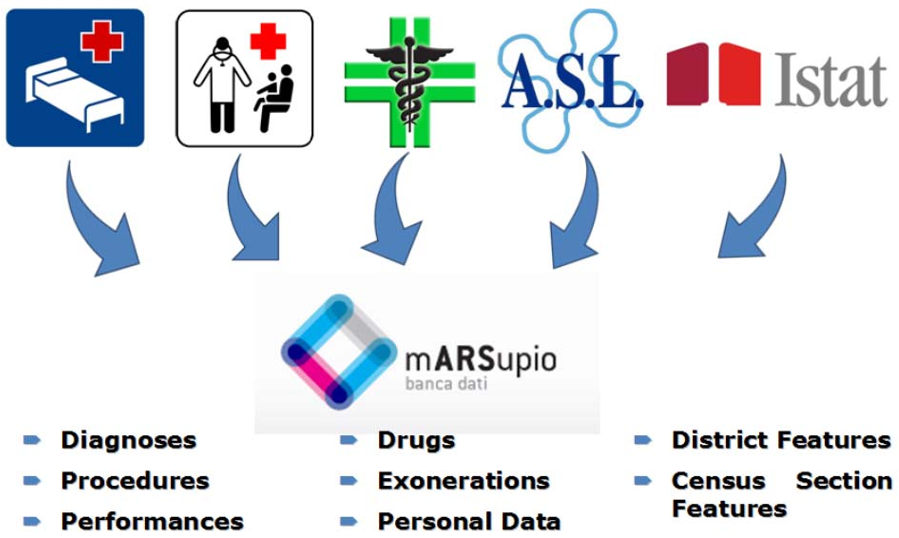
The study utilized the mARSupio database from Tuscany, processing data for over 1.5 million residents. This is a classic "needle in a haystack" problem, as the target event (avoidable hospitalization or death) occurs in less than 1.5% of the population.
1. Data Processing & Feature Selection
The researchers initially extracted 1,178 features, spanning:
- Diagnoses & Procedures: Grouped by Aggregated Clinical Codes (ACC).
- Pharmacology: Categorized by ATC3 pharmacological subgroups.
- Socio-economics: Census data including education level and house rental status.
To optimize performance, they employed the Boruta algorithm, a wrapper method built around Random Forest that iteratively removes irrelevant features. This pruned the feature space down to 280 essential variables, focusing heavily on cardiovascular, respiratory, and malignant tumor indicators.
2. Addressing Class Imbalance
Standard accuracy is a trap in healthcare; a model could achieve 98.5% accuracy just by predicting "no one will get sick." The authors utilized balanced training sets (1:20 undersampling) and focused on PPR (Positive Predictive Ratio) and F1-Score to ensure the model actually finds the high-risk outliers.
Results: A New Performance Benchmark
The results confirm a massive leap in predictive power compared to existing benchmarks in Tuscany.
- Random Forest achieved the highest PPR (39.83).
- LASSO provided the best balance for F1-Score (26.39%).
- In comparison, the current administrative algorithm in Tuscany only reaches a PPR of approximately 6.
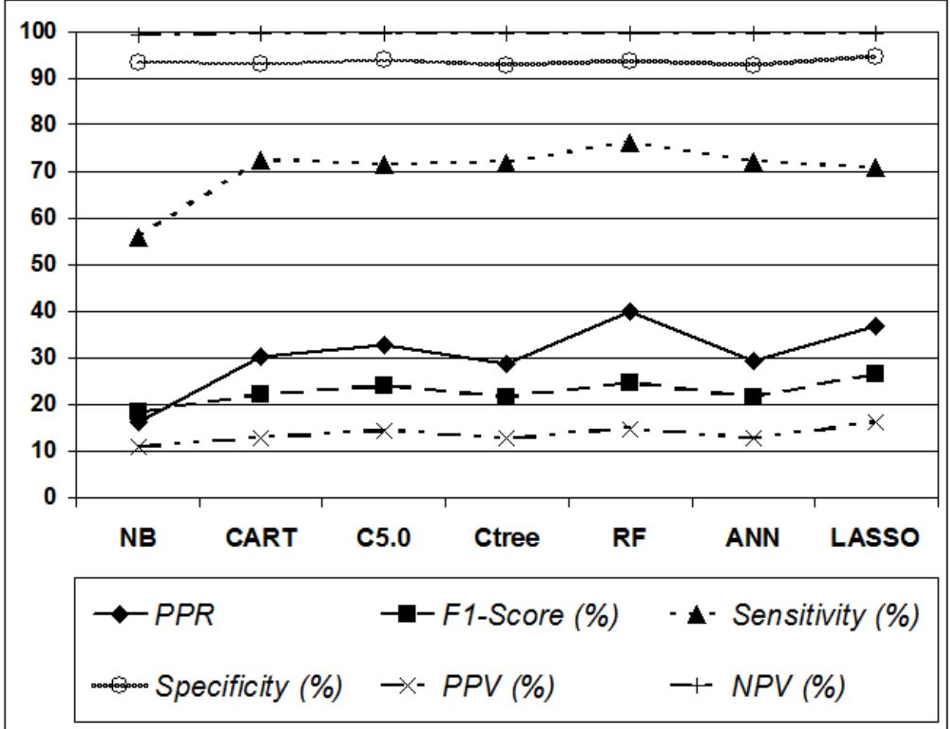
The experiment also highlights that feature reduction actually improved or maintained performance in almost every model (except ANN), proving that more data is not always better—quality features are.
Critical Analysis & Future Outlook
While the PPR is high, the models still generate a significant number of False Positives (about 4/5 of those flagged as positive). In most industries, this would be a failure. However, in Population Health, this is acceptable for first-level screening. It is safer to flag a patient for a GP's review than to miss a high-risk individual entirely.
The Verdict: The study proves that ML can turn "dormant" administrative data into a powerful early-warning system. The next frontier will be integrating real-time IoT and wearable data to refine these scores further, narrowing the gap between "high-risk" and "high-certainty."
Takeaways for the Industry
- Metric Choice is King: In imbalanced medical data, ignore Accuracy; optimize for PPR and Sensitivity.
- Feature Selection Matters: Reducing the input space by 75% significantly lowered compute time without sacrificing the "medical signal."
- Human-in-the-Loop: These AI tools are designed to augment GPs, not replace them, acting as a filter for resource-intensive interventions.