
Towards Semantic Port Integration: Bridging the Data Gap with OWL Ontologies
Towards Management of the Data and Knowledge Needed for Port Integration: An Initial Ontology
This paper proposes an initial common ontology for the maritime port domain using Web Ontology Language (OWL) to facilitate port integration decision-making. The methodology introduces a "learning space" framework across macro, meso, and micro data levels, specifically defining complex concepts such as port capacity, utilization, and performance through formal ontological descriptions.
TL;DR
Port integration is a high-stakes strategic move for regional economies, yet it is often paralyzed by "data silos" and "terminological chaos." This paper introduces a formal ontology-based framework using OWL (Web Ontology Language) to standardize how port data is modeled, ensuring that human concepts like "capacity" and "performance" are interpreted consistently by intelligent systems.
The "Babel" of Maritime Logistics
The maritime industry doesn't just move cargo; it generates a sea of heterogeneous data. The authors identify a significant "interoperability problem" categorized into:
- Noun Conflicts: Two different ports might define "congestion" in entirely different ways—one focusing on vessel calls, the other on berth utilization.
- Unit Conflicts: The nightmare of converting metric tons to pounds or TEUs across international borders.
- Aggregation Conflicts: Data grouped by "customs jurisdiction" vs. "coastal borders."
Current Decision Support Systems (DSS) fail because they lack the semantic glue to hold these disparate data points together.
Methodology: The "Learning Space"
To solve this, the authors propose a hierarchical data structure organized into three distinct levels:
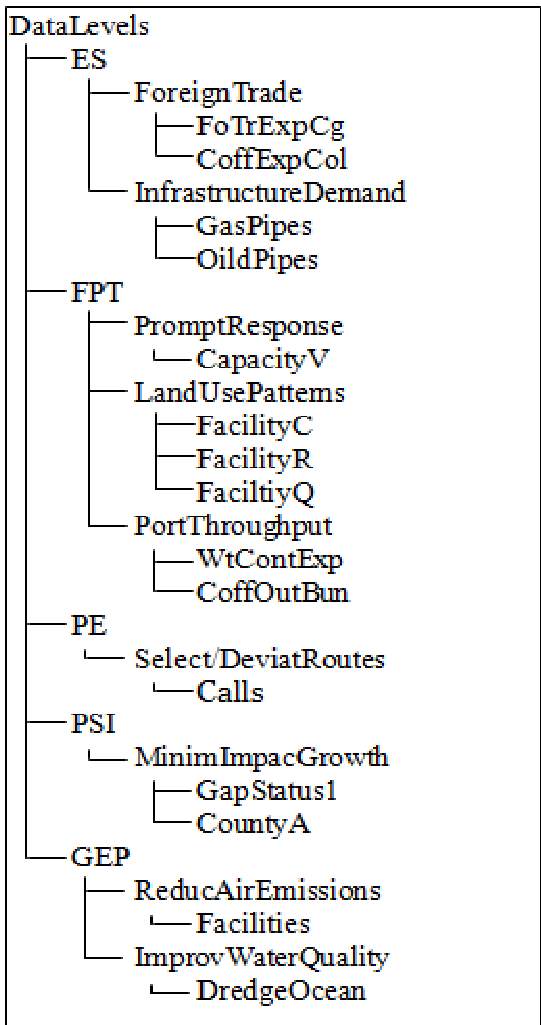
- Macro-level (Entities): High-level systems like Environmental Processes (GEP) or Economic Systems (ES).
- Meso-level (Classes): Concepts like Foreign Trade or Infrastructure Demand.
- Micro-level (Measurements): Raw data points like
FoTrExpCg(Annual water transportation exports).
Systemic Composition & Taxonomy
The paper maps these levels into a formal taxonomy where "necessary implication" drives the logic. For example, Foreign Trade is strictly an Economic System, ensuring no ambiguity during automated reasoning.
Core Insight: Defining the Indefinable
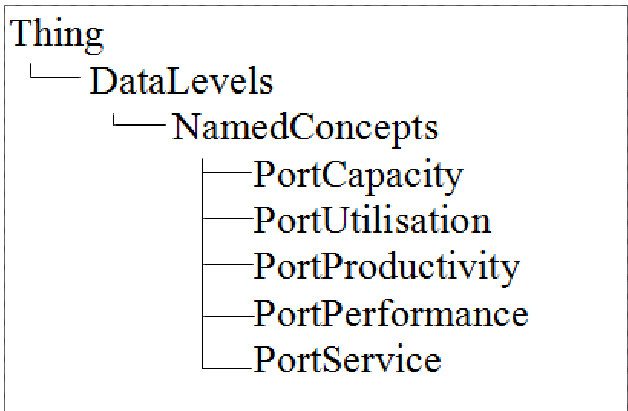
The true brilliance of this work lies in its Five Ontological Illustrations. Instead of offering a static dictionary, the authors use Description Logic to create "dynamic" definitions.
Highlight: Port Utilisation
A port's utilization isn't just about how full it is. The paper defines it by checking for the presence of specific facilities (Ro-Ro, Liquid Bulk) while simultaneously applying a negation restriction on environmental protection zones (GAPStatus1). If a port is surrounded by protected natural land, its utilization potential is fundamentally restricted—a nuance that standard databases often miss.
Implementation: The OWL Hierarchy
The researchers used Protégé to build these relationships, adhering to the "Open World Hypothesis." This means the system assumes there is always more to learn about a port, rather than assuming it knows everything based on a limited dataset.
| OWL Definition | Paraphrase | Rationale |
|---|---|---|
allValuesFrom | Only | Often misunderstood |
someValuesFrom | Some | Brevity and clarity |
SubclassOf(A,B) | A implies B | Clarify implication |
Critical Analysis & Future Outlook
While this initial ontology is a massive leap forward for the "Semantic Web" of logistics, it faces two main hurdles:
- Consensus: Getting competing port authorities to agree on a single terminology is harder than the technical implementation itself.
- Temporal Dynamics: Port data changes by the minute. The authors acknowledge that future work must incorporate temporal reasoning (using "parameter" and "event" ontologies) to handle the 4th dimension—time.
Conclusion
This paper serves as a blueprint for the i-DMSS (intelligent Decision Making Support Systems) of the future. By moving from raw data to a shared body of knowledge, ports can finally integrate not just their physical infrastructure, but their collective intelligence.