
Emo-HRED: Transforming Chatbots into Emotional Support Agents
3075_Positive Emotion Elicitation in Chat-Based Dialogue Systems.
The paper introduces a comprehensive framework for "positive emotion elicitation" in chat-based dialogue systems. It proposes a novel emotion-sensitive neural architecture (Emo-HRED) and a data augmentation method that leverages human appraisal examples to transform existing corpora into emotion-positive training data, achieving SOTA results in naturalness and emotional support.
TL;DR
Researchers have developed a new dialogue system architecture, Emo-HRED, designed not just to understand how you feel, but to actively move you toward a more positive emotional state. By utilizing "human appraisal" data and a novel hierarchical neural network that incorporates both text and audio, this system outperforms traditional chatbots in both conversational naturalness and emotional impact.
Background: Beyond Recognition and Simulation
In the world of Affective Computing, most systems follow a simple pattern: Recognize (Is the user sad?) or Simulate (Make the robot look sad too). While these "Mirroring" behaviors can build rapport, they don't necessarily help the user recover from negative states.
The authors of this paper argue that we’ve overlooked Positive Emotion Elicitation. Drawing from the "Circumplex Model of Affect" (Valence and Arousal), they suggest that a system should act like a human friend—using specific conversational triggers to improve the user's emotional experience.
The Core Innovation: Capturing Human Appraisal
The secret sauce lies in Human Appraisal. When you say something to a friend, your friend's response acts as a stimulus. How you feel after that stimulus is the result of your appraisal.
1. Response Retrieval based on Appraisal
Instead of just looking for the most "semantically similar" response, the authors developed a retrieval system that re-ranks candidates based on:
- Emotional Similarity: Matching the user's current valence/arousal state to similar situations in a database.
- Expected Impact: Choosing the response that historically led to the most positive change in the listener.
2. The Emo-HRED Architecture
To make this work in a generative model, the team proposed the Emotion-Sensitive Hierarchical Recurrent Encoder-Decoder (Emo-HRED).
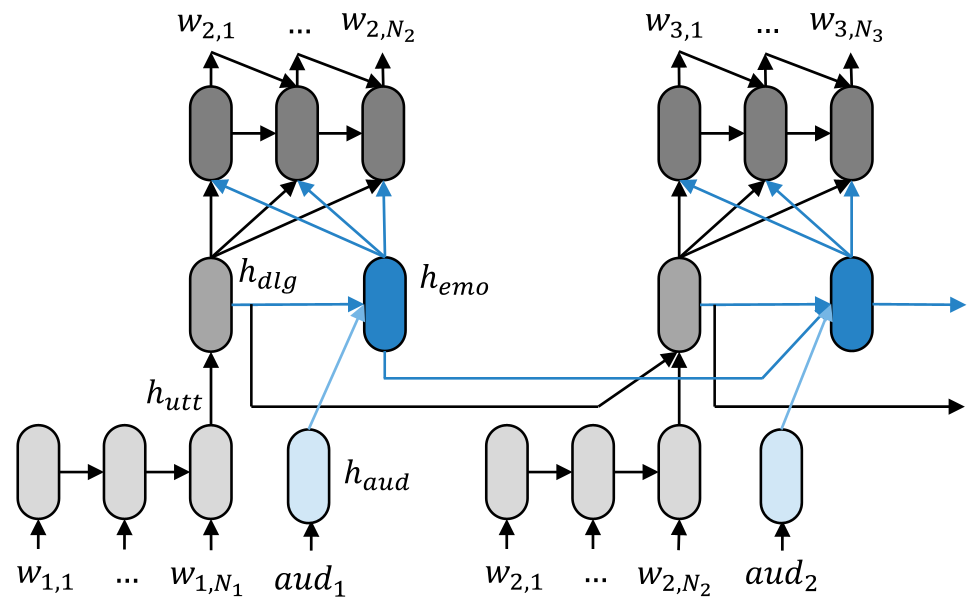
- Hierarchical Structure: It captures dialogue at two levels—the individual words (Utterance) and the sequence of turns (Context).
- Multimodal Emotion Encoder: It doesn't just read the text; it uses an Audio Encoder to process acoustic features, meaning it "hears" the emotion in your voice to better predict what response will make you feel better.
- Selective Fine-Tuning: Since emotion-rich data is scarce (the SEMAINE corpus is small), they pretrained the model on 5.5 million movie subtitle pairs and then specifically tuned only the "emotion" components.
Experiments and Results
The system was tested using the SEMAINE database, a famous multimodal dataset of interactions with "Sensitive Artificial Listeners."
SOTA Performance
The researchers found that adding an emotion encoder and using "Positive Data" (responses manually or automatically improved to be more supportive) dramatically improved performance.
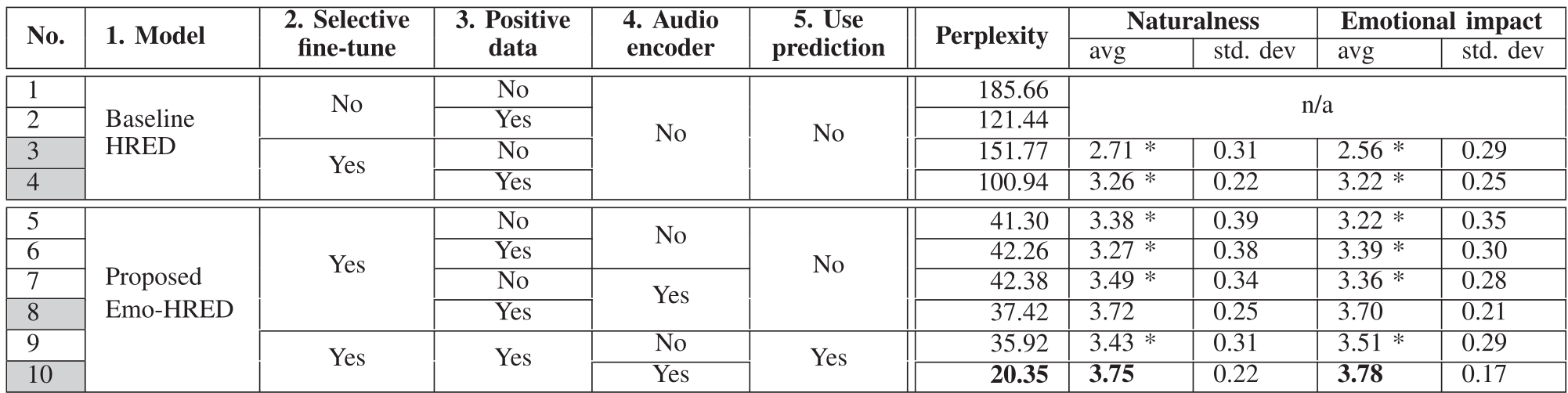
- Perplexity: Dropped from a staggering 185.66 (Standard HRED) to 20.35 (Emo-HRED with Audio).
- Subjective Naturalness: Humans rated the Emo-HRED responses significantly higher than traditional retrieval or generative baselines.
The "Short and Sweet" Strategy
Interestingly, the system learned to prefer shorter, positive-sentiment words like "Good," "Hope," and "Nice." While this helps maintain naturalness in short-term support, it highlights a common challenge in AI: the "generic response" problem. However, in the context of emotional support, these "short and sweet" validations often mimic how humans offer comfort in casual settings.
Critical Insight: Why This Matters
Most LLMs today (like GPT-4) are trained on massive text completion tasks. While they are great at info-retrieval, they often lack a consistent Affective Inductive Bias. They might be polite, but they aren't optimized to change your mood.
This paper provides a roadmap for Outcome-Driven Affective Computing. By shifting the loss function from "what word comes next" to "what word makes the human feel better," we can build AI that serves as a genuine companion for mental well-being.
Conclusion and Future Work
The Emo-HRED is a major step toward empathetic AI. However, the authors note a few limitations:
- Context Length: The current model uses limited history; longer conversations require better memory.
- Explicit Strategies: Future iterations could use Reinforcement Learning (RL) to explicitly reward the model for positive shifts in user valence.
Takeaway: The future of chatbots isn't just about being smart—it's about being "Emotionally Intelligent" enough to lift us up when we're down.