
PIDS: Strategizing Social Intervention Through Positive Influence Dominating Sets
Positive Influence Dominating Set in Online Social Networks
The paper introduces the Positive Influence Dominating Set (PIDS) as a novel framework to alleviate real-world social problems like binge drinking via online social networks. It proposes a PIDS selection algorithm designed to ensure that every individual in a network is exposed to a majority of positive peer influences, significantly outperforming traditional 1-dominating sets in influence density.
TL;DR
Researchers have developed a new graph-theory-based approach called Positive Influence Dominating Set (PIDS) to combat social issues like binge drinking and drug use. Unlike typical viral marketing that aims for "maximum reach," PIDS ensures "majority influence." By selecting a strategic 58% of a community for intervention, the average positive influence on individuals increases by 330% compared to traditional methods, effectively "drowning out" negative peer pressure.
Problem & Motivation: The Dangers of "Just One Friend"
In traditional network theory, a 1-Dominating Set is a group of people positioned so that everyone in the network is "connected" to at least one of them. While this works for spreading a news link, it fails for behavioral change.
If a student is surrounded by five binge-drinking friends and only one "abstainer" (from the intervention program), the negative influence will likely win. The authors argue that behavioral change requires a positive majority. The challenge is: how do we select the smallest possible group of people to initiate intervention so that everyone in the community sees a majority of positive behaviors from their peers?
Methodology: Engineering a Positive Majority
The core of this paper is the PIDS Selection Algorithm. The goal is to find a set such that for any individual , at least half of their friends (degree ) are positive influencers.
The Greedy PIDS Approach
The authors utilize a greedy strategy based on the following logic:
- Initial Pruning: Identify existing positive influencers (e.g., current abstainers).
- Iterative Domination: Repeatedly select nodes that dominate the highest number of "at-risk" (negative-influenced) individuals.
- Refinement: Update the positive degree of all nodes and continue until the "majority positive" condition is met for every node in the graph.
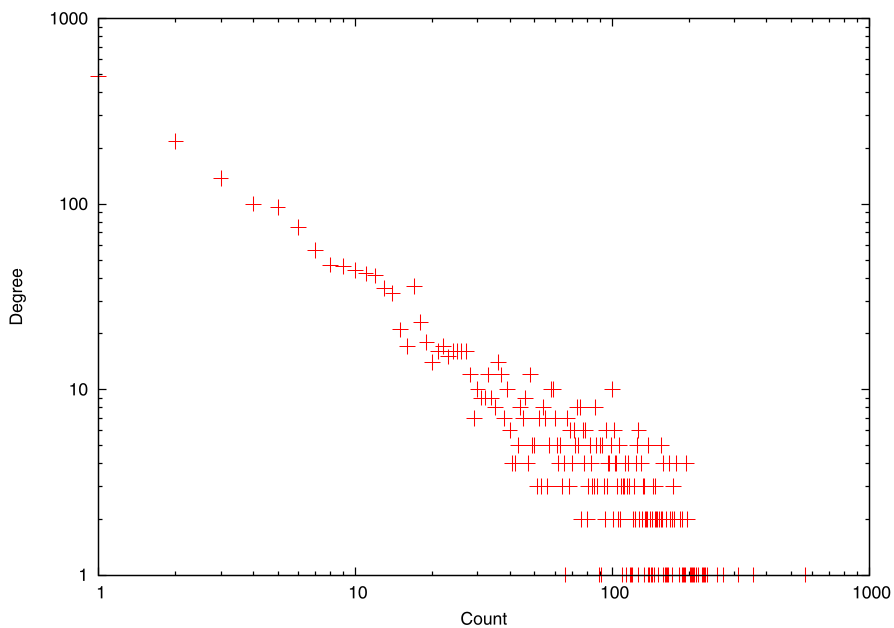 Figure 1: Node degree distribution in the Facebook "Fighter's Club" dataset, showing the Power-Law nature of real-world social connections.
Experiments & Results: The Power of Strategic Scaling
The researchers tested their algorithm on real Facebook data (2,334 users). They compared their Greedy PIDS against a standard 1-Dominating Set.
Key Findings:
- Influence Jump: By increasing the intervention group size from 31.9% (1-dominating) to 58.2% (PIDS), the average positive influence felt by users jumped from 24.1% to 79.3%.
- Efficiency: A mere 26% increase in the number of participants led to a 3.3x increase in average positive degree.
- Graph Paradox: Counter-intuitively, the study found that Power-Law graphs (like real social networks) actually require larger dominating sets than random graphs. This is because though "hubs" help, the sheer number of sparse "leaf nodes" in real networks requires more individual attention.
Performance Comparison
| Algorithm | Size of Set (%) | Avg. Positive Degree (%) |
|---|---|---|
| Greedy PIDS | 58.2% | 79.3% |
| Greedy 1-Dom | 31.9% | 24.1% |
Critical Analysis & Conclusion
Takeaway
The PIDS model proves that for social intervention, "reach" is not enough—"saturation" is key. If a budget allows for 30% of a population to be trained, it might be better to find the extra 20% of funding needed to reach 50%, as the resulting social stability of the community increases exponentially rather than linearly.
Limitations
- Static Assumption: The model assumes once someone is "educated," they remain a positive influencer. In reality, people fluctuate.
- Cost: Selecting 60% of a network for intervention is expensive. Future work should look at "Probabilistic PIDS" where we don't need a strict 50% majority for everyone.
Future Outlook
This research opens doors for "Precision Intervention." By moving beyond simple information diffusion to "Influence Dominance," social workers and public health officials can use digital footprinting to identify exactly who needs to be the "positive anchor" in a community.