
Fighting Fire with Facts: The Peer-to-Peer Approach to Rumor Containment
Positive Information Diffusion for Rumor Containment in Online Social Networks
This paper introduces the Peer-to-Peer Linear Threshold (PLT) model to simulate information diffusion in private messaging networks. It proposes a novel Proximity-Weight-Degree (PWD) algorithm to select positive seed nodes that spread "anti-rumor" information to effectively contain rumor propagation within a specific "rumor-relevance interval."
TL;DR
Information doesn't always spread through public "shouting" on social media feeds; often, it travels through the "whispers" of private messages. This paper introduces the Peer-to-Peer Linear Threshold (PLT) model to reflect this reality and proposes PWD, a high-efficiency algorithm that identifies the best "influencers" to spread accurate information and stop rumors in their tracks—achieving results similar to the best known mathematical models but at a fraction of the computational cost.
Context: Why Traditional Models Fail Private Conversations
Most research on social influence relies on the classic Linear Threshold (LT) model. In that world, if you are "activated" by a rumor, you immediately broadcast it to all your friends.
However, in platforms like WhatsApp, Signal, or Email, communication is often serial. You might message one friend at 10:00 AM and another at 11:00 AM. This slows down the diffusion process and changes the geometry of how a rumor consumes a network. The authors argue that to fight rumors effectively, we must model this specific peer-to-peer (P2P) behavior.
Methodology: The Proximity-Weight-Degree (PWD) Strategy
The gold standard for finding influential nodes is the Greedy Algorithm. It simulates thousands of scenarios to see which node produces the best result. While accurate, it is incredibly slow—virtually unusable for massive networks.
The authors propose PWD, which focuses on "Proximity" and "Influence." Instead of looking at the whole network, it looks at the "border" where the rumor is currently spreading.
The "Height" Metric
The PWD algorithm calculates a "height" for every potential anti-rumor seed. This isn't just about how many followers someone has (Max-Degree); it’s a calculation of:
- Exposure: How close is this person to the current rumor-active nodes?
- Potential: How many currently "uninfected" people can this person reach?
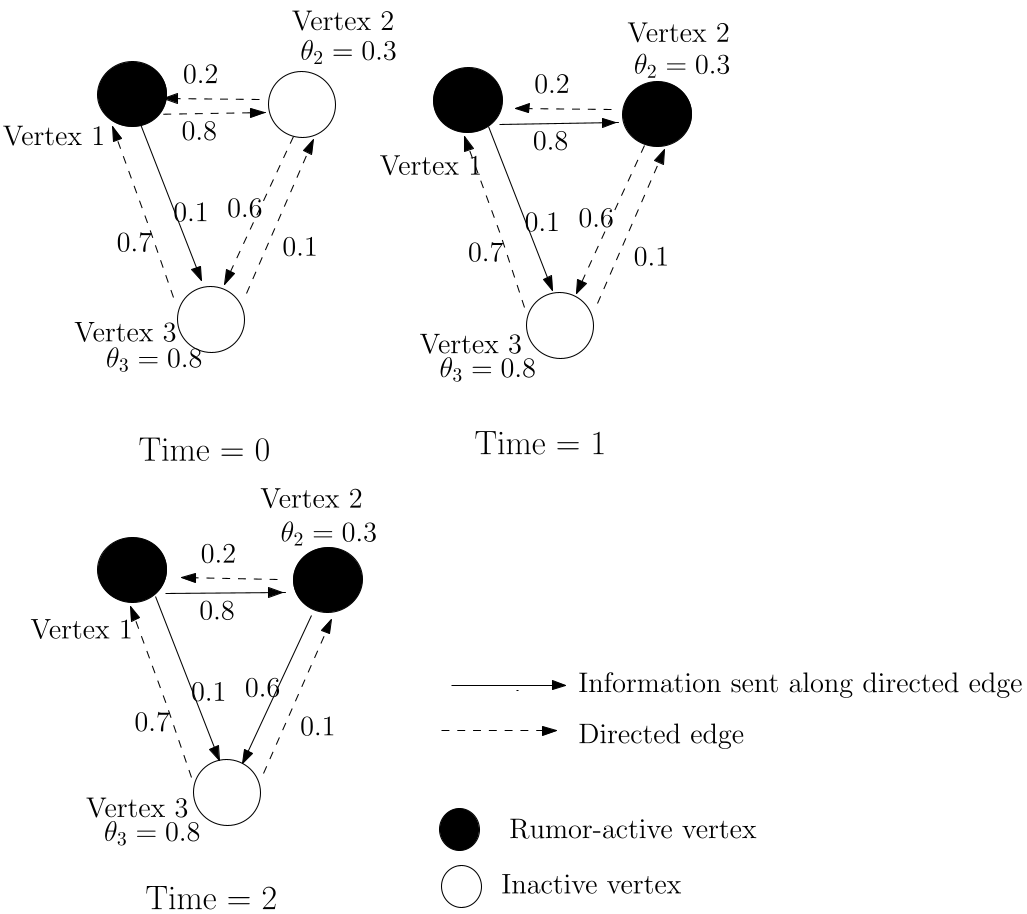 Fig 1: A visualization of the sequential nature of the PLT model where information flows to one neighbor at a time.
Experimental Battleground
The researchers tested their method against four competitors: Random, Max-Degree (the "Celebrity" approach), and Greedy (the "Brute Force" approach). They used real-world datasets: the Enron email network and a High-Tech firm social network.
Key Findings:
- The Power of Time: The study highlights the Rumor-Relevance Interval (T). Rumors (like election misinformation) often have an "expiration date." The PWD algorithm is specifically tuned to maximize containment within these windows.
- Performance: PWD consistently matched the performance of the Greedy algorithm. In the Enron dataset, PWD actually showed superior stability in reducing the number of rumor-active nodes as the budget of positive seeds () increased.
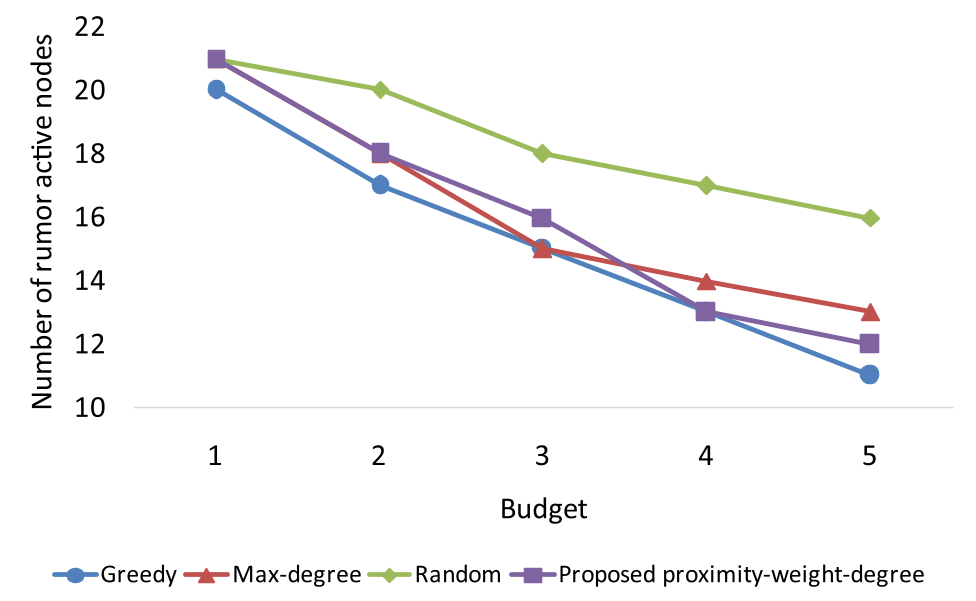 Fig 2: Comparison of rumor containment across different algorithms. Notice how PWD (proposed) tracks closely with the optimal Greedy line.
Critical Insight & Future Outlook
The core takeaway is that global popularity does not equal local influence. In private messaging networks, the most effective "fact-checkers" are those who are directly adjacent to the spread of the rumor, not necessarily the nodes with the most total connections.
Limitations: The current model assumes a fixed "negative bias" (rumors win in a tie). Future work could explore more nuanced human psychology—what if some users are "fact-checkers" by nature and others are more prone to rumors?
Ultimately, this work provides a scalable blueprint for OSN administrators to deploy automated "positive information bots" or influencer campaigns that can neutralize social panic before it scales, specifically in the growing segment of private P2P communication.