
Beyond the Face: Decoding Spontaneous Emotions through Grassmann Manifolds and RGB-D Fusion
Positive/Negative Emotion Detection from RGB-D Upper Body Images
The paper introduces a bimodal framework for detecting spontaneous positive and negative emotional states using RGB-D (color and depth) data. It combines 2D facial feature extraction with a novel 3D geometric approach that models upper-body dynamics on a Grassmann manifold, achieving a SOTA classification rate of 71.32% on the Cam3D dataset.
TL;DR
Recognizing human emotions in the real world is notoriously difficult because spontaneous expressions are often subtle and fleeting. This paper presents a dual-modality system that looks beyond the face to the "energy" of upper-body movements. By projectng noisy depth data onto Grassmann manifolds, the researchers achieved a 71.32% accuracy in distinguishing positive from negative moods, proving that how we move is just as telling as how we look.
The "Posed" vs. "Spontaneous" Gap
For decades, Affective Computing has focused on the "Big Six" basic emotions (Happy, Sad, Angry, etc.) using posed datasets. But real humans don't always "act" their emotions. Spontaneous mental states—like confusion, frustration, or concentration—are dominated by neutral facial expressions and subtle body shifts.
Current 2D systems struggle with:
- Illumination changes: Shadows can be mistaken for facial furrows.
- Occlusions: Hands blocking the face during a "thinking" state.
- Subtlety: Spontaneous smiles or frowns often lack the intensity of acted ones.
Methodology: The Geometry of Emotion
The authors tackle this by splitting the problem into two distinct pipelines that are eventually fused.
1. RGB Pipeline: Targeted Indicators
Instead of full facial reconstruction, the system targets specific regions:
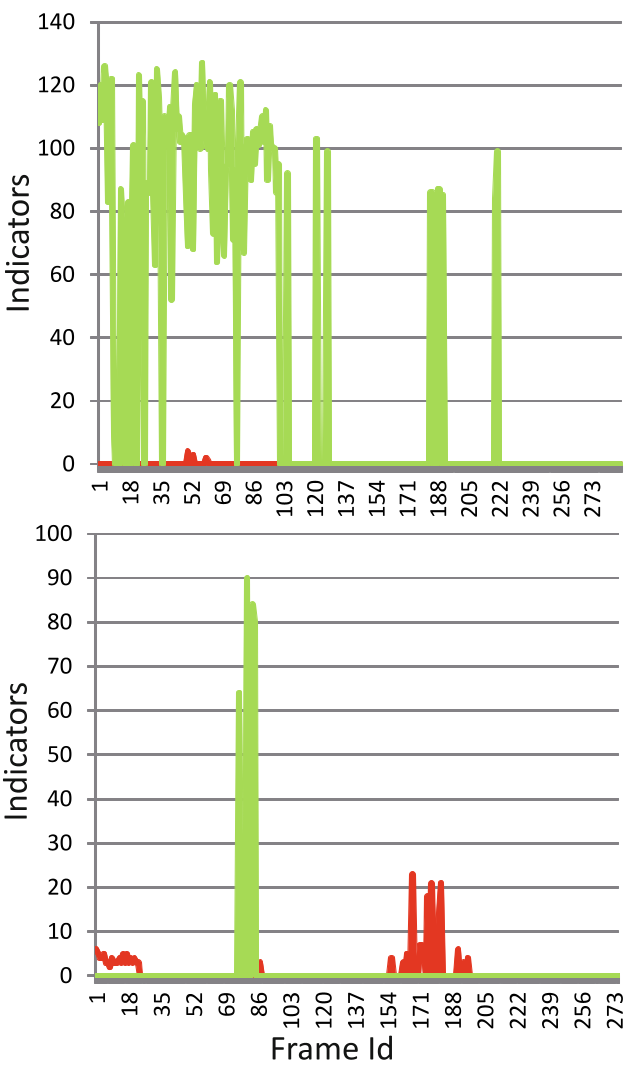
- Negative Indicators: Uses Gabor filters to detect vertical lines above the nasal root (Action Unit 4), correlated with anger or frustration.
- Positive Indicators: Employs a Multi-Layer Perceptron (MLP) with a custom mask to identify informative pixels related to happiness.
2. Depth Pipeline: Mapping Velocity on Grassmann Manifolds
This is the technical heart of the paper. Depth cameras (like Kinect) are notoriously noisy. To extract a clean signal of "movement dynamics," the authors treat a sequence of depth frames as a subspace.
- The Insight: Instead of tracking individual pixels (which are noisy), they compute a -dimensional subspace via Singular Value Decomposition (SVD).
- The Manifold: These subspaces are points on a Grassmann Manifold ().
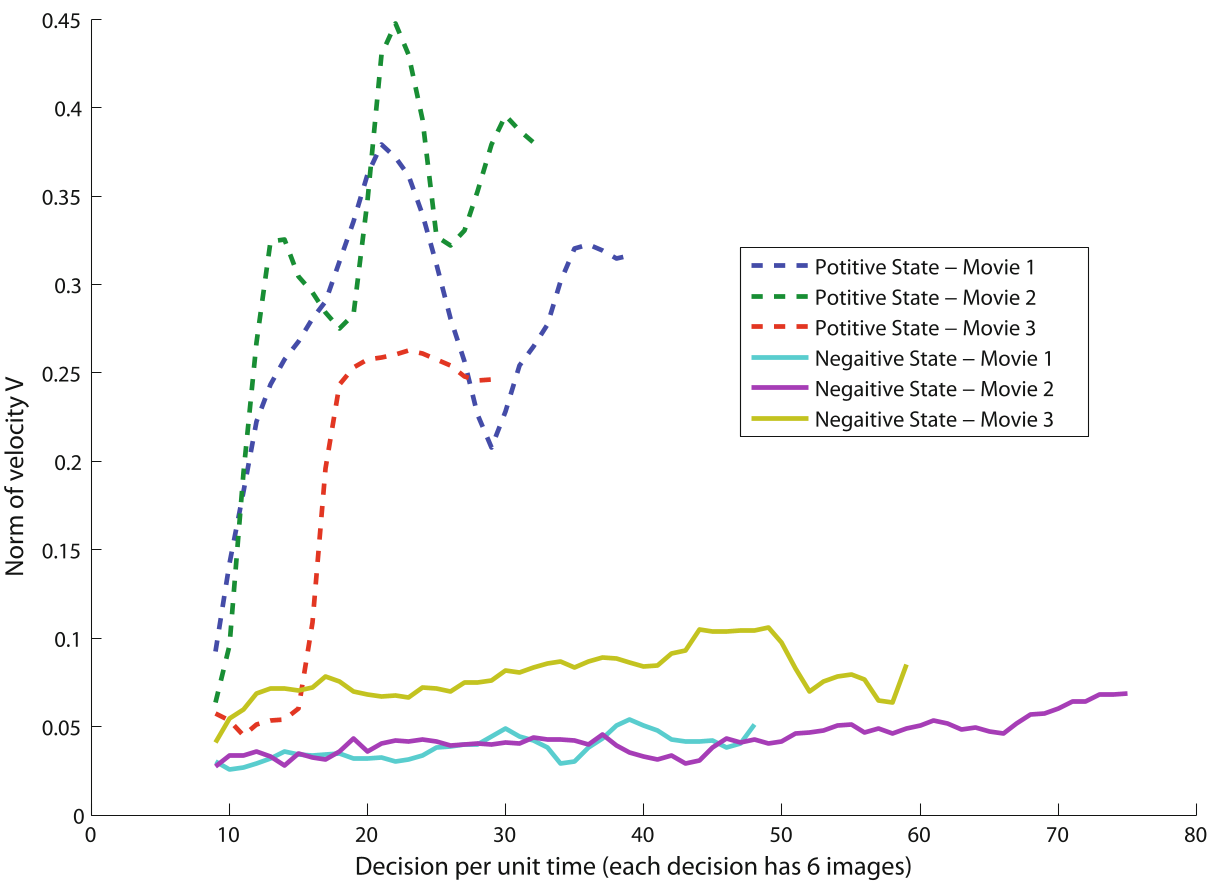
- The Physics of Affect: By measuring the velocity (tangent) vector between successive points on this manifold, the system quantifies the "energy" of the movement. The study found that positive emotions generally exhibit higher velocity norms (more energetic movements) than negative ones.
Experiments & SOTA Results
The framework was tested on the Cam3D dataset, which features complex, spontaneous mental states (thinking, concentraitng, frustrated).
| Approach | Accuracy |
|---|---|
| 2D Image Only (Face) | 63.00% |
| Depth Image Only (Body) | 68.12% |
| RGB-D Fusion | 71.32% |
The results reveal a fascinating hierarchy: Body movement is a stronger indicator of spontaneous emotion than facial expression. When the two are fused, the system becomes significantly more robust to the "uncontrolled" conditions of real-world interaction.
Critical Insights
The true value of this work lies in its Inductive Bias. By using Riemannian geometry, the authors assume that the "space of movements" has a specific curvature. This allows them to filter out sensor noise—which is random—while preserving the "flow" of the body, which is structured and manifold-bound.
Limitations: While powerful, calculating SVD and geodesic paths can be computationally expensive for real-time mobile applications. Furthermore, the binary "Positive/Negative" classification is a simplification; future work should map these manifold velocities to a continuous Valence-Arousal space.
Conclusion
This paper shifts the focus from "what" a face looks like to "how" a body moves through space. By leveraging the elegant mathematics of the Grassmann manifold, it provides a blueprint for more empathetic and accurate Human-Computer Interaction (HCI) systems.