
Behind the Water Cooler: Why You Are the Object of Workplace Gossip
Who are the objects of positive and negative gossip at work?: A social network perspective on workplace gossip
This study investigates the social network determinants of positive and negative workplace gossip using Exponential Random Graph Modeling (ERGM) on a female-dominated healthcare organization. It reveals that gossip is primarily an intra-group phenomenon and that low informal social status is a significant predictor for becoming a target of negative gossip.
TL;DR
Gossip isn't just "idle talk"—it is a sophisticated tool for social control. This study reveals that we primarily gossip about members of our own work groups (not outsiders) to enforce norms. While positive gossip is shared broadly, negative gossip is ruthlessly targeted toward "scapegoats"—individuals with low informal social status who lack the allies to defend themselves.
The "Invisible" Variable: The Gossip Object
While organizational psychology has long studied the "gossip" (the person talking) and the "gossip receiver," the gossip object—the individual being talked about—has remained a shadowy figure in academic literature. We know that being the target of negative gossip can feel like victimization, similar to social undermining or bullying, yet we didn't know why certain people are picked out of a crowd.
The authors of this study argue that gossip is a group-level phenomenon. It serves to maintain group solidarity and monitor norms. If you aren't at the table, you're on the menu—but why you?
Methodology: Mapping the Social Web
The researchers looked at a Dutch child care organization consisting of 36 employees divided into seven formal teams. Instead of simple surveys, they used Social Network Analysis (SNA) and Exponential Random Graph Modeling (ERGM).
ERGM is crucial here because social ties are not independent (if A gossips to B, and B to C, it influences the likelihood of A gossiping to C). This method allows us to see the "architecture" of gossip beyond simple percentages.
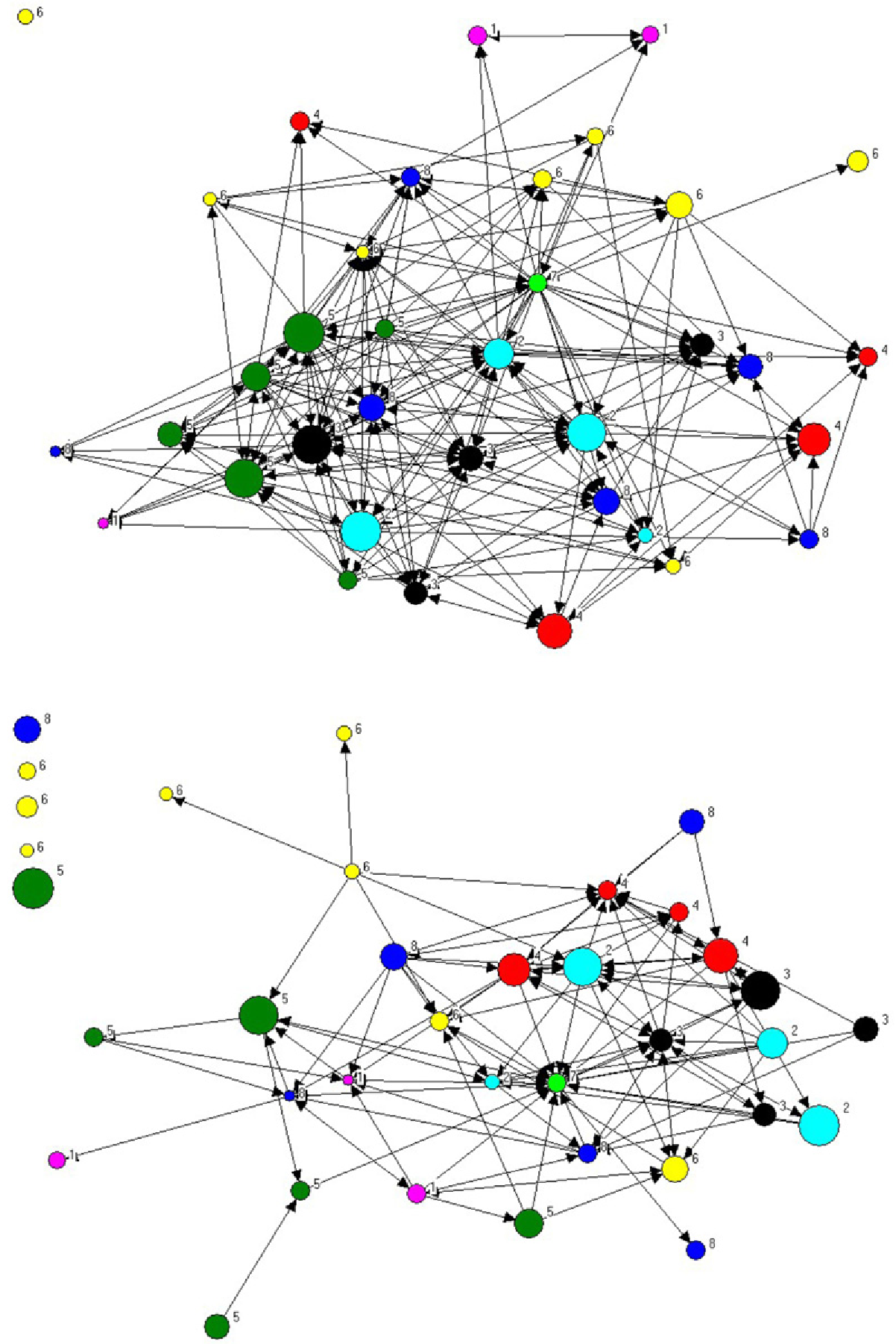 Figure 1: Sociograms showing positive (top) and negative (bottom) gossip networks. Circle size represents informal status, and shades represent formal work groups.
Key Insights: Why Proximity and Status Matter
1. The In-Group Focus
Contrary to "us vs. them" theories, the study found that we gossip about our closest colleagues.
- Why? Interdependence. We care more about the norms of those we actually work with.
- The Black Sheep Effect: We judge in-group members more harshly for failures because their behavior directly affects our group’s success.
2. Social Status as a Shield
The study measured "Social Status" via eigenvector centrality—not just how many friends you have, but how popular your friends are.
- Negative Gossip: Low-status individuals are significantly more likely to be targets. They are "safe" targets because they lack formidable allies to retaliate or defend their reputation.
- Positive Gossip: High status surprisingly did not significantly increase positive gossip. Being popular may protect you from the "sticks," but it doesn't necessarily grant you extra "carrots" in the informal grapevine.
3. The Birth of a Scapegoat
One of the most striking findings was the concentration of negative gossip.
- Positive gossip is spread relatively evenly across the organization.
- Negative gossip creates "Hubs" or Scapegoats. A small number of individuals become "magnets" for negativity, leading to a phenomenon the authors call "character assassination."
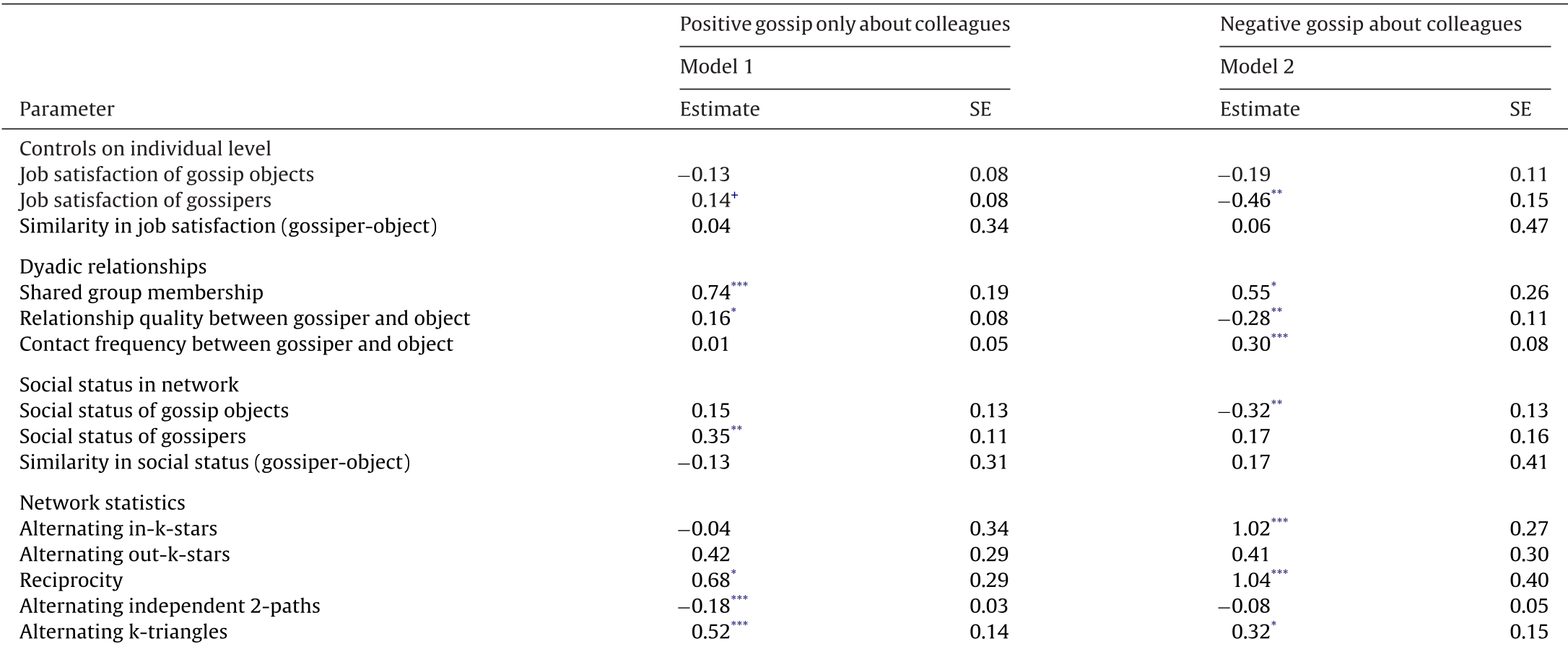 Table 2: ERGM results showing the significant negative impact of social status on being a negative gossip object (β = -0.32) and the high "Alternating in-k-stars" indicating scapegoating (β = 1.02).
Critical Analysis & Takeaways
The study highlights that negative gossip is a form of social control, but it often targets the defenseless rather than the most disruptive.
Limitations:
- Gender Homogeneity: The study focused on an all-female organization. Gossip dynamics in male-dominated or mixed-gender groups might differ (e.g., male groups often have more differentiated status at the top/leaders).
- Cross-sectional Data: We can't definitively say if low status causes negative gossip, or if being gossiped about lowers your status. It is likely a vicious cycle.
Future Outlook: For managers, this research suggests that "solving" gossip isn't about banning talk—it's about social integration. When an employee is peripheral to the social network, they are at high risk of becoming a scapegoat. Strengthening informal ties for low-status members can dismantle the "hubs" of negative reputation before they lead to turnover.