
EPTR: Enhancing Opportunistic Social Networks through Social-Aware Routing and Trust Matrices
An effective positive transmission routing algorithm based on social relationships in opportunistic social networks
The paper introduces the Effective Positive Transmission Routing (EPTR) algorithm for opportunistic social networks. It leverages an improved modularity-based community division and a relationship strength matrix (combining trust and encounter probability) to optimize message forwarding, achieving the highest transmission success rate among compared baselines.
TL;DR
The EPTR (Effective Positive Transmission Routing) algorithm addresses the "selfish node" problem in Opportunistic Social Networks (OppNets). By combining community detection via an improved modularity metric and a relationship strength matrix (Trust + Markov-based encounter prediction), it ensures messages move in the direction of increasing forwarding capability while minimizing network load.
Problem & Motivation: The Reality of Node Selfishness
Opportunistic networks rely on the "store-carry-forward" paradigm. Historically, routing protocols assumed nodes were altruistic, willing to spend their battery and storage to help strangers. In reality, nodes are often selfish (preserving resources) or malicious (dropping packets).
The authors identify a gap in existing community-based routing: most algorithms ignore the multidimensional social ties between people and fail to account for the dynamic nature of trust. When nodes move predictably (e.g., a student moving between dorms and classrooms), simple encounter histories aren't enough—we need a model that understands the physics of social interaction.
Methodology: The Core Mechanics of EPTR
The EPTR algorithm operates in two sophisticated stages:
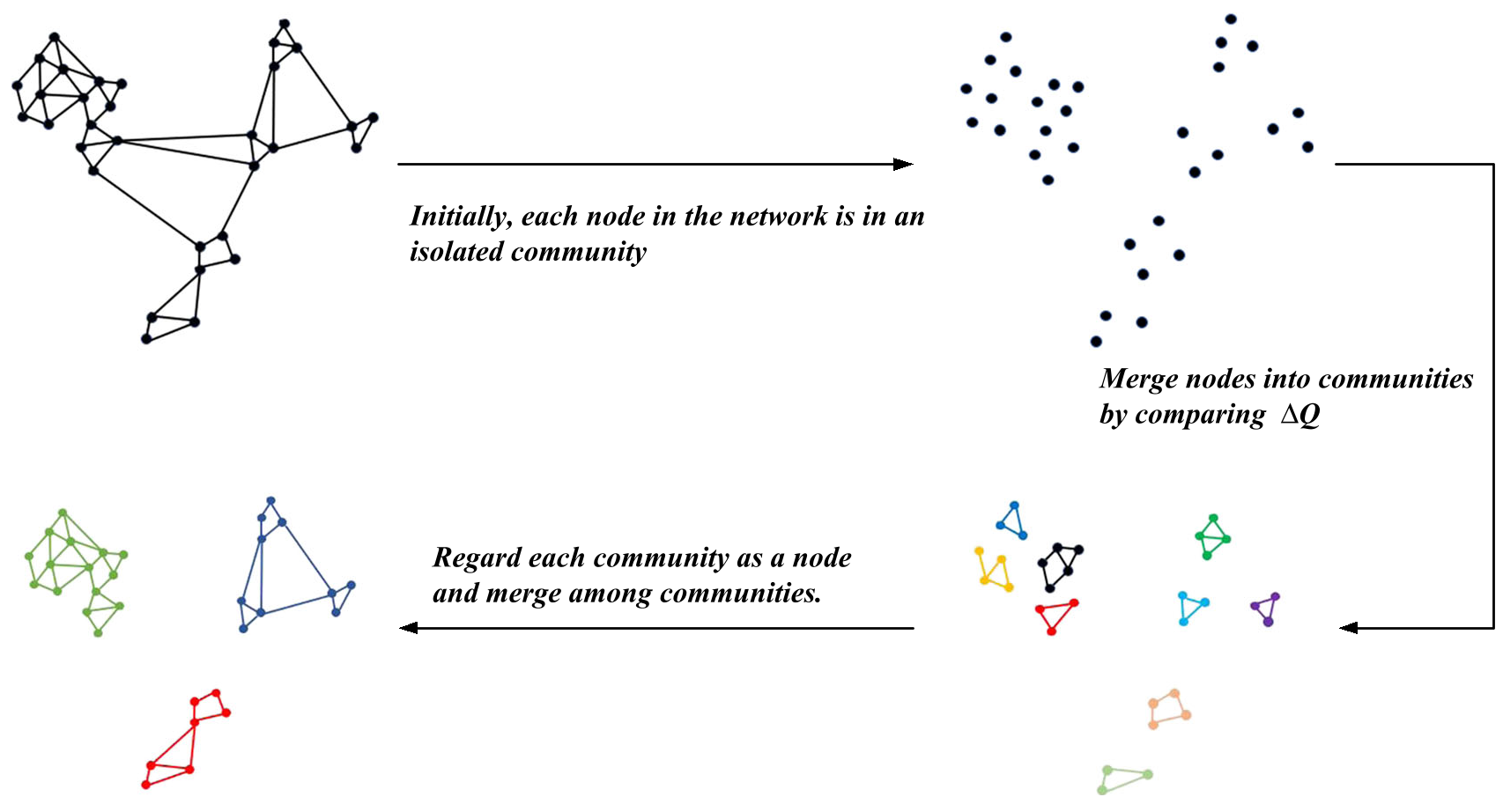
1. Improved Modularity-Based Community Partitioning
Standard community detection often treats weights between nodes as binary. EPTR recalculates these weights by incorporating , the similarity of social attributes.
Nodes are then merged into communities based on the maximization of Modularity increment (), ensuring that communities represent tight social circles.
2. The Relationship Strength Matrix
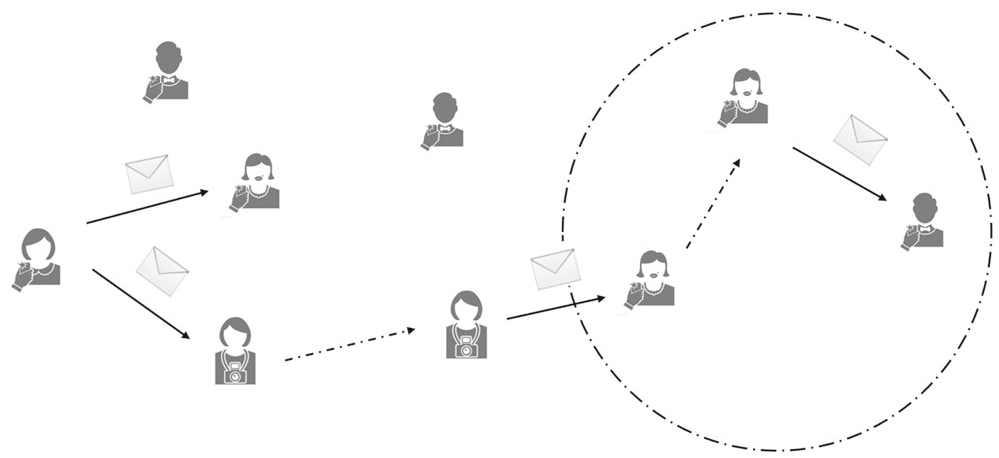
To choose a relay, the source node evaluates neighbor nodes based on a composite "Relationship Strength" . This is the product of:
- Trust Degree (): Dynamically updated based on successful vs. failed forwarding attempts.
- Forwarding Capability (): Predicted using a Continuous-time Markov Chain to calculate the probability that a node will encounter the destination community.
- Destination Trust (): The destination community's internal trust levels.
Experiments & Results: SOTA Performance
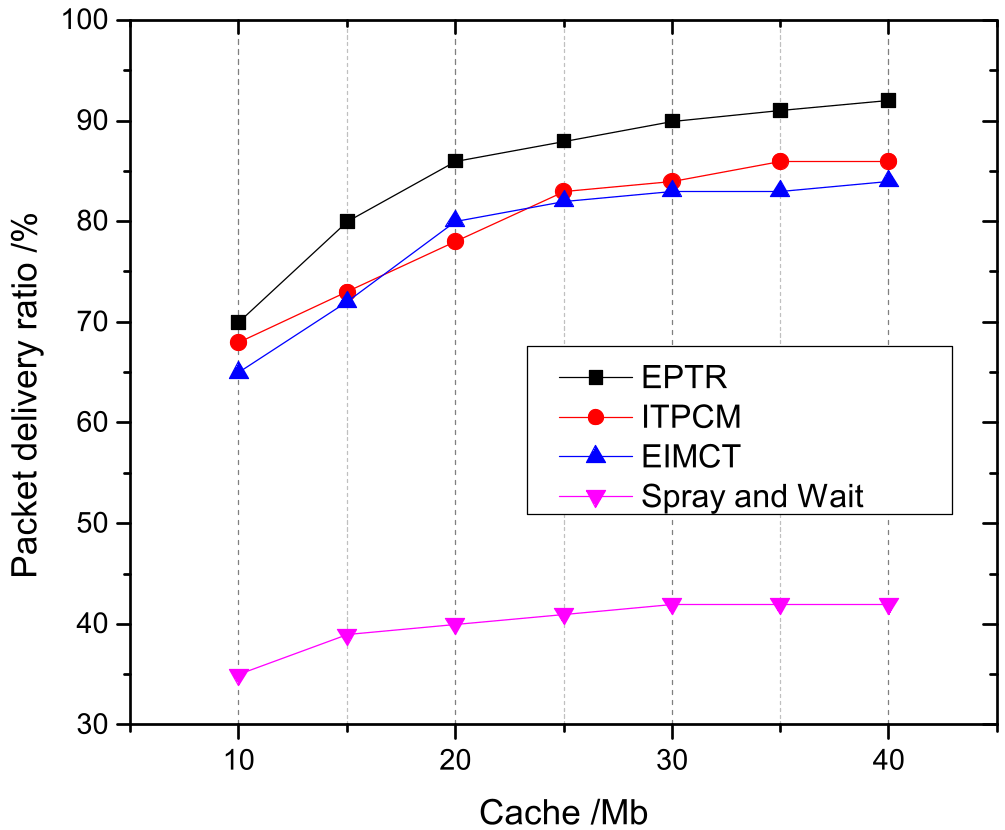
Using the ONE (Opportunistic Network Environment) simulator, the authors compared EPTR against Spray and Wait, EIMCT, and ITPCM.
Key Findings:
- Resilience to Abnormal Nodes: Even with a high ratio of malicious nodes, EPTR maintained a significantly higher delivery ratio because its trust mechanism bypasses suspicious relays.
- Optimized Overhead: While Spray and Wait floods the network with copies, EPTR’s "positive transmission" strategy selects only the most capable nodes, keeping network congestion low.
- Cache Efficiency: As node cache increases, EPTR's performance gap widens, proving it utilizes available resources more effectively than social-agnostic protocols.
Critical Analysis & Conclusion
Takeaway
The genius of EPTR lies in its mathematical marriage of social stability (modularity) and temporal dynamics (Markov Chains). It recognizes that in a human-centric network, routing is not just a shortest-path problem, but a trust-management problem.
Limitations
The algorithm currently assumes that social attributes are static and readily available. In privacy-sensitive scenarios, nodes might be reluctant to share these attributes to help calculate . Future work should look into Privacy-Preserving Community Detection or Federated Learning approaches to build these trust matrices without exposing raw user data.