
Beyond Clinical Trials: A Data Mining Pipeline for Real-World Drug Safety Evaluation
Post-marketing Drug Safety Evaluation Using Data Mining Based on FAERS
The paper introduces a comprehensive data mining and statistical analysis pipeline for post-marketing drug safety evaluation using the FDA Adverse Event Reporting System (FAERS). By applying Zero-Truncated Negative Binomial (ZTNB) regression to 14 neurology drugs, the study successfully uncovers drug-specific adverse event signatures and comparative risk profiles.
TL;DR
Clinical trials provide the "gold standard" for drug approval, but they often miss rare or long-term risks due to scale and time constraints. This paper presents a robust data mining pipeline using 13 years of FDA Adverse Event Reporting System (FAERS) data. By applying advanced statistical modeling (Zero-Truncated Negative Binomial Regression), the researchers analyzed 14 antimanic drugs, revealing that real-world safety profiles often diverge significantly from pre-marketing trial expectations.
The "Big Data" Challenge in Pharmacovigilance
The move toward medical "Big Data" is a double-edged sword. Databases like FAERS contain over 6 million reports, offering a goldmine for post-marketing surveillance. However, researchers face three primary hurdles:
- Normalization Hell: Reports come from physicians and patients using a mixture of brand names, generic names, and non-standard terminology.
- Sparsity & Scale: With thousands of types of adverse events (AEs) and millions of rows, the data is incredibly sparse.
- Statistical Bias: Every entry in FAERS represents a patient who already experienced an event. Standard Poisson models fail here because the data is "zero-truncated" (no zeros) and "over-dispersed" (variance is much higher than the mean).
Methodology: High-Dimensional Mapping and ZTNB
The authors' pipeline focuses on transforming messy raw data into structured knowledge.
1. Data Cleaning & Hierarchical Mapping
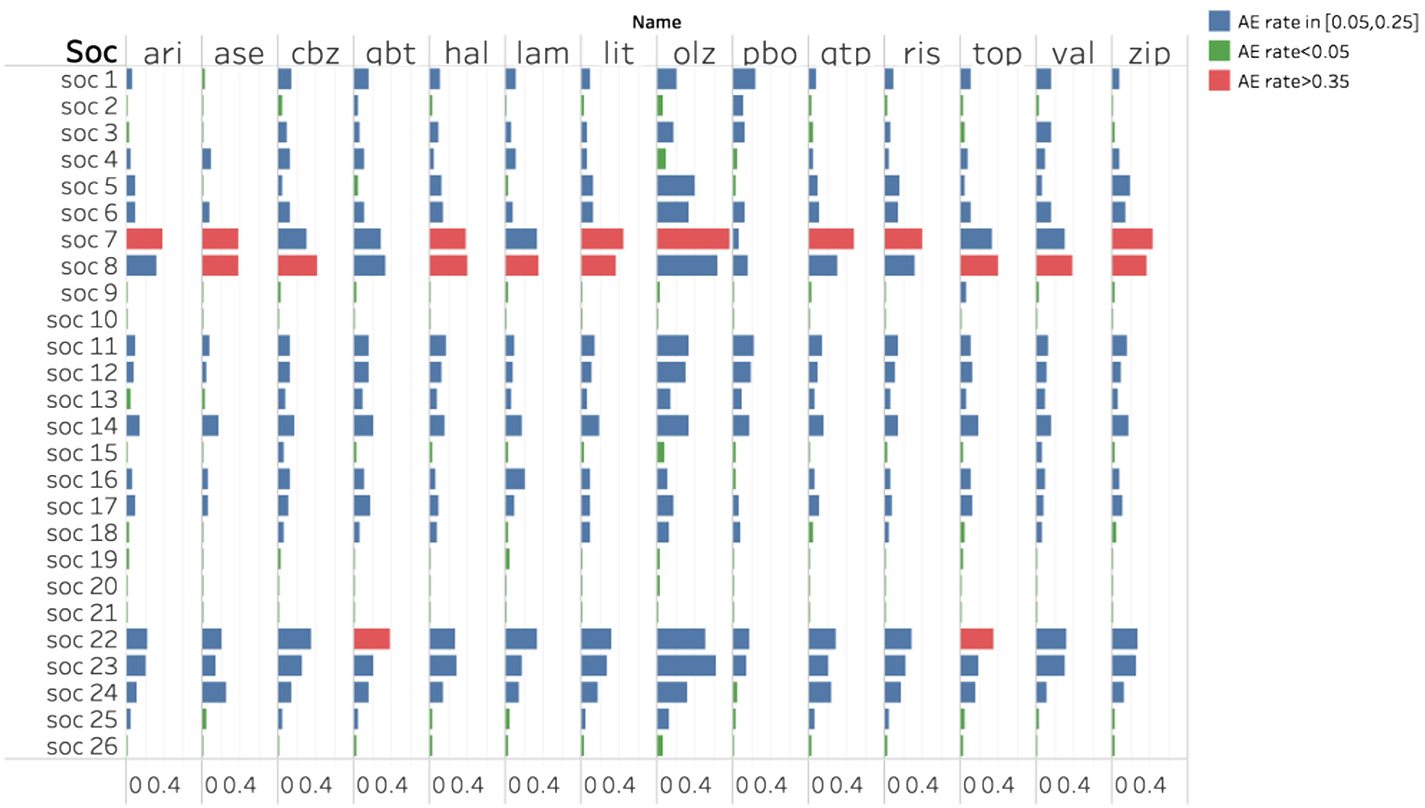
The team mapped drug names to RxNorm standards and aggregated thousands of specific Preferred Terms (PT) for reactions into 26 System Organ Classes (SOC). This reduces dimensionality, allowing for a clearer organ-level overview of drug influence (e.g., Cardiac disorders vs. Nervous system disorders).
2. The Statistical Core: Zero-Truncated Negative Binomial (ZTNB)
Because the dataset only includes patients who reported at least one AE, the authors couldn't use a standard distribution. They employed the ZTNB model:
- Zero-Truncated: Adjusts for the fact that in the database.
- Negative Binomial: Handles "over-dispersion," which occurs when AEs co-occur in clusters rather than appearing as independent, random events.
Key Results: Trials vs. Reality
The results provided a fascinating localized look at drug safety that pre-marketing trials (which focus on "dropout rates") often obscure.
- The Case of Olanzapine: While clinical trials often rank Olanzapine high for "acceptability" (low dropout), this study found it had the highest AE rates in metabolism and nutrition (SOC 6) and endocrine disorders (SOC 5).
- Death Rates: Haloperidol showed the highest all-cause death rate (17.26%), while Asenapine was the lowest (4.81%).
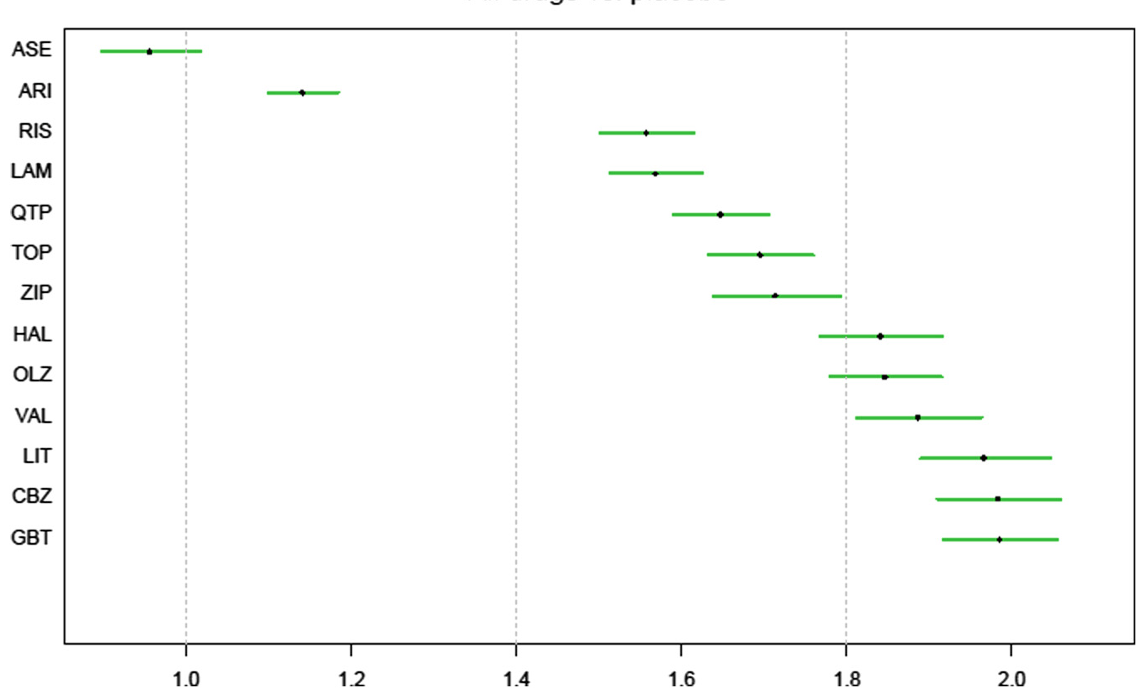
- AE Rate Ratios: Using a forest plot, the researchers demonstrated that Gabapentin had the highest expected number of AEs per person relative to the placebo.
Critical Insight: The "Why" Behind the Method
Why go through the trouble of ZTNB? If the authors had used a simple mean comparison, the heavy-tailed nature of the data (patients with a high number of co-occurring AEs) would have skewed the results. By accounting for over-dispersion, the model identifies the Rate Ratio, providing a more scientifically rigorous ranking of drug risk that can inform clinical decision-making.
Conclusion & Limitations
This work establishes a replicable framework for mining safety signals from massive, noisy databases. However, the authors acknowledge Ascertainment Bias: doctors might prescribe certain drugs (like Haloperidol) to sicker patients, potentially inflating the death rate unrelated to the drug's inherent toxicity.
The future of the field lies in integrating these FAERS insights with the time-to-event data and Electronic Health Records to create a 360-degree view of patient safety.
Takeaway: Don't rely solely on pre-marketing "acceptability." Real-world data mining is essential to uncover the specific organ-system risks of long-term pharmaceutical use.