
Decoding Merger Success: A Social Network Revolution in Cultural Integration
Post-merger cultural integration from a social network perspective: a computational modeling approach
This study presents an Agent-Based Model (ABM) to examine post-merger cultural integration from a social network perspective. By simulating individuals as adaptive agents within dynamic network structures, the research identifies how within-firm and between-firm tie concentrations influence cultural alignment and organizational dysfunctions.
TL;DR
Why do mega-mergers like Daimler-Chrysler or AOL-Time Warner collapse despite perfect financial logic? This paper argues the answer lies in the invisible architecture of social ties. By using agent-based computational modeling, the researchers demonstrate that cultural integration isn't a top-down mandate—it's a bottom-up diffusion process that succeeds only when the right "bridges" are built between companies.
The Missing Link: Why Firm-Level Analysis Fails
For decades, management scholars have focused on macro-level variables like strategic fit and executive chemistry. Yet, a famous meta-analysis by King et al. (2004) proved these factors have almost zero explanatory power for post-merger performance.
The authors of this study identify a critical blind spot: Culture lives in people, not balance sheets. It is transmitted through "water-cooler" conversations and daily collaborations. If we don't account for how individuals are connected, we can't understand how (or if) two corporate identities will ever merge.
Methodology: Simulating "Cultural Contagion"
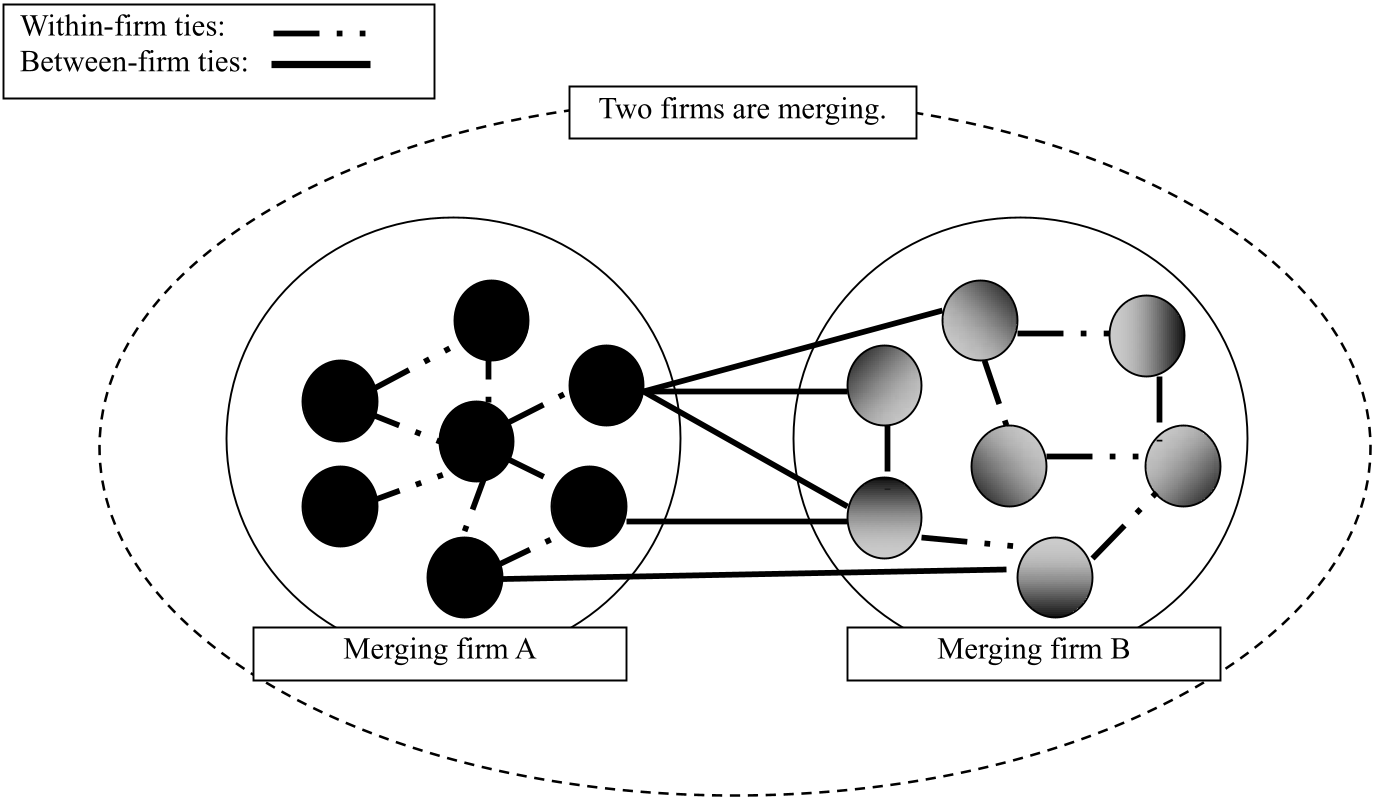
The researchers built a digital laboratory where 100 individuals (agents) are represented as vectors in a 10-dimensional "cultural space."
- The Mechanism: Individuals "listen" to their neighbors. If their cultures are similar, they move closer together and strengthen their bond. If they are too different, the relationship weakens and eventually snaps.
- The Variables: The study manipulates two specific network traits:
- Within-firm concentration (): Is the company a "flat" democracy or a centralized hierarchy?
- Between-firm concentration (): Do only the CEOs talk to each other, or are frontline workers mingling?
Core Findings: The "Centralized Internal, Decentralized External" Paradox
The simulation results (detailed in Table 1 and 2) yield a counter-intuitive insight for HR departments and CEOs:
1. The Integration Sweet Spot
The highest level of cultural integration occurs when:
- Within-firm concentration is HIGH: Centralized firms have "hubs" that can quickly spread new cultural norms to the rest of the group once they themselves are converted.
- Between-firm concentration is LOW: When only CEOs talk ( is high), they often clash and resist change. However, when peripheral employees (who are less "entrenched" in the old culture) form bridges, they integrate faster and pull their respective organizations along with them.
2. The Dysfunction Trade-off
The study discovered that organizational "health" doesn't improve uniformly.
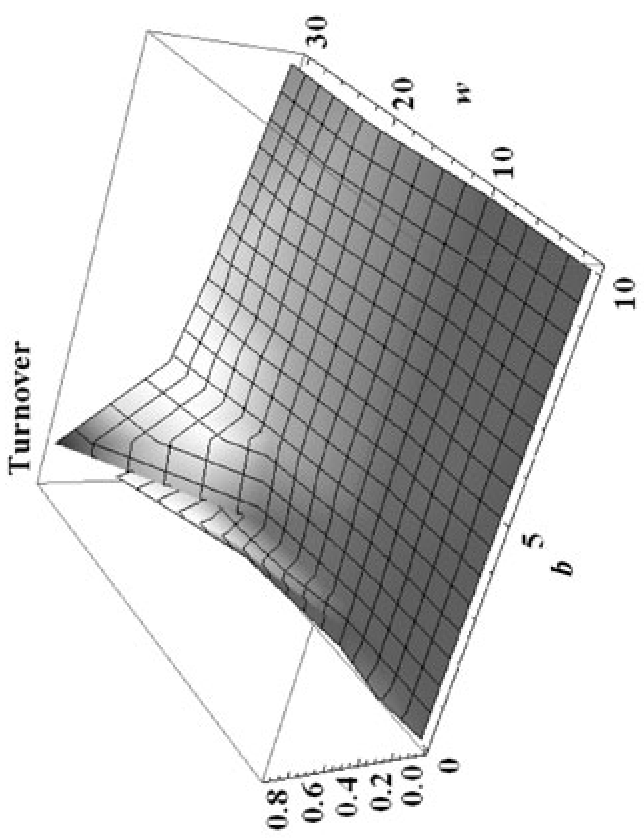
- Turnover: Occurs when people feel like "misfits." Centralized hierarchies actually increase turnover because the dominant culture acts as a social control mechanism that ejects "cultural outliers."
- Communication Ineffectiveness: If the few "bridge" individuals between firms fail to align, the entire organization's communication collapses, even if local teams are getting along fine.
Critical Insight: Beyond Executive Handshakes
The standardized regression coefficients () confirm that interaction terms matter. Within-firm concentration promotes integration specifically when between-firm concentration is low.
From an academic standpoint, this is a pioneering example of Adaptive Network Modeling in management. It shows that node properties (culture) and link topologies (friendships) co-evolve. As people become more culturally similar, they interact more; as they interact more, they become more similar.
Takeaways for Future Mergers
- Don't just merge the Top: Relying solely on executive retreats to integrate culture is statistically the least effective strategy.
- Empower the Perimeter: Create cross-functional project teams involving non-central employees. They are your most effective "cultural ambassadors."
- Monitor the Network: Use Social Network Analysis (SNA) to identify if your "hubs" are becoming bottlenecks for cultural dissonance.
Conclusion
This paper shifts the M&A narrative from "Strategic Fit" to "Structural Fit." It reminds us that a merger is not just one firm buying another, but two complex social ecosystems learning to breathe together. Success isn't found in the board meeting—it's found in the density and distribution of the ties that bind the frontline.