
Syncing Practice vs. Social Goals: A Deep Dive into Cross-Platform Post-Syncing
Studying and Understanding Characteristics of Post-Syncing Practice and Goal in Social Network Sites
This research investigates the "post-syncing" functionality in Social Network Sites (SNSs), focusing on Weibo as a sink platform. Utilizing a mixed-methods approach (quantitative analysis of 211,233 synced-posts and qualitative interviews), it characterizes the users, content types, and underlying motivations of automated cross-platform sharing.
TL;DR
Is post-syncing a bridge between social worlds or a privacy nightmare? This study analyzes over 200,000 synced-posts on Weibo to reveal that while post-syncing empowers self-promotion and urgent information broadcasting, it often clashes with platform norms by exposing sensitive data like location without explicit user consent for every post.
Background: The Divergence of Social Bridges
Modern digital life is fragmented across multiple SNSs. To bridge this, "post-syncing" allows a "Source SNS" (e.g., Douban) to automatically push updates to a "Sink SNS" (e.g., Weibo). However, the industry is split: Facebook has restricted these permissions to protect user experience, while Twitter and Weibo still embrace them. This paper asks a critical question: Does automated syncing violate the unwritten rules of the platforms we use?
The "Why": Content Exhibition over Conversation
The authors find that syncing behavior isn't random. It is driven by specific needs:
- Publicity & Urgency: Users sync content that needs to be seen by everyone (news, recruitment, emergencies).
- Remarkableness: Users broadcast achievements (e.g., a high score in a singing app) to maximize "Likes" across different social circles.
- Affordance Gaps: Users use niche apps (TikTok, Changba) for creation but rely on Weibo for its massive "broadcast" infrastructure.
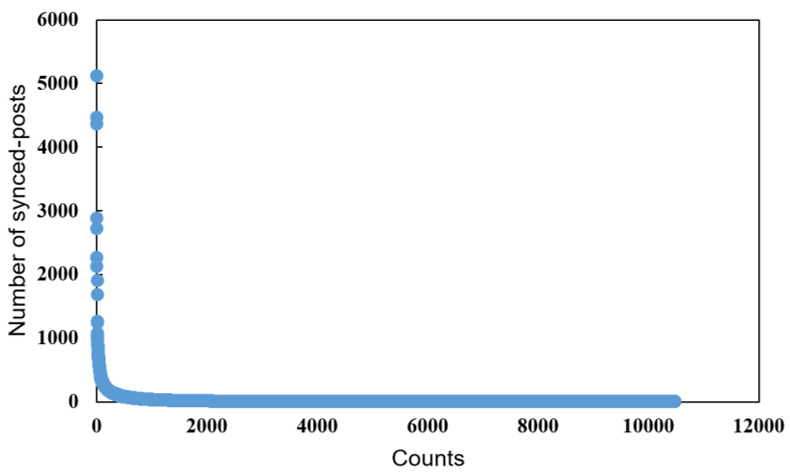 Figure 1: The distribution of synced-posts shows a "long tail" effect; most users sync very few posts, highlighting the selective nature of this practice.
Methodology: High-Dimensional Behavior Analysis
To tackle the complexities of user behavior, the research utilized:
- Negative Binomial Regression: Ideal for the skewed data typical of social networks (where most users have 0-5 synced posts).
- Text-CNN Classifiers: Used to categorize tens of thousands of posts into topics (Home, Food, Shopping) and goals (Intimacy, Promotion, Advertisement).
Key Mathematical Intuition: The Follower Paradox
One of the most striking findings is that synced-post size decreases as follower size increases.
- Visual Logic: Users with massive followings (KOLs) are more cautious about "context collapse." They understand that a generic auto-post might alienate a large, diverse audience. In contrast, smaller users feel more "embedded" and comfortable using syncing as a social experiment.
Experimental Results: The Promotion Machine
The data reveals that synced-posts are disproportionately used for Promotion and Location Sharing compared to manually written posts.
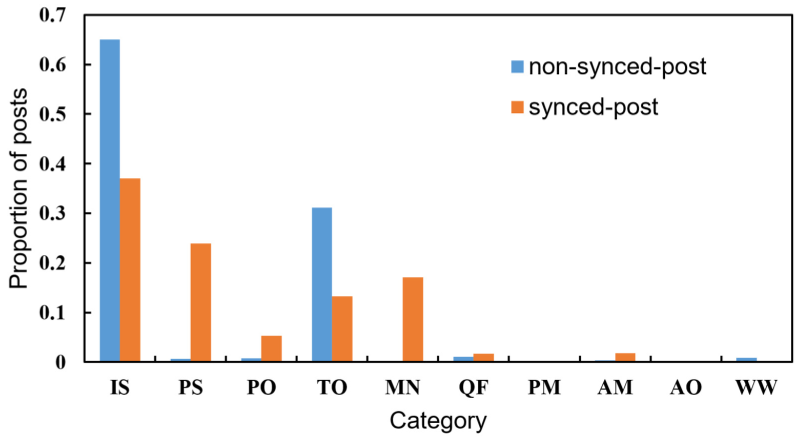 Figure 2: Comparison between synced and non-synced posts across categories. Notice the surge in "Promotion (Self)" and "Me Now" for synced content.
The Dark Side: The One-Time Consent Trap
A critical takeaway from the qualitative interviews is the "One-time Consent" problem. Many users bind their accounts once for a specific activity (like a vote) and later forget that the app has perpetual permission to sync their location or check-ins. This leads to unintended self-disclosure, where users accidentally broadcast their physical location to a broad, public Weibo audience.
Critical Analysis & Future Outlook
This paper serves as a vital blueprint for SNS practitioners. It effectively argues that:
- Social Context Matters: Auto-syncing ignores the unique culture of the "Sink SNS."
- Gendered Privacy Gap: Male users were found to be less conscious of privacy risks in syncing than female users, suggesting that platform defaults need to be protective by design rather than by choice.
Future Work: The authors suggest a shift toward "post-level authentication," where the sink site asks, "Are you sure you want to sync this specific location?"—moving away from the broad, dangerous API permissions of the past.
Conclusion
Post-syncing is not just a technical convenience; it is a trade-off between broadcast efficiency and personal privacy. For researchers, it highlights the need for more nuanced, cross-platform privacy models that account for the "socially embedded" nature of our online lives.