
Decentralizing the Social Stream: Content-Based Pub/Sub without Big Brother
Poster: Towards Content-Based Publish/Subscribe for Distributed Social Networks
The paper proposes a decentralized architecture for distributed social networks that integrates content-based publish/subscribe (pub/sub) functionality. By combining "semantic friendship" with approximate pub/sub protocols, it enables users to subscribe to specific topics across a Peer-to-Peer (P2P) network while maintaining data ownership.
TL;DR
This research tackles the "all-or-nothing" problem of social media notifications in decentralized networks. By introducing semantic friendship—where nodes connect based on shared interests rather than just social ties—the authors build a system where you can subscribe to specific topics (like "Pathology updates") across a P2P network, ensuring you get relevant content while keeping your data on your own machine.
Background: The Price of Connection
Traditional social platforms (Facebook, LinkedIn) are central hubs of data exploitation. While they offer sophisticated "content matching," the cost is your privacy. Distributed Social Networks (DSNs) aim to fix this but often struggle with cognitive overload. If you follow 1,000 people in a decentralized system, how do you filter their updates effectively without a central server doing the heavy lifting?
The Core Insight: Semantic Friendship
The authors argue that a social graph isn't enough. They introduce a dual-layer routing architecture:
- Social Neighborhood: Your explicit friends and colleagues.
- Semantic Neighborhood: A dynamic set of links to strangers who share your specific interests, maintained via a Rewiring Service.
This allows for Approximate Pub/Sub. Instead of blasting every post to every follower (which kills the network), publications stay local. Subscriptions (Continuous Queries) are routed to nodes that are "thematically close," creating a "distributed index" of interests.
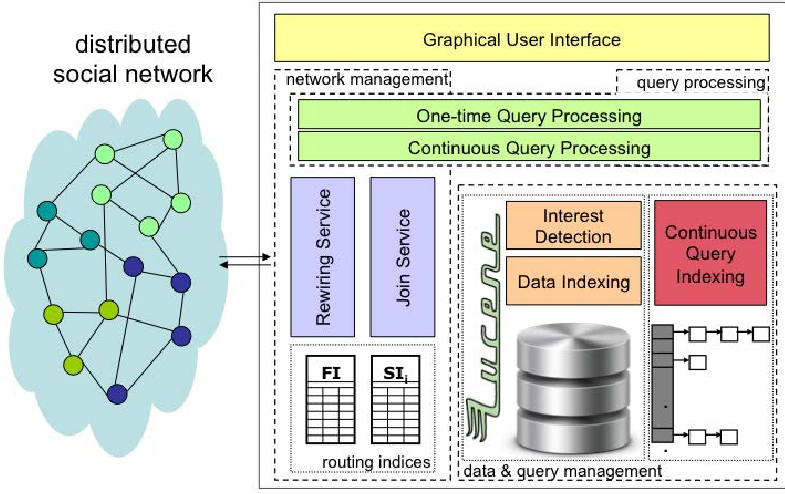 Figure 1: High-level view of the node architecture, showcasing the Rewiring and Query Processing services.
Methodology: The Fireworks Strategy
To balance discovery and efficiency, the system uses a Fireworks routing strategy:
- Broadcasting (Explosion): When a query is highly relevant to a node’s local neighborhood, it spreads wide to find similar content.
- Fixed Forwarding: If the query is outside a node's expertise, it is sent to a few "best-guess" semantic friends to find the right cluster.
This mechanism ensures that a query for "Appendicitis surgery" eventually finds its way to the "Medical professional" cluster of nodes, even if the person who started the query only has social links to "General Pathologists."
Experiments: Scalability through Self-Organization
Using real-world data from the Delicious social bookmarking site, the researchers compared different routing strategies.
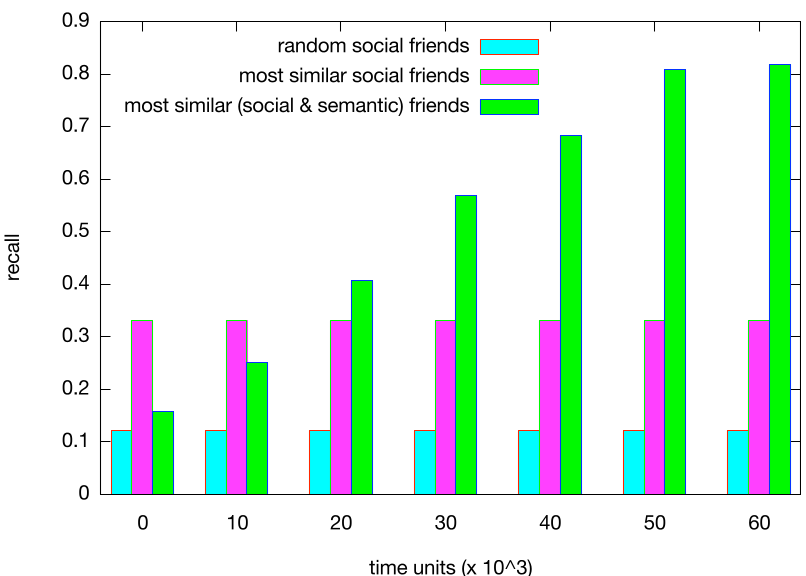 Figure 2: The growth of Recall over time as the network self-organizes through semantic rewiring.
The results reveal a key trend: static social links (Random or Social Friends) provide poor recall because social circles are often too diverse. However, as the Semantic Rewiring service matures, nodes find their "tribes," and the recall (the ability to find relevant posts) jumps significantly.
Critical Analysis & Conclusion
This paper is a pioneer in bringing Content-Awareness to the P2P social space. By treating every user as both a consumer and a mini-search engine, it moves us closer to a "personal Web 2.0."
Key Takeaways:
- Efficiency: By keeping publications local, they solve the massive bandwidth problem of decentralized systems.
- Diversity: The authors hint at using the "Sainte-Laguë method" (an election algorithm) to ensure user feeds aren't dominated by one single viewpoint or source.
- Limitations: The system assumes nodes are frequently online; in a mobile-first world, "store-and-forward" mechanisms for offline users remain a significant hurdle.
In the future, expect these decentralized pub/sub models to move into Corporate Social Networks, where data privacy isn't just a preference—it's a legal requirement.