
CUD: Leveraging the "Internet's Collective Wisdom" to Outsmart URL Spam
Poster: CUD: crowdsourcing for URL spam detection.
This paper introduces CUD (Crowdsourcing for URL Spam Detection), a novel framework that leverages existing user comments on the web to identify malicious URLs. By combining automated crawler technology with NLP-based sentiment analysis, CUD achieves a 86.8% true positive rate while detecting 75% of spam URLs missed by traditional blacklisting services.
TL;DR
CUD (Crowdsourcing for URL spam detection) is a defensive framework that doesn't look at the URL itself, but at what people say about it. By crawling forums and blogs for user comments and applying sentiment analysis, it detects malicious URLs with 86.8% accuracy. Crucially, it finds 75% of spam missed by traditional giants like Google and McAfee.
Background: Why Technical Features Are Failing
The cat-and-mouse game of cybersecurity is usually played on the attacker's home turf. Most detection systems analyze:
- Lexical features: The structure of the URL string.
- Landing pages: The content hosted at the destination.
- Hosting properties: IP addresses and DNS records.
The fatal flaw? Attackers control all of these. They can obfuscate code, rotate IPs, and use DGA (Domain Generation Algorithms) to stay one step ahead. The authors of CUD realized that while computers struggle with these evolving patterns, humans are excellent at recognizing scams—and they often warn others about them in public forums.
Methodology: Turning Gossip into Intelligence
The CUD system operates through a four-stage pipeline designed to distill chaotic internet comments into a binary security verdict.
1. The Crowdsourcing Crawler & Information Collector
Instead of manually recruiting users, CUD "passively crowdsources" by using search engines to find where a specific URL is being discussed. It filters through noise to extract relevant posts from forums and blogs.
2. Deep Sentiment Analysis (Beyond Adjectives)
Standard sentiment analysis often looks for negative adjectives (e.g., "bad," "fake"). CUD introduces a domain-specific insight: Negative Verbs. In the context of security, phrases like "do not enter," "don't click," or "never visit" are high-confidence indicators of maliciousness, even if no explicit "insult" is used.
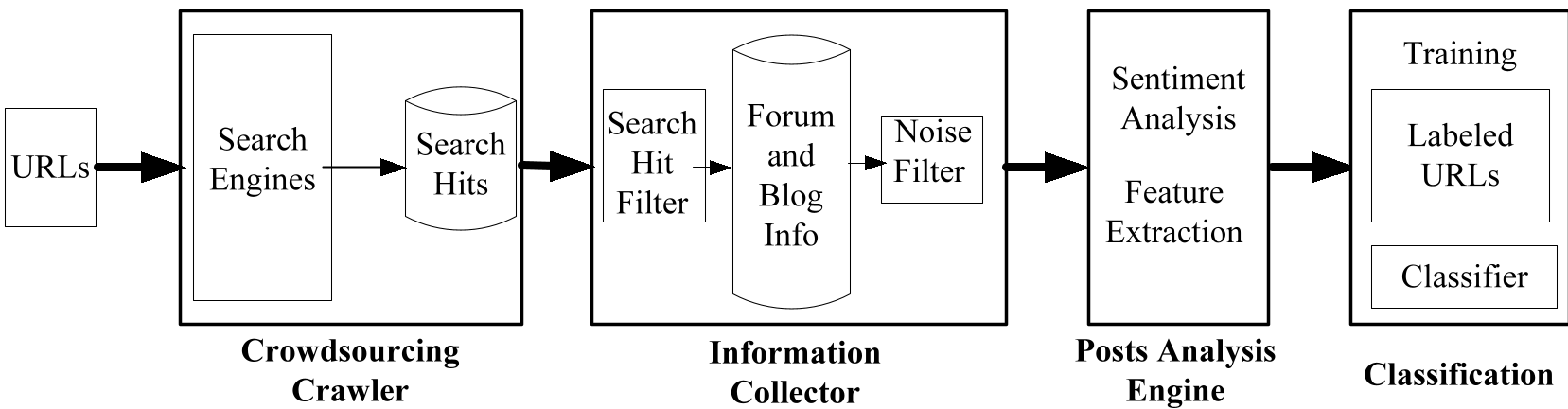 Figure 1: The architecture of the CUD system, showing the flow from URL input to final classification via sentiment analysis.
3. Feature Engineering
The classifier uses four key features:
- Strong Negative Word Ratio: The percentage of posts containing words like "malware" or "phishing."
- Negative Verb Presence: Binary indicator for cautionary verbs.
- Negative/Positive Word Counts: Aggregate sentiment scores.
Experimental Results: Filling the Gaps
The most striking finding of the CUD study is its coverage and complementarity.
- High Coverage: Even back in 2011, nearly 98% of known malicious URLs had some form of discussion online.
- Low False Positives: With a 0.9% FP rate, the system is reliable enough for automated blacklisting.
Comparison with Industry Standards
When compared against industry leaders like Google SafeBrowsing and McAfee SiteAdvisor, CUD proved it wasn't just another tool—it was a necessary tool.
 Table 2: CUD successfully identified thousands of spam URLs that traditional blacklists missed entirely.
The data suggests that traditional tools are blind to a significant portion of the "long tail" of spam, which CUD catches by eavesdropping on human warnings.
Deep Insight: The Value of Stationarity
One of the major technical advantages of CUD is stationarity. In machine learning, if the data distribution changes (e.g., attackers use new coding tricks), the model must be retrained. However, the human language used to describe a scam (e.g., "This is a scam") is incredibly stable. CUD doesn't need constant retraining because the way humans warn each other hasn't changed in decades.
Conclusion & Limitations
CUD marks a shift from "Technical Intelligence" to "Social Intelligence" in cybersecurity. While highly effective, it does have a "cold start" problem: if a URL is brand new (seconds old), there may not be any comments yet.
However, as a supplementary layer, it provides a robust defense against "evasive" spam that bypasses automated scanners but cannot hide from the collective scrutiny of the internet community. Future iterations could integrate LLMs to better understand the context of these comments, further reducing the false positive rate in complex discussions.