
Taming Malicious Workers: Solving the Crowdsourcing Dilemma with Zero-Determinant Strategies
Poster: Solving the Crowdsourcing Dilemma Using the Zero-Determinant Strategy
The paper introduces a Zero-Determinant (ZD) strategy-based algorithm to mitigate malicious behaviors in crowdsourcing systems. By modeling the interaction between requestors and workers as an Iterated Prisoner's Dilemma (IPD), the authors prove that a requestor can unilaterally control a worker's expected payoff to enforce cooperation.
Executive Summary
TL;DR: This paper tackles the persistent issue of "malicious behavior" in crowdsourcing platforms—where workers may attack peers or the system to boost their own rewards. By framing the relationship between a requestor and a worker as an Iterated Prisoner's Dilemma (IPD), the authors introduce an algorithm based on Zero-Determinant (ZD) strategies. This allows a requestor to unilaterally set the worker's payoff, effectively forcing them to choose cooperation over conflict.
Contextual Positioning: Published at MobiHoc'16, this work is a sophisticated application of evolutionary game theory (specifically the revolutionary ZD strategy proposed by Press and Dyson in 2012) to the practical field of mobile networking and crowdsourced task management.
Problem & Motivation: The Victim-Employer Paradox
In crowdsourcing, the requestor is in a unique position: they are both the victim of worker attacks (through reduced quality or increased costs) and the employer who controls the paycheck.
Existing solutions often struggle because:
- Detection Lag: It is difficult to detect an attack within a single round due to resource constraints.
- Systemic Complexity: Previous attempts often required external monitoring components that weren't integrated into the core economic model of the platform.
The authors' key insight is that the requestor doesn't need to detect every single malicious act instantly. Instead, by viewing the relationship as a long-term, repeated interaction, the requestor can use the power of the purse to shape worker behavior over time.
Methodology: The Power of Unilateral Control
The core of the paper lies in the Zero-Determinant (ZD) strategy. Conventionally, in a game, your payoff depends on both your moves and your opponent's. However, ZD strategies allow a player to unilaterally dictate a linear relationship between the two players' scores.
1. The Payoff Matrix
The game is defined by a matrix where both parties choose to Co-operate (C) or Defect (D). If both cooperate, they reach a stable state; if the worker defects (attacks), they might gain a short-term bonus while the requestor suffers.
2. The ZD Mechanism
By choosing specific cooperation probabilities (), the requestor can satisfy a mathematical condition where the numerator of the expected payoff equation becomes zero. This leads to the fundamental ZD equation: By setting , the requestor can literally fix the worker's expected payoff () to a specific value, regardless of what the worker does.
3. The Algorithm
The proposed algorithm doesn't just keep the payoff static. It acts as a "carrot and stick":
- If the worker cooperates: The requestor increases the worker's future expected payoff.
- If the worker defects: The requestor aggressively slashes the expected payoff.
Experiments & Results: Evolution Toward Harmony
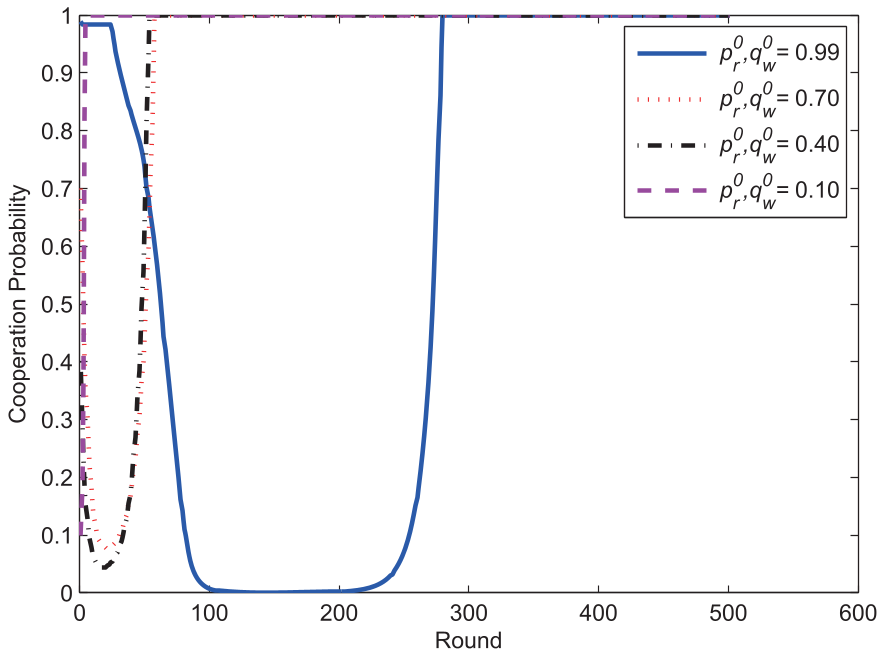
The authors conducted simulations to see if this "coercion" actually works. They tested various initial conditions where workers started with different tendencies to cooperate or defect.
 (Note: Refer to Figure 2 in paper for cooperation probability curves)
Key Findings:
- Convergence: In every scenario, the worker's cooperation probability eventually reached 1.0 (100%).
- The "Huge Reward Space": Workers who started with low cooperation (very malicious) were actually easier to reform because the requestor had more "room" to increase their rewards once they began to behave, providing a stronger incentive signal.
Critical Analysis & Conclusion
Takeaway
The "Crowdsourcing Dilemma" is solvable without complex surveillance. By leveraging the mathematical properties of ZD strategies, a requestor can transform from a passive victim into a strategic coordinator who "programs" the worker's incentives.
Limitations & Future Work
While mathematically elegant, the ZD strategy assumes a consistent, iterated relationship between the same requestor and worker. In highly transient crowdsourcing environments where workers change constantly, the "iteration" might not last long enough for the strategy to converge. Future research could explore how these individual ZD interactions scale to a massive population of workers using a shared reputation pool.
Subject Area: Algorithmic Game Theory / Crowdsourcing Security Key Terms: IPD, Zero-Determinant Strategy, Incentive Mechanisms, Mobile Computing.