
Posting Dynamics and Content Active Filtering: Engineering Diversity in Social Networks
10266_Posting Behavior Dynamics and Active Filtering for Content Diversity in Social Networks.
This paper introduces a dynamical model based on stochastic approximations to characterize the posting behavior of publishers in social networks under the influence of positive and negative externalities. The authors further propose a Content Active Filtering (CAF) mechanism to optimize content diversity, achieving a balanced distribution of information from multiple sources.
TL;DR
This research moves beyond simple observation of social media trends to provide a rigorous mathematical framework for why publishers post and how platforms can control various content flows. By modeling social networks as dynamic systems with externalities, the authors prove that a "Content Active Filtering" (CAF) mechanism can balance the visibility of different viewpoints, effectively engineering "content diversity" as a stable Nash Equilibrium.
Problem & Motivation: The Attention Economy and Externalities
In any social network, user attention is a finite resource. This creates externalities: if Publisher A floods the network, the popularity of Publisher B's posts inevitably shifts.
- Negative Externalities: High volume from one source makes it harder for others to be seen (attention competition).
- Positive Externalities: Posts on a hot topic from one source might increase interest in related posts from another (trend synergy).
Traditional sociological models often overlook these popularity-feedback loops. The authors validate these externalities using 5 years of data from major French news outlets, revealing that the "likes" received by Le Monde are statistically correlated with the posting frequency of Le Figaro.
Methodology: From Dynamics to Game Theory
The core of the paper lies in bridging Stochastic Approximations with Game Theory.
1. The Dynamical Model
The authors represent the posting rate () as a stochastic process. A publisher only posts if the predicted popularity (determined by current network state and externalities) exceeds a certain threshold. The evolution is captured by: where is a binary decision based on popularity probability.
2. The Rest Point as Nash Equilibrium
A brilliant insight of this work is proving that the system naturally converges to a "Rest Point." This point is shown to be equivalent to a Nash Equilibrium of a non-cooperative game where each publisher maximizes their own popularity minus a cost of generation.
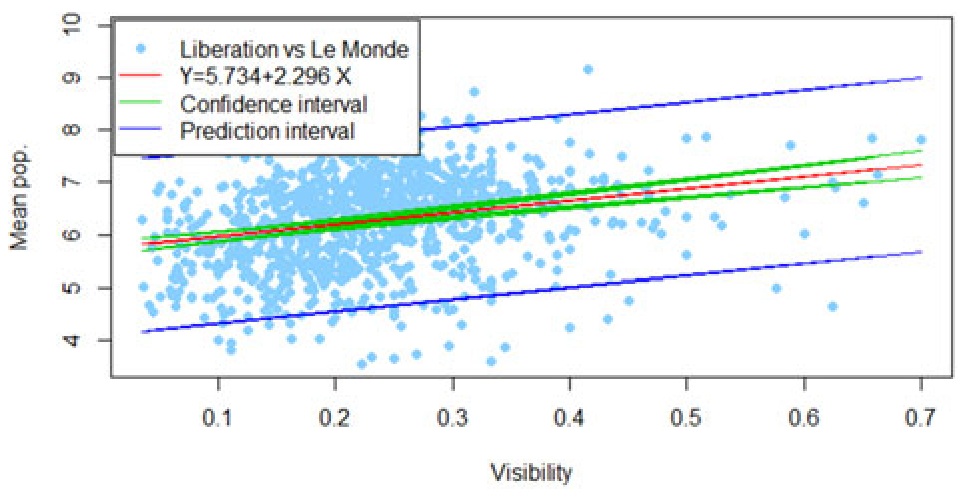 Figure 1: Conceptual overview of the information flow from sources to publishers and finally to the Social Network.
Content Active Filtering (CAF): Engineering Diversity
If the natural "equilibrium" of a network is dominated by a single loud voice, how can an administrator intervene? The authors propose Content Active Filtering.
Instead of banning users, the administrator assigns a probability to each publisher. When a publisher attempts to post, the system "accepts" it with probability . The paper provides a closed-form solution for that ensures the final resting state of the network is perfectly diverse (equal visibility).
Key Experimental Evidence
The authors used "Reverse Engineering" (Least Squares) on real-world news data to estimate influence matrices. Simulations show that without CAF, one publisher might dominate the feed; with CAF, the rates converge to a uniform distribution quickly.
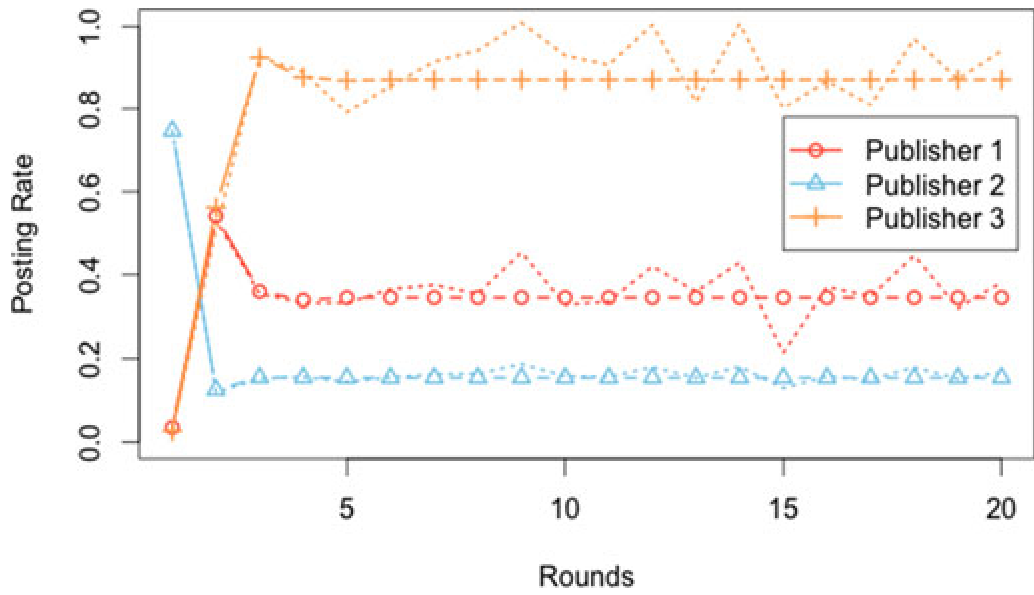 Figure 2: Convergence of the Best Response algorithm. Solid lines show perfect knowledge, while dotted lines show the algorithm's robustness under noisy observations.
Critical Analysis & Conclusion
Takeaway
The value of this work is its predictive power. By establishing that social media activity follows Martingale properties and converges to a Nash Equilibrium, platform designers can treat social engineering as a control theory problem. Diversity is no longer an abstract goal but a mathematically reachable state.
Limitations
- Linearity Assumption: The model assumes popularity is a linear function of posting rates. In reality, viral growth is often non-linear or exponential.
- Context-Blindness: The model treats all "posts" from a publisher as a monolithic rate. It doesn't yet account for the specific sentiment or topic of individual messages.
Future Outlook
As social platforms face increasing pressure to break "echo chambers," the algorithms developed here for Content Active Filtering could serve as the foundation for modern News Feed curation—moving from "engagement at all costs" to "stability through diversity."