
Steering the Social Stream: Dynamic Modeling and Active Filtering for Content Diversity
15214_Posting Behavior Dynamics and Active Filtering for Content Diversity in Social Networks.
This paper introduces a dynamical model for publisher posting behavior in social networks, accounting for positive and negative externalities between content sources. Using stochastic approximations and game theory, the authors propose an "Active Filtering" mechanism to achieve optimal content diversity across different publishers.
TL;DR
Social networks are battlegrounds for attention where one publisher’s post can cannibalize or boost another’s popularity. This paper provides a rigorous mathematical framework—blending stochastic approximations and game theory—to model these "externalities." More importantly, it offers a "Content Active Filtering" (CAF) mechanism that allows platform administrators to programmatically ensure content diversity, preventing any single voice from dominating the feed.
Motivation: The Hidden Cost of Attention
In Online Social Networks (OSNs), visibility is a zero-sum game. When Le Figaro posts more frequently, does it help or hurt the visibility of Le Monde? Current sociological models often ignore these interactions. The authors argue that because consumers have a limited attention budget, negative externalities are inevitable.
The research intuition is clear: if we can model the "influence matrix" between publishers, we can treat the social network as a dynamical system. If that system converges to an unfair state, we can apply control theory (filtering) to nudge it toward a more diverse equilibrium.
Methodology: From Dynamics to Games
The authors frame the posting behavior as a stochastic process where publishers only post content they estimate will be "popular enough."
1. The Dynamical Model
The evolution of a publisher's average posting rate is governed by a stochastic approximation: This equation acts as a noisy version of an Ordinary Differential Equation (ODE). The authors prove that under specific conditions (diagonal dominance of the influence matrix), this system converges to a unique rest point.
2. The Game Theoretic Link
A brilliant insight of this paper is proving that this organic "rest point" is actually a Nash Equilibrium. In this scenario, publishers are players maximizing a utility function: The equilibrium represents a state where no publisher has an incentive to change their posting frequency.
3. Content Active Filtering (CAF)
To solve the "echo chamber" or dominance problem, the authors introduce a control vector . The platform can choose to "accept" a post with probability . By solving for , the administrator can force the rest point of the system to satisfy the Diversity Property, where all publishers have equal representation.
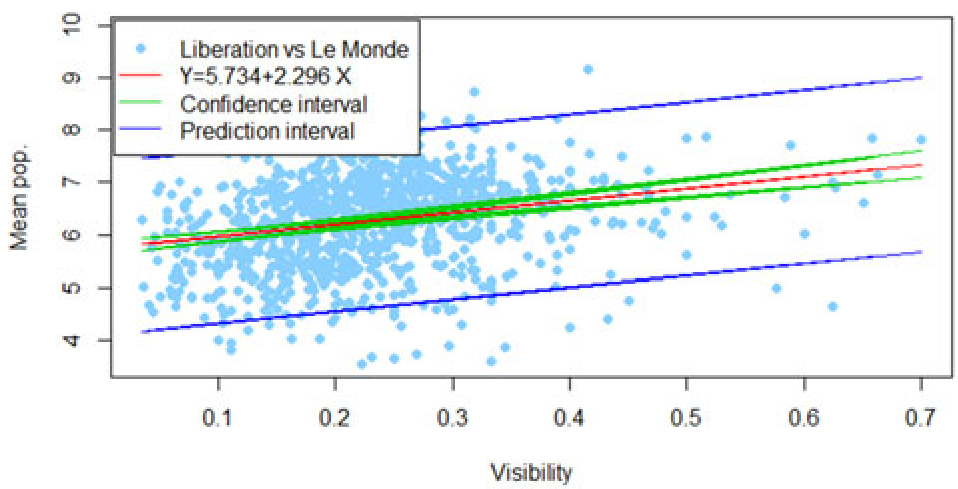 Figure: The interaction between sources, publishers, and the social network filtering layer.
Experiments: Real-World News Dynamics
The authors analyzed 52,376 messages from French news giants. Their "Reverse Engineering" method (Least Squares) revealed a tangible correlation matrix where Le Monde exhibited the highest influence on others.
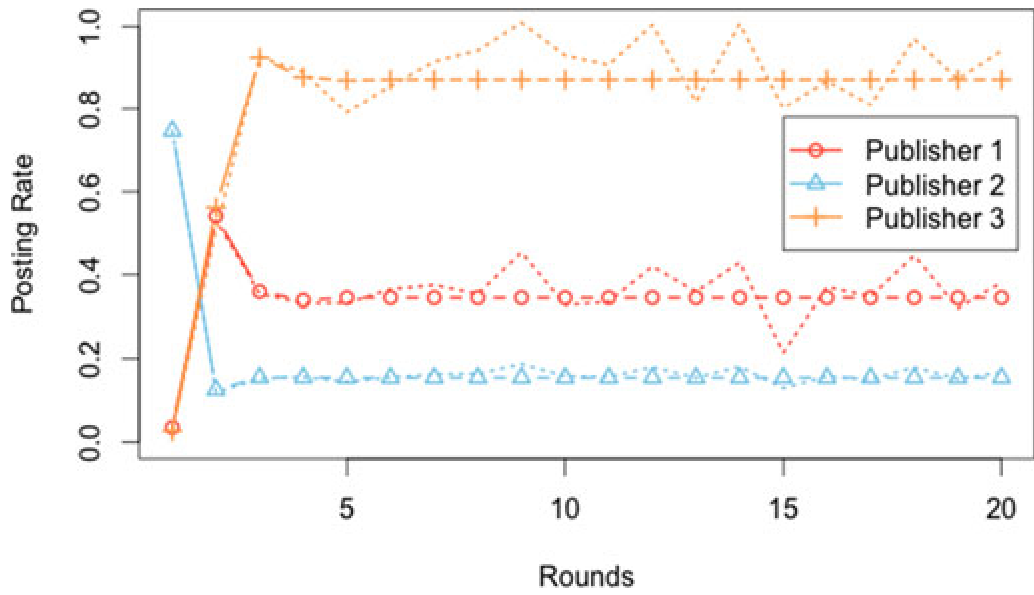 Figure 4: The Best Response algorithm converging to a Nash Equilibrium, even under noisy observations.
In simulations, applying CAF (filtering) successfully flattened the distribution. While a raw "Best Response" competition led to a skewed equilibrium (e.g., rates of 0.35 vs 0.87), the CAF-enabled system forced all publishers to converge to the same rate, effectively "democratizing" the news feed.
Critical Analysis & Conclusion
The paper provides a refreshing "hard science" look at a problem—content diversity—that is usually discussed in purely qualitative terms.
Strengths:
- Closed-form solutions: The authors don't just say diversity is possible; they provide the exact filtering probability required to reach it.
- Empirical Grounding: Using real Facebook data to seed the correlation matrices adds significant weight to the theoretical claims.
Limitations:
- Linear Assumption: The model assumes a linear relationship between posting rates and popularity, which might not hold in highly viral, non-linear social media environments.
- Homogeneous Users: It assumes the administrator wants global diversity, but doesn't account for individual user preferences (personalization).
Future Outlook: This work paves the way for "diversity-aware" recommendation engines. As platforms face increasing pressure to provide "neutral" or "fair" access to information, these control-theoretic approaches will likely replace ad-hoc heuristics in the Silicon Valley algorithm stack.