
Machine Learning for Postsilicon Debug: Breaking the Simulation Bottleneck
9743_Postsilicon Trace Signal Selection Using Machine Learning Techniques.
This paper introduces a novel signal selection framework for postsilicon validation that leverages machine learning to maximize state restoration. By replacing expensive mock simulations with a high-accuracy regression model (specifically using the Cubist algorithm), the approach identifies critical trace signals with high efficiency.
TL;DR
Postsilicon validation is the "final exam" for a chip, but limited observability makes debugging internal errors a nightmare. This paper introduces a machine learning-driven approach that uses regression models to predict which internal signals are most "informative." By replacing slow simulations with fast ML predictions, the authors achieve up to 143% improvement in state restoration while significantly slashing computation time.
The Observability Crisis in Silicon
Modern chips contain millions of flip-flops, but due to area and power constraints, only a few hundred can be "traced" (recorded) during execution. Choosing the wrong signals means that when a bug occurs, engineers cannot reconstruct the internal state of the chip, leading to costly redesigns and delayed time-to-market.
Existing solutions fall into two camps:
- Structural Heuristics: Fast but "blind" to the actual logic behavior, leading to poor reconstruction.
- Simulation-based Methods: High quality, but they require exhausting simulations that scale poorly (), making them unusable for massive industrial designs.
The Insight: Learning the Circuit’s "Restoration Function"
The authors' core breakthrough is realizing that the relationship between a set of traced signals and the resulting "Restored States" is a function that can be learned. Instead of running a full simulation for every possible combination of signals, why not train a model on a few samples and let it predict the rest?
Methodology: The Two-Step Pipeline
To handle the high dimensionality of chip signals, the authors proposed a clever hierarchical approach:
- Linear Pruning: Using Support Vector Regression (SVR) with a linear kernel to quickly discard bottom-tier signals. This narrows the field without the heavy lifting.
- Nonlinear Refinement: On the reduced set, they use the Cubist model (a rule-based regression tree). As seen in their analysis, Cubist provides a near-perfect correlation between predicted and actual restoration values.
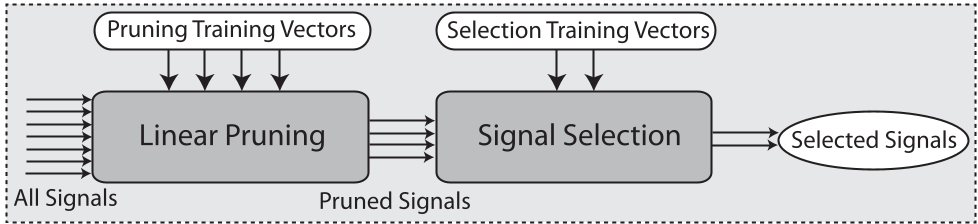 Figure 1: The two-step process utilizing linear pruning followed by nonlinear selection.
Expanding the Search Space
Because ML predictions are nearly instantaneous compared to gate-level simulations, the team could afford to be much more aggressive in their search strategy. They implemented a Compound Search-Space Exploration:
- Elimination: Starting from all signals and removing the "weakest."
- Augmentation: Starting from zero and adding the "strongest."
- Random Initial Set: A stochastic approach to escape local optima—a luxury simulation-based methods simply couldn't afford.
Experimental Results: Better, Faster, Stronger
The performance gains recorded are substantial. In benchmark s38584, the restoration ratio improved by 143.1% compared to the previous state-of-the-art.
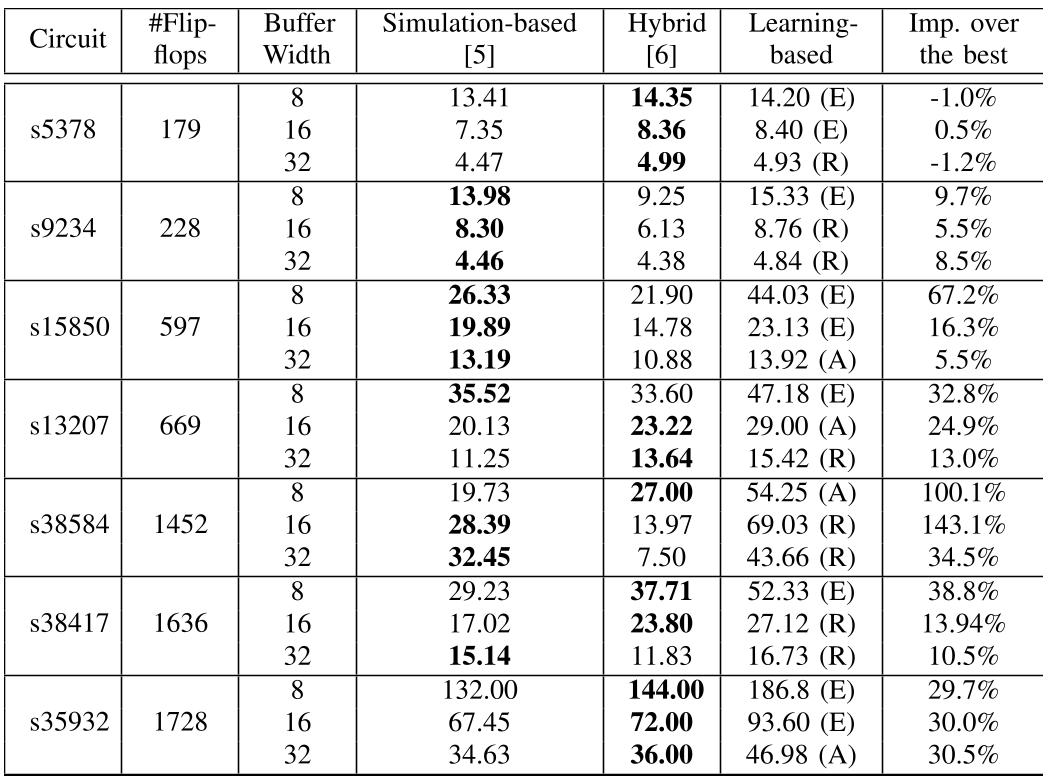 Table 1: Comparison of Restoration Ratios. The Learning-based (R) and (E) methods consistently outperform prior simulation and hybrid works.
Perhaps more importantly for industry adoption, the runtime is decoupled from the trace buffer width. In traditional hybrid models, as the buffer gets wider, the search takes longer. In this ML approach, once the model is trained, finding 8 signals or 32 signals takes virtually the same amount of time.
Critical Perspective & Takeaway
This work marks a significant shift in EDA (Electronic Design Automation) from purely deterministic or structural algorithms toward behavioral modeling through ML.
Limitations: The quality of the "Mock Simulations" used for training is critical. If the test vectors are not representative of real-world silicon workloads, the ML model might learn an inaccurate restoration function (Out-of-Distribution problem).
Future Outlook: As we move toward AI-designed hardware, using ML to optimize the validation of that hardware is the logical next step. This methodology could likely be extended to hardware security, identifying signals that are most prone to leaking information.
Final Summary: By treating hardware debug as a feature selection problem, the authors have turned a computational bottleneck into a scalable, high-performance predictive task.