
The Fun-House Mirror: Why Online Data Distorts Social Reality
Potential networks, contagious communities, and understanding social network structure
The paper introduces the concept of "Contagious Networks" to describe online social platforms that grow via technology adoption cascades over underlying social structures. Using the "Potential Networks" framework, the author demonstrates that cascades can catalyze "fun-house mirror" distortions, making the resulting network appear to have heavy-tailed distributions and shrinking diameters even when the underlying social network does not.
TL;DR
Is Facebook a literal map of human friendship, or a distorted reflection? This seminal paper by Grant Schoenebeck argues the latter. By modeling online networks as Contagious Networks—structures that grow like a virus—the author proves that the "weird" mathematical properties of the internet (like power-law degrees and shrinking diameters) can emerge from perfectly normal, regular social structures.
Background Positioning
In the hierarchy of network science, this work serves as a critical "sanity check." While many researchers were rushing to claim that human society follows "Power Laws," Schoenebeck used a PhD-level theoretical lens to suggest we might just be seeing Sampling Bias in action.
Problem: The Mirage of Digital Data
Sociologists have long studied "Trust Networks" and "Friendship Networks," which usually feature high clustering but lack the extreme "hubs" found in the digital world. When Web 2.0 arrived, data from Twitter and LiveJournal showed something different:
- Heavy-tailed degree distributions (a few people have millions of followers).
- Shrinking diameters (the world seems to get smaller as the network grows).
- Missing Communities: A strange "core-whisker" structure where large, tight-knit communities are surprisingly absent.
The author asks: Are we different people online, or is the way we join these sites distorting the data?
Methodology: The Potential Networks Framework
The paper proposes a two-phase model called Potential Networks.
- The Potential Network: An underlying, often unobservable social structure (e.g., a Watts-Strogatz small-world model).
- The Behavioral Network: The observable online network, created by a "contagion" spreading over the potential network.
The author simulated several transmission models, most notably Random Edge Transmission (RET). In this model, an infection (technology adoption) moves across a graph. If you are "infected" (join the site), you are likely to "infect" your neighbors.
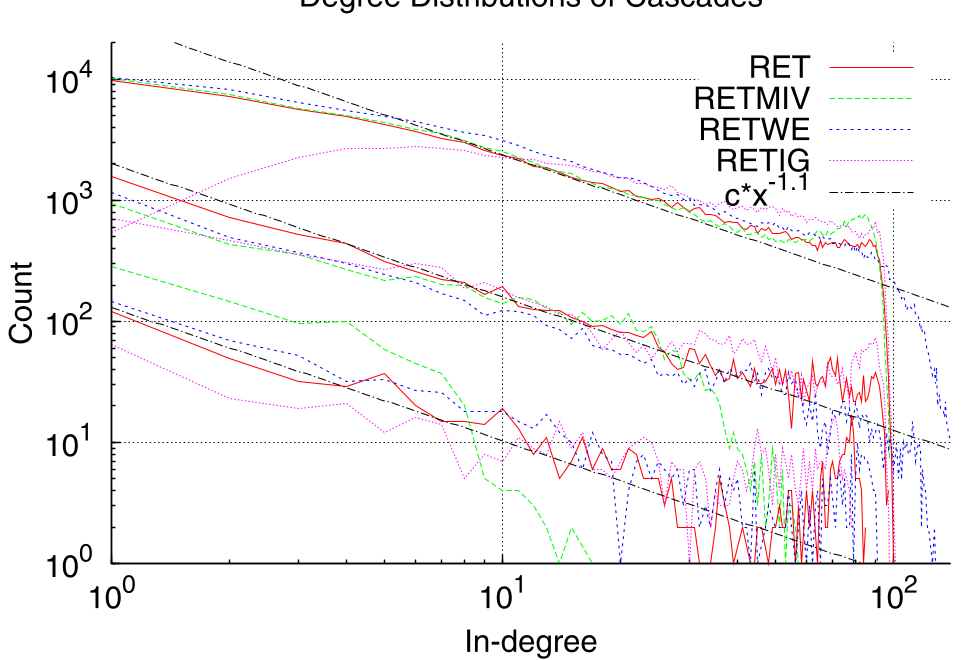 Figure 1: Comparison of the original Watts-Strogatz graph vs. the resulting heavy-tailed distribution of the contagious network.
Why It Works: The Yule Process Intuition
The "How" is the most brilliant part of the paper. Schoenebeck explains that when a cascade spreads, it behaves like a Yule Process.
- When a virus moves locally within a "clique" (strong ties), it fills in the degree of local nodes.
- When it jumps via a "shortcut" (weak ties) to a new part of the graph, it's like starting a new "genus."
Mathematically, this leads to a power-law distribution even if the original graph was entirely regular! The "hubs" we see in online data aren't necessarily "super-popular" people in real life; they are simply the nodes that happened to be at the center of a local adoption explosion.
Results: Replicating the "Internet"
The simulations successfully replicated four major properties of real-world contagious networks using "boring" underlying graphs:
- Densification: The average degree increased over time (Figure 3 in paper).
- Shrinking Diameter: The distance between nodes dropped as the cascade reached a critical mass.
- Community Profile: The "Core-Whisker" structure matched the data from over 70 real-world datasets like Epinions and LinkedIn.
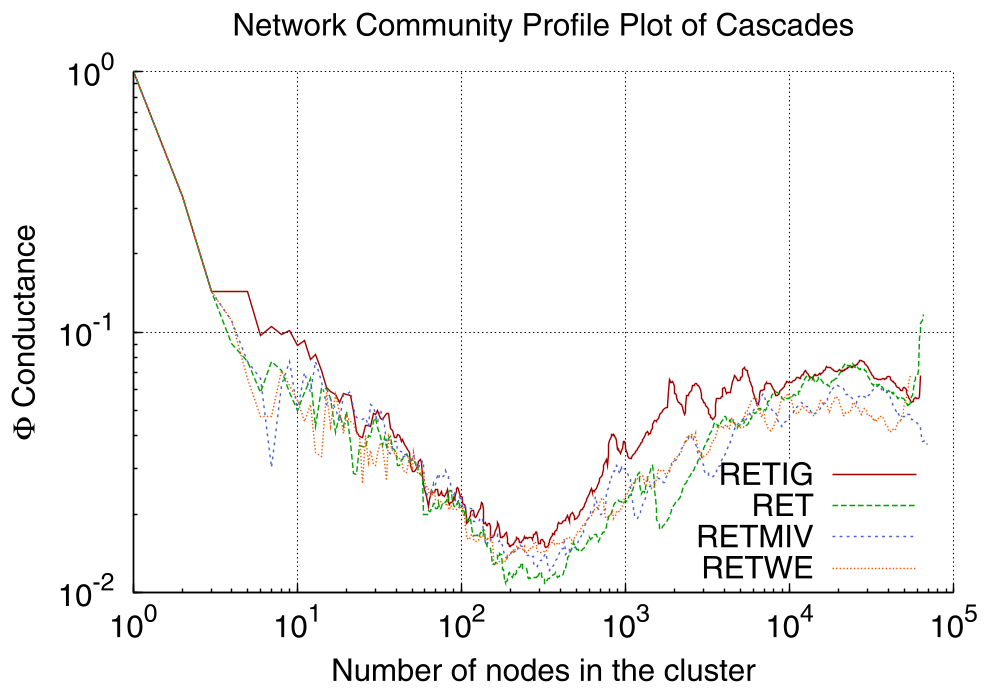 Figure 2: The Network Community Profile showing how the cascade creates the signature "core-whisker" dip found in real social media data.
Critical Analysis & Conclusion
Takeaway
This paper is a cautionary tale for data scientists. It suggests that many "Universal Laws" of social networks might actually just be "Universal Laws of Cascades." If you want to understand the true social fabric, you cannot just look at the pixels; you have to account for the lens.
Limitations
The models are "stylized" (simplified). In reality, users might join a network via advertising (non-social) or lose interest over time, which this model doesn't fully capture.
Future Outlook
The "Potential Networks" framework opens a door for Inverse Network Engineering: Can we write an algorithm that "un-distorts" the fun-house mirror to see the real social network underneath? That remains one of the most exciting open questions in computational sociology.