
Green Social Streaming: The Power Efficiency of Soft Deadlines in Wireless Community Clouds
Power-efficient collaborative distribution of social videos over wireless community cloud
This paper investigates the collaborative distribution of social videos in Wireless Community Clouds to minimize the total power consumption of participants. The authors propose an optimal online power allocation strategy leveraging a Markovian system model and a novel "soft deadline" threshold to balance user Quality of Service (QoS) with energy efficiency.
TL;DR
Researchers from Sun Yat-Sen University and NTU Singapore have addressed the high energy cost of social video distribution. By replacing "hard" playback deadlines with a probabilistic "soft deadline" model, they derived a strategy that reduces total power consumption while maintaining user experience. Their findings show that even a slight relaxation of delivery certainty can lead to massive energy savings (over 50%).
Background: The Rise of the Wireless Community Cloud
Social video content differs from traditional VOD; it spreads rapidly and is often consumed via mobile devices and local gateways. A Wireless Community Cloud utilizes the shared resources (storage and bandwidth) of participants (like STBs or gateways) to deliver content without massive centralized infrastructure investment. However, these participants are often energy-constrained, making power allocation the central bottleneck for sustainable scaling.
The Problem: The Hard-Deadline Trap
In standard video transmission, a packet is either "on time" or "expired" (Hard Deadline). Mathematically, optimizing power under these binary constraints is notoriously difficult, often resulting in sub-optimal, heuristic-based "best effort" solutions. The authors argue that since human perception of video quality is inherently subjective, we can model QoS as a probability—the Soft Deadline Threshold ().
Methodology: Markovian Modeling & Power Homogeneity
The authors treat the video delivery process as a synchronous, parallel multi-path operation.
1. Markovian State Transition
The system state is defined by the playback buffer occupancy and the transmission queue status. The model accounts for:
- Re-buffering (S-1): When the buffer is empty.
- Steady State (Sk): When the buffer has sufficient segments.
2. The Power Policy
Under an ON/OFF channel model (where channels are either good or blocked), the authors mathematically prove that the Optimal Power Allocation Strategy is homogeneous. This means that to minimize total energy, packets should be distributed equally across parallel paths, and contributors should use a consistent power level across states.
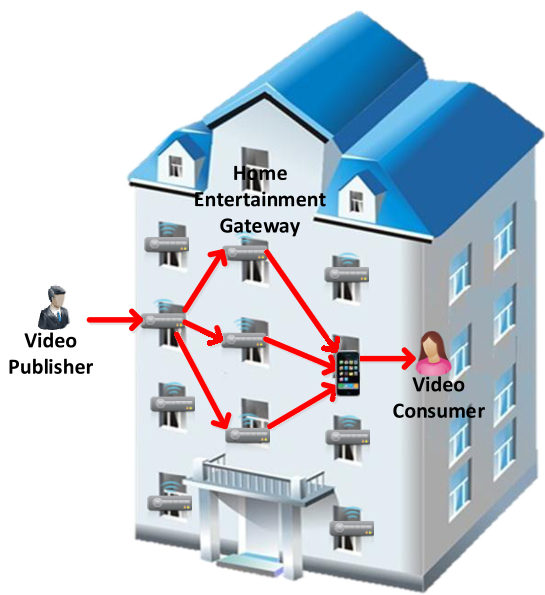 Figure 1: The architecture of a Wireless Community Cloud where participants collaborate to stream segments.
Experimental Analysis: The "Convex" Reality
The numerical evaluations produced three critical insights for the future of green networking:
- The High Cost of Perfection: As the soft deadline threshold approaches 1 (equivalent to a hard deadline), the power required scales convexly.
- The Multi-path Trade-off: Increasing the number of parallel paths () lowers the power consumption for any individual device (prolonging battery life for your neighbor’s STB) but increases the total power consumption of the network due to synchronization overhead and lower efficiency at the margin.
- Channel Dominance: In environments with strong signal (High ), the choice of soft deadline has a much larger impact on energy savings than simply adding more paths.
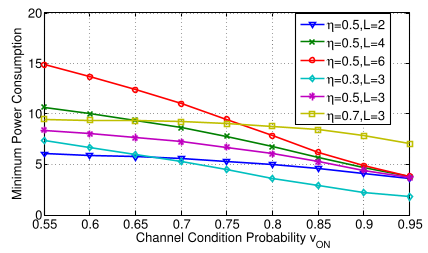 Figure 2: Power consumption vs. Soft Deadline Threshold (a) and Channel Condition (b).
Critical Insight & Conclusion
The study’s closed-form solution, , provides a deterministic way for community clouds to manage resources.
The Takeaway: For system architects, the message is clear—implementing "aggressive" re-buffering logic for every segment is an energy disaster. By allowing a small, calculated probability of delay (), community clouds can operate at significantly higher efficiency.
Limitations: The current model relies on a simplified ON/OFF channel assumption. Future work must address more complex fading models (like Rayleigh or Rician) and asynchronous packet delivery to make this strategy viable for highly dynamic mobile environments.