
Beyond Connectivity: Influence Games as a New Frontier for Social Centrality
Power Indices of Influence Games and New Centrality Measures for Agent Societies and Social Networks
The paper introduces four game-theoretic centrality measures for social network analysis: the classical Banzhaf and Shapley-Shubik power indices, along with two novel measures, Effort and Satisfaction. These measures are derived from "Influence Games," a framework that models social influence as a spread process within a simple coalitional game.
TL;DR
This research redefines how we measure "importance" in a social network. Instead of just looking at who has the most friends or who sits on the most paths, the authors use Influence Games and Power Indices (Banzhaf and Shapley-Shubik) to identify actors who are essential for building majority-winning coalitions. They also introduce Effort and Satisfaction as two new metrics that capture the cost and psychological alignment of social influence.
The Problem: The Blind Spots of Traditional Centrality
Standard metrics like Degree, Closeness, and Betweenness have been the bread and butter of Social Network Analysis (SNA) for decades. However, they share a common structural bias: they are largely "geometry-based."
- Degree only sees immediate neighbors.
- Betweenness assumes influence only travels along shortest paths.
- Closeness assumes everyone is equally easy to influence.
In real-world "Agent Societies," influence is collaborative and threshold-based. You might not be a "hub," but you might be the "swing vote" that allows a group to reach a majority decision. Traditional metrics often fail to capture this strategic "kingmaker" status.
Methodology: Social Influence as a Voting Game
The researchers bridge the gap between sociology and Cooperative Game Theory. They transform a social network into an Influence Game , where:
- Weight (): The strength of ties.
- Label (): The resistance/threshold of each actor to being influenced.
- Quota (): The number of people who need to be convinced for a "win."
1. The Power Indices
- Banzhaf Index (Bz): Measures how often an actor is a "critical" member of a winning coalition (i.e., if they leave, the coalition loses).
- Shapley-Shubik (SS): Similar to Banzhaf but considers the order in which actors join a coalition, providing a different probabilistic weight to influence.
2. The Newcomers: Effort and Satisfaction
- Effort Centrality (): Measures the minimum "social cost" () required to form a winning coalition containing a specific actor. A central actor should make winning "easier."
- Satisfaction Centrality (): Measures how often an actor's presence in or absence from a coalition aligns with the "winning" or "losing" outcome.
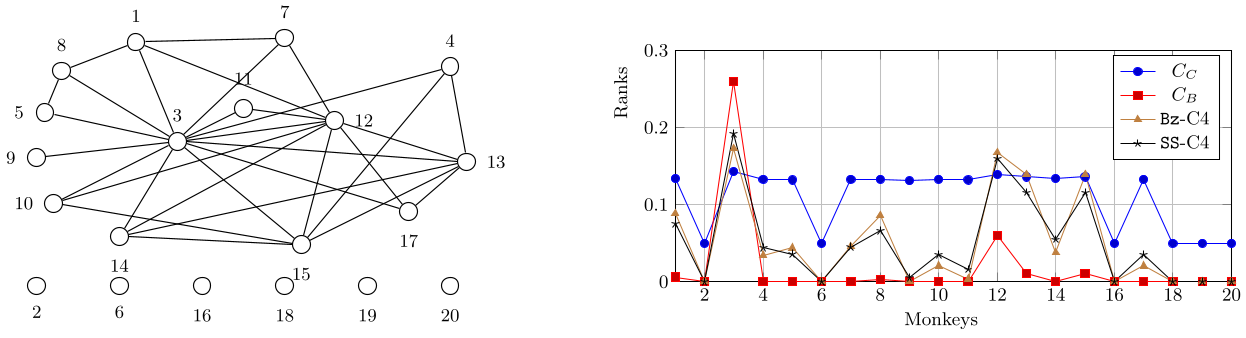 Figure 1: Comparison between the raw interaction graph (left) and the influence-weighted graph (right).
Experimental Analysis: Monkeys, Girls, and Politicians
The authors tested their measures across three distinct social contexts. The most revealing results came from the Student Government network.
In this network, a member's position (Advisor, Minister, Prime Minister) determined their resistance to influence.
- Traditional Failures: Node 10 (an advisor) had the highest Closeness but the lowest Betweenness.
- Strategic Insights: When analyzed as an Influence Game, nodes 1, 3, and 10 showed high Banzhaf and Shapley-Shubik scores. Even though they weren't "gatekeepers" of information flow (Betweenness), they were mathematically essential for forming any coalition capable of hitting the influence quota.
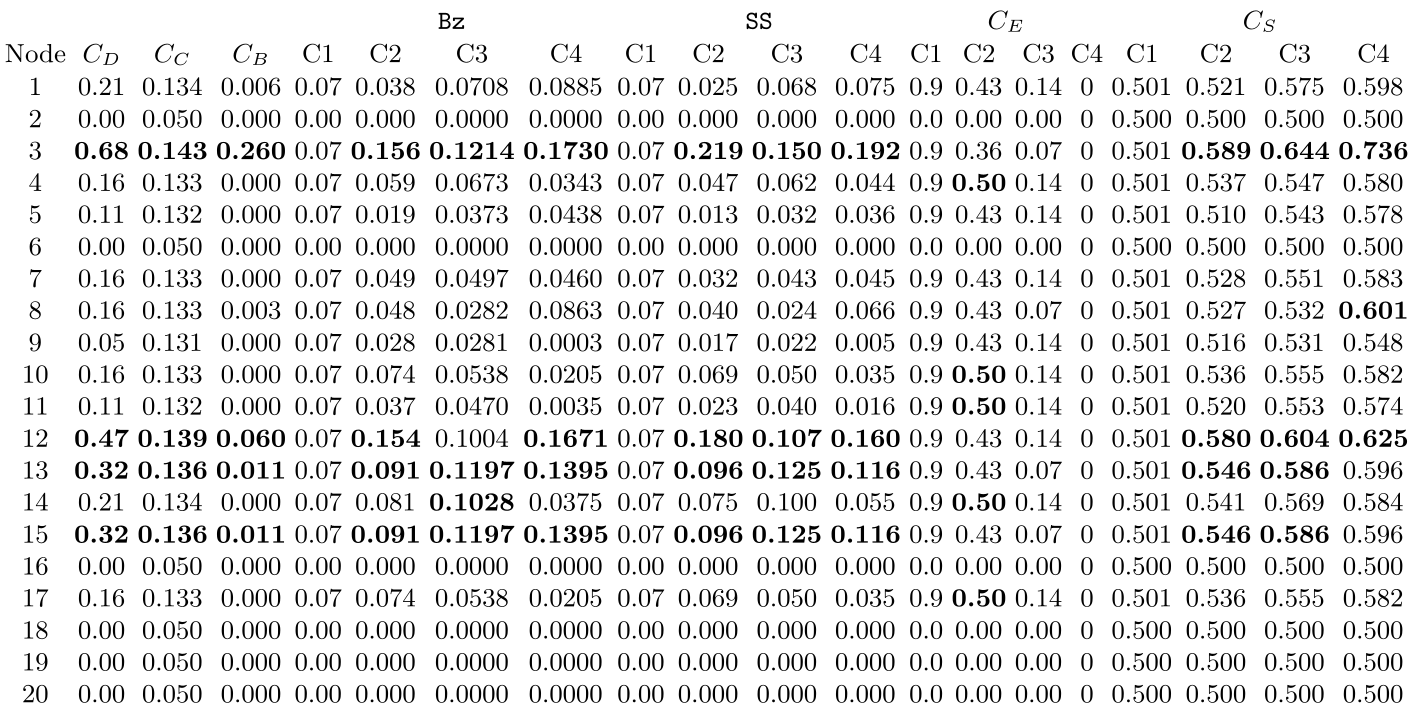 Table 1: Detailed comparison of traditional vs. power-based centralities. Notice how SS and Bz provide unique rankings as the labeling functions (C1-C4) become more complex.
Critical Insight: Why Does This Matter?
The most profound takeaway is the sensitivity to context. By adjusting the "labels" () and the "quota" (), the Influence Game model can simulate different social climates:
- Low Quota/Low resistance: The network acts like a rumor mill; everyone has equal power.
- High Quota/High resistance: The network acts like a rigid bureaucracy; only a few "power players" can satisfy the game.
Standard measures are static; they give the same answer regardless of whether you are trying to spread a meme or pass a law. The Influence Game approach is dynamic.
Conclusion & Limitations
This work marks a successful first step in applying power indices to general social networks. However, the computational complexity of calculating Shapley and Banzhaf values is notoriously high (NP-hard in some game representations). Future work will likely need to focus on approximation algorithms for larger "Big Data" social networks.
The Takeaway: If you want to know who is actually "in charge" of a decision, stop looking at their follower count and start looking at their Power Index.