
NETTIDE: Moving Beyond Sigmoids to Decipher the Power-Law Growth of Giant Social Networks
On Power Law Growth of Social Networks
The paper introduces NETTIDE, a novel parsimonious framework that characterizes the growth dynamics of both nodes and links in social networks using a "fizzling" power-law pattern. Validated on massive datasets like WeChat (300M nodes), it significantly outperforms traditional Sigmoid-based models (Bass, SI) in long-term forecasting.
TL;DR
Why do textbook models fail to predict the growth of giants like Facebook or WeChat? This paper reveals that social networks don't grow exponentially—they grow according to Power Laws. By introducing the NETTIDE model, which features a "fizzling" temporal decay, the authors provide a unified framework to predict both node and link growth with unprecedented accuracy (97% accuracy over a 2-year horizon).
The "Exponential" Fallacy
For decades, the standard for modeling growth has been the Sigmoid curve (from the Bass or SI models). These models assume an early exponential explosion. However, when looking at the inception of WeChat or the evolution of arXiv, the data simply doesn't fit.
The authors argue that human enthusiasm is not constant; it "fizzles." Whether it's the "forgetting nature" of humans or the diminishing novelty of a platform, the rate at which we invite friends or create links decays. When this decay follows a power law, the resulting cumulative growth shifts from a Sigmoid to a Log-Logistic or Stretched-Exponential pattern.
Methodology: The Fizzling Engine
The core of NETTIDE lies in a parsimonious differential equation. Unlike previous models that assume a constant infection rate , NETTIDE introduces a temporal fizzling exponent .
1. NETTIDE-Node
The growth of nodes is defined by: As increases, the term slows down the growth. If , the model perfectly approximates Power-Law growth—a phenomenon the authors observed in WeChat's 300 million users.
2. NETTIDE-Link: The First of Its Kind
While node growth is well-studied, link growth (how friendships form) was a black box. The authors propose that links grow through a combination of external arrivals (new users) and internal densification (existing users finding each other).
 Table 1: Only NETTIDE captures all dimensions, including the elusive link growth differential equations.
Experimental Results: Predicting the Future
The most striking achievement of NETTIDE is its forecasting power.
- Long-Term Accuracy: On WeChat data, the model was trained on the first period and asked to predict two years into the future. It hit the mark with a 3% error rate, while traditional models like SI were off by over 130%.
- Versatility: The model successfully captured the dynamics of:
- WeChat: (Social) , massive power-law growth.
- ArXiv: (Co-authorship) Faster fizzling due to academic cycles.
- Enron: (Enterprise) High fizzling reflecting organizational constraints and eventual bankruptcy.
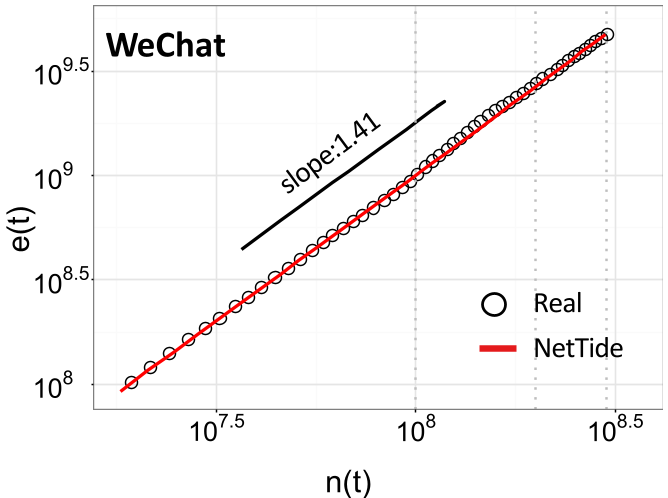 Figure 1: NETTIDE's fit (red/blue lines) against real-world data (dots) across different types of networks.
Stochastic Generators: From Macro to Micro
The authors didn't just stop at equations; they provided two generators:
- NETTIDE-Survival: Uses hazard rates to simulate when a node will "succumb" and join the network.
- NETTIDE-Process: Simulates micro-level interactions between individuals to see if aggregate behaviors emerge that match the differential equations.
Both generators reproduced realistic power-law exponents (e.g., ~2.15 for nodes and ~3.0 for links in the WeChat simulation), proving that the macro-level "fizzling" is a robust property of micro-level social interactions.
Critical Insight & Conclusion
The true value of this work lies in the (fizzling exponent). It provides a single "knob" to describe the health and momentum of a network. A low suggests a viral product with lasting appeal, while a high indicates a "flash in the pan" that saturates quickly.
Limitations: The model assumes a closed system. It does not account for external "shocks" (like a massive marketing campaign or a new competitor). However, as a baseline for intrinsic social dynamics, NETTIDE is the new state-of-the-art for anyone looking to predict how digital populations evolve.
Takeaway: If you are modeling growth, stop using Sigmoids. The data says humans fizzle, and your model should too.