
NETTIDE: Cracking the Code of Power-Law Growth in Modern Social Networks
On Power Law Growth of Social Networks
This paper introduces NETTIDE, a unified framework for modeling the growth dynamics of nodes and links in social networks. By analyzing massive real-world data like WeChat (300M nodes), the authors demonstrate that network growth follows a Power-Law pattern rather than the traditional Sigmoid/exponential curves, achieving SOTA forecasting accuracy with error rates as low as 3%.
TL;DR
Forget the textbook Sigmoid curves. By analyzing WeChat's massive evolution, researchers have discovered that social networks actually grow according to a Power-Law, not exponentially. They proposed NETTIDE, a parsimonious model that uses a "temporal fizzling" mechanism to predict node and link growth with unprecedented accuracy—forecasting two years ahead with just a 3% error rate.
Executive Summary
How many users will a platform have in two years? Traditional models like the Bass model or SI (Susceptible-Infected) model suggest an initial exponential explosion. However, real-world data from giants like WeChat tells a different story. This paper identifies a fundamental "fizzling" of human enthusiasm that slows growth into a power-law pattern. NETTIDE provides the first unified differential equations to handle both node population and the complex "densification" of internal links.
The "Exponential" Fallacy and Growth Realities
Most growth models are built on the intuition of contagion: one person infects two, two infect four, and so on. This leads to Sigmoid curves. In the early stages of a social network, these models predict a straight line on a log-linear scale.
The Problem: Real data from WeChat (300 million nodes) and arXiv shows a straight line on a log-log scale, signifying Power-Law growth. The missing ingredient in previous models was the "human factor"—specifically, the fact that enthusiasm for "infecting" others (inviting friends) decays over time.
Methodology: The Power of Temporal Fizzling
The heart of the NETTIDE model is the "fizzling exponent" (). The authors modify the standard population growth equation by adding a time-decaying rate:
1. NETTIDE-Node
By setting , the model approximates a Log-Logistic distribution, which perfectly mimics the power-law growth observed in the early-to-mid stages of a product's lifecycle.
2. NETTIDE-Link
This is the first-ever differential equation for link growth. It accounts for:
- External Links: New nodes bringing initial connections.
- Internal Links: Existing nodes forming new bonds (Densification), constrained by an underlying "organizational structure" ().
 Figure 1: Comparison of WeChat growth (Power-Law) vs. traditional models (Sigmoid).
Experimental Results: Predicting the Unpredictable
The researchers tested NETTIDE against four diverse datasets: WeChat (Online), arXiv (Co-authorship), Enron (Enterprise), and Weibo (Cascades).
SOTA Comparison
NETTIDE consistently outperformed baselines like SpikeM and PhoenixR. On WeChat, the cumulative error was less than 1%, while traditional models exhibited errors up to 10 times larger.
Long-Term Forecasting
Perhaps the most "academic-to-industry" contribution is the model's forecasting power. When trained on the early stages of WeChat, NETTIDE predicted the user count 730 days in the future with only 3% error. Traditional SI models, by contrast, failed to account for "fizzling" and overestimated growth by over 300%.
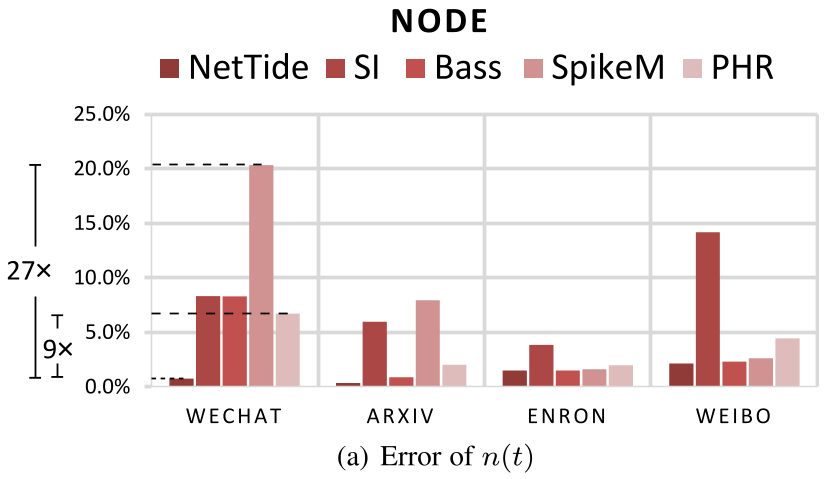 Figure 2: NETTIDE's ability to forecast node (a, b) and link (c, d) growth up to two years ahead.
Micro-Level Generators
To prove the model wasn't just "curve fitting," the authors developed two stochastic generators:
- NETTIDE-Survival: Uses hazard rates to determine when a specific individual joins.
- NETTIDE-Process: Simulates pairwise interactions at the micro-level. Both generators successfully reproduced the macro-level power-law dynamics observed in real social networks.
Critical Insights & Conclusion
Takeaways:
- Growth is not infinite: The saturation ceiling () and the decay rate () are the two most critical parameters for social platform longevity.
- Links grow faster than nodes: The model captures the "densification" phenomenon, where the number of connections grows super-linearly relative to the number of users.
Limitations:
The model assumes a closed system. It does not currently account for external shocks (e.g., a massive marketing campaign or a rival platform launching), which could temporarily "reset" the fizzling exponent.
Future Outlook: NETTIDE establishes a new baseline for "Network Science." It moves the field beyond simple topology and into the realm of rigorous, predictive temporal dynamics. For product managers and data scientists, it provides a mathematical toolkit to distinguish between a sustainable growth path and an unsustainable "bubble" trajectory.