
The Power of Tags: Decoding Social Popularity across Space and Time
Power of Tags: Predicting Popularity of Social Media in Geo-Spatial and Temporal Contexts
The paper introduces a spatial and temporal analysis of social media popularity using the DF-W (Document Frequency - Weights from Regression) algorithm. Applied to the massive YFCC100M dataset, it identifies which annotated tags most significantly influence engagement (views) across different geographic regions and time periods.
TL;DR
Why do some photos go viral while others remain unnoticed? This research demonstrates that the secret lies in contextual tagging. By analyzing 100 million Flickr posts, the authors reveal that the "value" of a tag changes based on geography and time. Using the novel DF-W algorithm, they prove that localized and time-aware models significantly outperfrom "one-size-fits-all" popularity predictors.
Background: Beyond the Image
While computer vision researchers often focus on the pixels, this paper argues that text annotations (tags) are more accessible and often more influential indicators of social popularity. However, a tag like "#sunset" doesn't carry the same weight in 2009 as it does in 2024, nor does it have the same impact in Tokyo as it does in Paris.
Methodology: The DF-W Algorithm
The core of this research is the DF-W (Document Frequency - Weights from Regression) algorithm.
Why not TF-IDF?
Traditional TF-IDF fails for social tags because:
- TF is always 1: A tag usually appears only once per post.
- IDF is sparse: Most tags are too rare to provide meaningful global statistics.
The DF-W Solution
The authors train a Support Vector Regression (SVR) model where the target is the popularity score (views/comments). The weight assigned to each tag by the SVR represents its predictive power. The final importance score is defined as: This formula ensures that the most influential tags are both widely used () and statistically significant ().

Spatial Analysis: Cultural Fingerprints
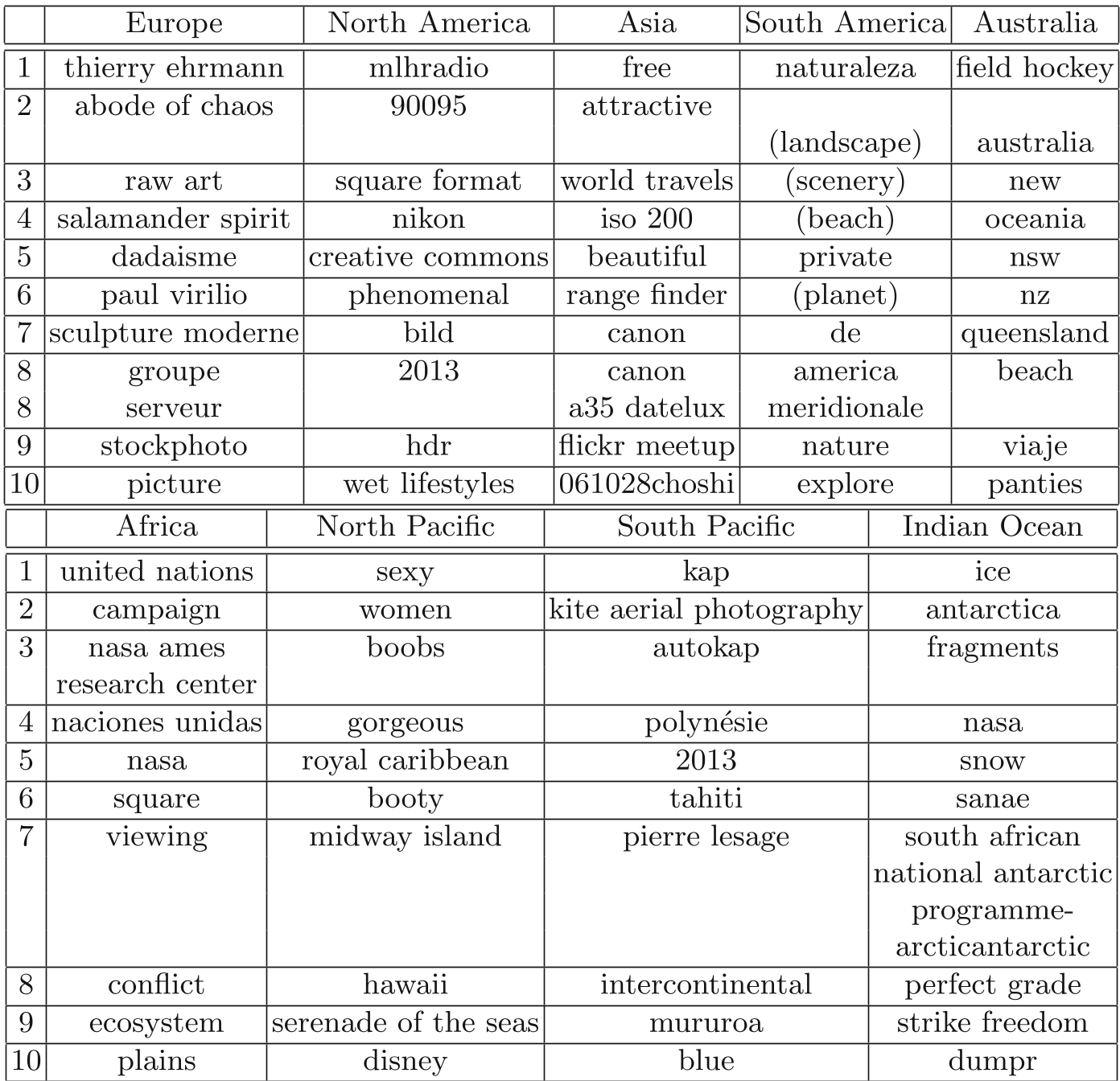
By clustering geotagged data into nine world regions, the study found distinct cultural focuses:
- Europe: High focus on "art" and specific artists (e.g., abode of chaos).
- North America/Asia: Heavy emphasis on photography gear and tech (e.g., nikon, hdr, range finder).
- South America: Driven by nature and travel (e.g., landscape, explore).
The research highlights that localized models achieve higher Pearson correlation coefficients than global models, proving that popularity is a regional phenomenon.
Temporal Evolution: Riding the Trend Waves
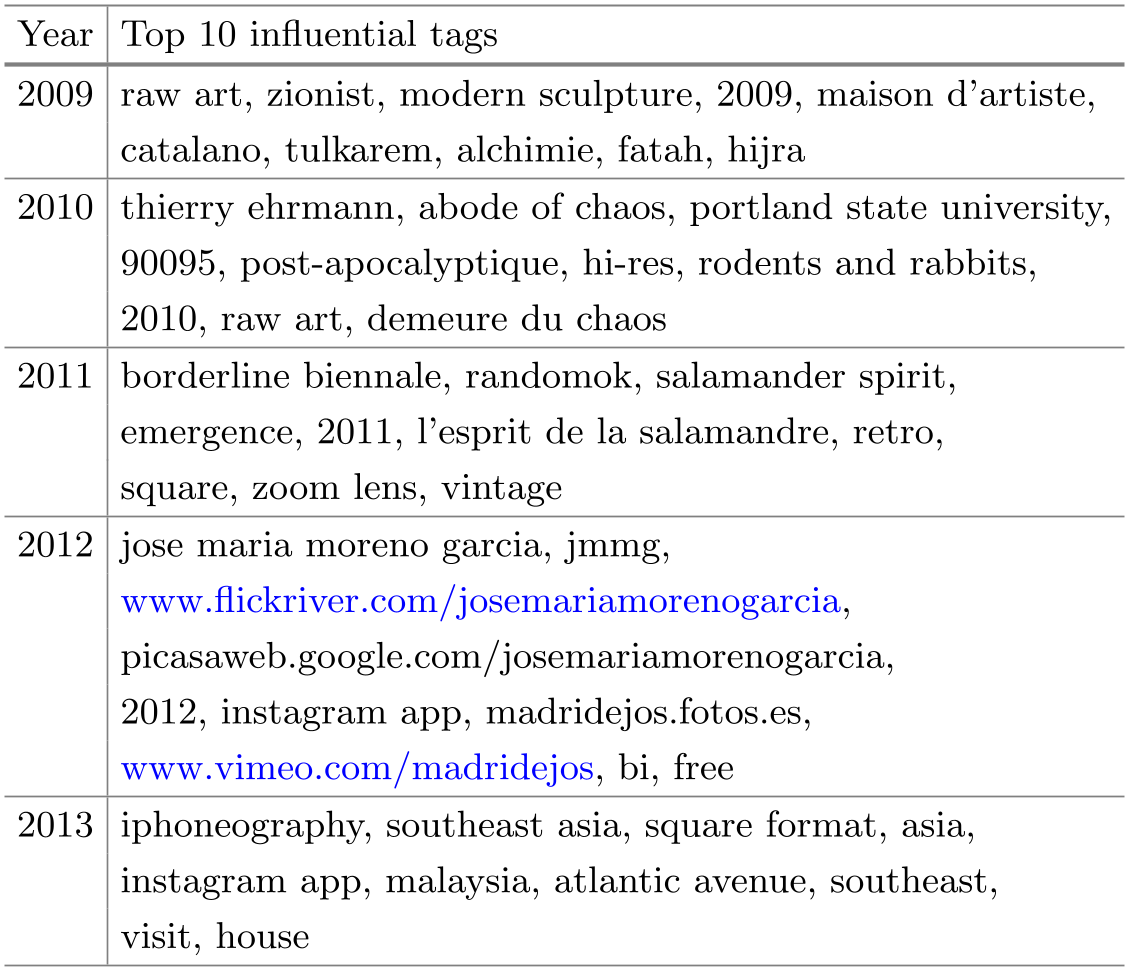
The longitudinal study from 2009 to 2013 captured the "rise and fall" of social trends:
- Technology Shifts: "High resolution" was a top-tier tag in 2009 but vanished by 2012 as HD became standard.
- Platform Emergence: Tags like "instagram app" and "iphoneography" spiked in 2011-2012, mirroring the real-world growth of mobile photography.
- Cyclical Trends: Tags like "winter" and "explore" show predictable bi-annual peaks corresponding to holiday seasons in different hemispheres.
Deep Insight & Conclusion
The significance of this work lies in its simplicity and scalability. By moving away from heavy visual processing and focusing on the "folksonomy" (social tagging), the authors provide a lightweight framework for recommendation systems.
Takeaway for Practitioners: If you are building a content discovery engine, you cannot rely on stagnant tag weights. Your algorithm must "breathe" with the tempo of global events and adapt to the specific geographic dialect of your users.
Limitations: The study primarily measures "views," which can be influenced by platform algorithms (feedback loops). Future iterations would benefit from including visual aesthetics to see how "good" photos interact with "good" tags.