
The Power of Random Neighbors: A Mathematical Deep Dive into the Friendship Paradox
The Power of Random Neighbors in Social Networks
The paper provides a rigorous mathematical characterization of the "Friendship Paradox" in social networks using power-law graph models. It proves that for networks with power-law exponents , a polylogarithmic sample of nodes is sufficient to observe an asymptotic gap between the average degree of nodes and their neighbors, achieving significant improvements in tasks like influence maximization.
TL;DR
The "Friendship Paradox" suggests that on average, your friends have more friends than you do. While intuitively simple, this paper provides the first rigorous proof of why this happens in social networks. By modeling networks as re-wired power-law graphs, the authors demonstrate that you don't need to see the whole graph to find influential people—sampling just a few random nodes and looking at their neighbors is enough to find the "hubs."
Beyond the Intuition: Why Feld's Proof Wasn't Enough
Sociologist Scott Feld famously noted that the average degree of a neighbor in any graph is at least as large as the average degree of the nodes. However, this is a global average. In a regular graph (where everyone has the same degree), the "paradox" doesn't exist. Furthermore, you can build "misbehaved" power-law graphs (as shown below) where the paradox fails because nodes only connect to others with the exact same degree.
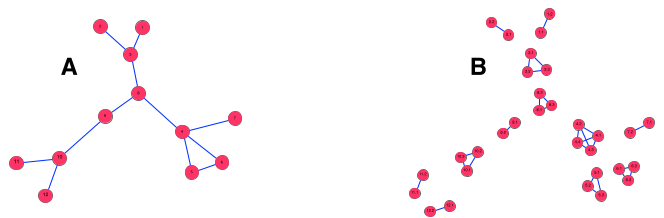 In the right-hand network, despite a power-law distribution, every node has the same degree as its neighbor, neutralizing the paradox.
The researchers realized that for the paradox to hold in a way that is useful for algorithms, we need a model that accounts for the "noisy" nature of social connections—specifically, the presence of random, long-range links.
The Methodology: Re-wiring and Phase Transitions
The authors analyze a model where a power-law graph (with exponent ) has its edges re-wired with a probability . This introduces the necessary randomness to break artificial structures.
The Threshold
The study reveals a fascinating phase transition based on the power-law parameter :
- : A single random node is sufficient. Its random neighbor will have an asymptotically higher degree with constant probability.
- : A single node isn't enough. However, a polylogarithmic sample (e.g., nodes) is guaranteed to contain nodes whose neighbors are significantly more influential than the nodes themselves.
This is a critical insight for data scientists: the heavier the tail (lower ), the easier it is to find "super-spreaders" just by asking a random person who their friends are.
Experimental Proof: From YouTube to Enron
The authors tested their theory on eight massive datasets. The results were striking. In the YouTube network, the average degree of a node's neighbor was 150 times higher than the node's own degree.
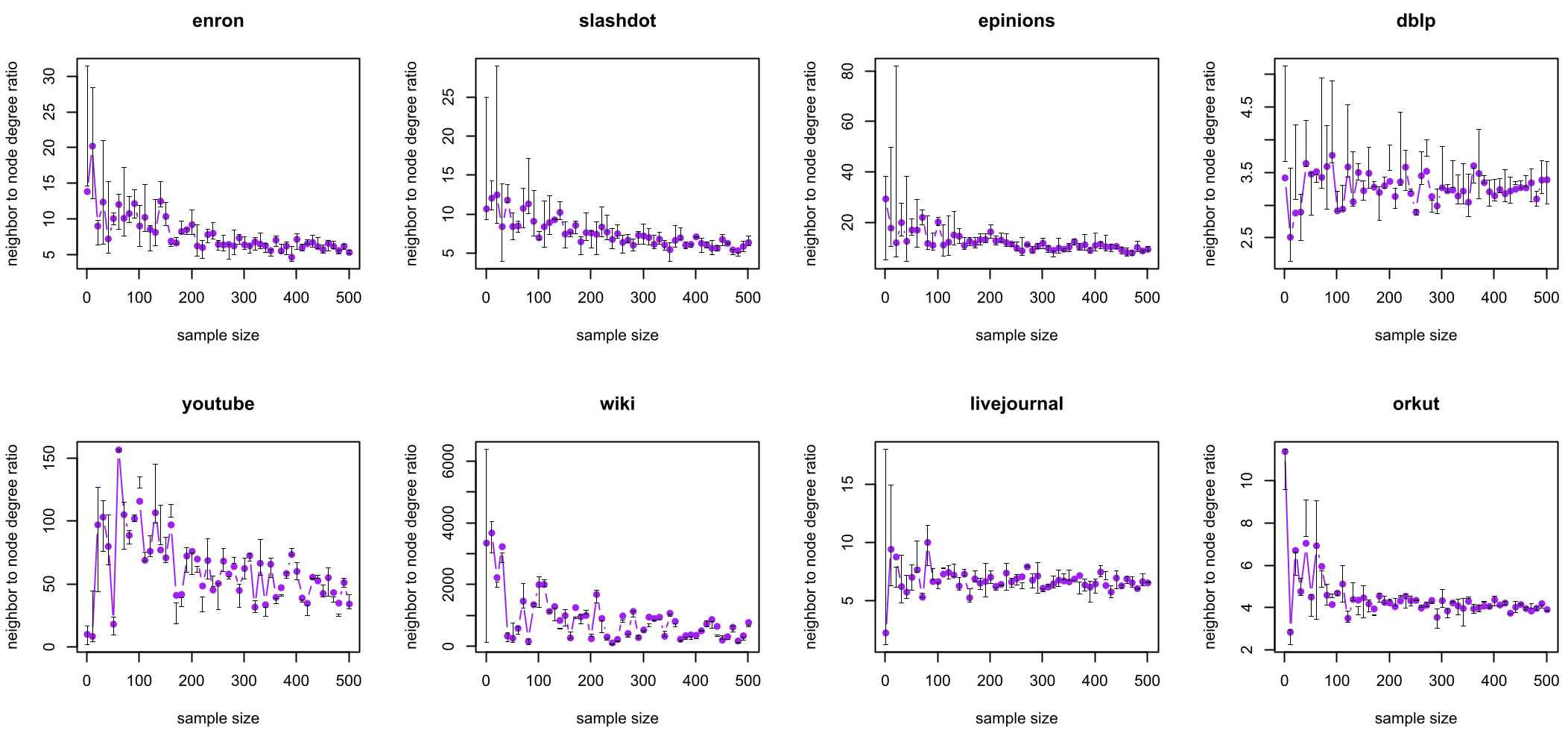 The ratio is consistently above 1 across all tested networks, confirming the robustness of the paradox.
A key finding from their "Beyond the First Circle" analysis (Figure 7) is that the "boost" in influence is strongest at the first hop. While going two hops away might find even higher-degree nodes in some networks (like Enron), the most significant marginal gain always happens when moving from the initial sample to their immediate neighbors.
Real-World Impact: Influence Maximization
Why does this matter? Imagine you are a marketer with a limited budget. You can't see the whole Facebook graph; you only see the users who walk into your store (a random sample).
The paper proves that Adaptive Seeding works:
- Sample a small set of random users.
- Instead of giving them all your coupons, ask them to refer a friend.
- Give the coupons to those friends.
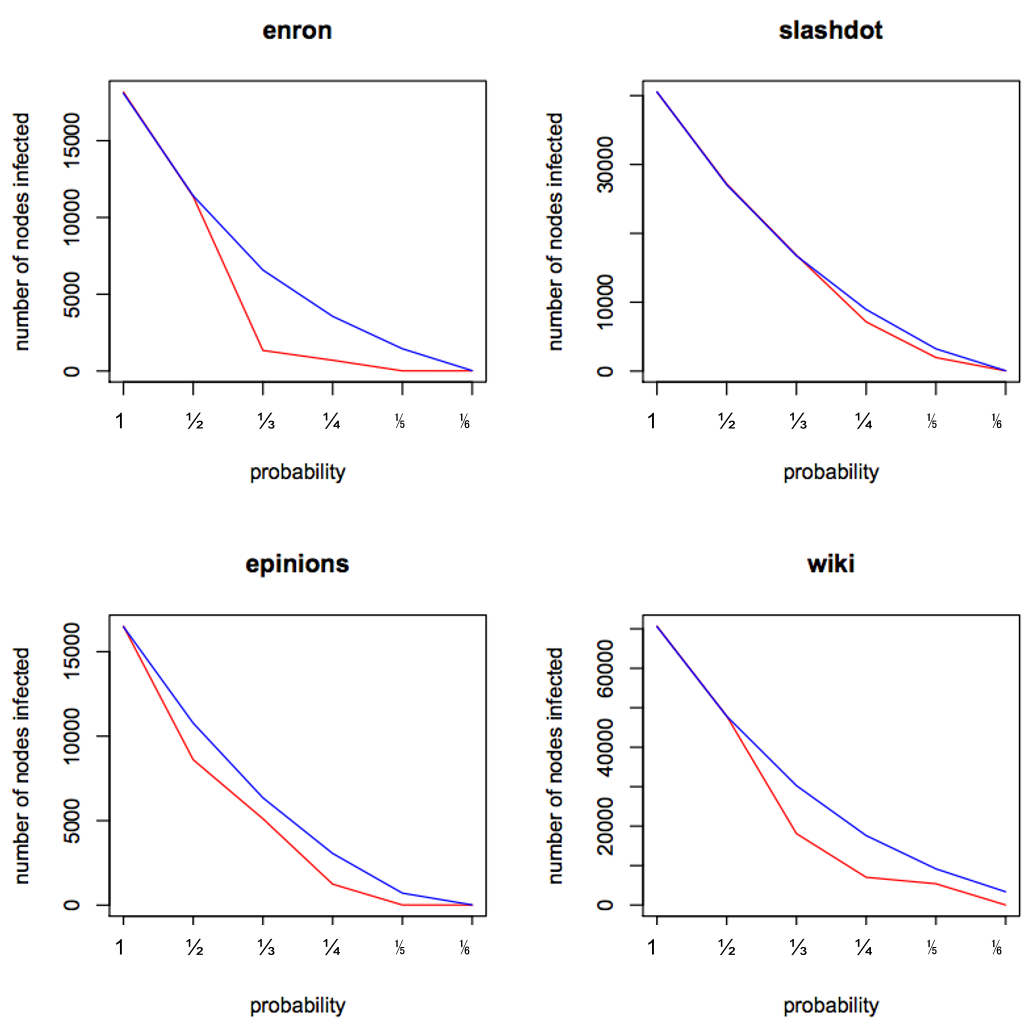 Seeding neighbors (blue line) consistently outperforms seeding the initial random sample (red line) across varying infection probabilities.
Conclusion
This paper elevates the friendship paradox from a "fun fact" to a proven algorithmic tool. It demonstrates that the inherent structure of social networks—characterized by heavy tails and random links—automatically rewards the strategy of looking "one hop away." Whether you're trying to stop an epidemic or start a viral trend, your best bet isn't the person you just met; it's their friend.