
The Social Migration: Why "Thumbs-Up" Culture is Disrupting Retail Efficiency
The power of a thumbs-up: Will e-commerce switch to social commerce?
This study investigates the consumer migration from traditional e-commerce to social commerce using the Push-Pull-Mooring (PPM) framework. It identifies low transaction efficiency as a "push" factor from e-commerce, while sociability (social presence, support, benefits, and self-presentation) serves as a "pull" factor toward social commerce, ultimately shaping switching intentions and actual behavior.
TL;DR
Is the era of purely transactional e-commerce ending? This study explores the "Cyber Migration" from product-centered sites (like PChome) to social-centered platforms (like Kidshome). By applying the Push-Pull-Mooring (PPM) framework, the research reveals that while "low transaction efficiency" pushes users away from traditional sites, it is the psychological allure of Social Benefits and Social Support that pulls them into the social commerce ecosystem.
The Friction of Pure Efficiency: Problem & Motivation
Traditional e-commerce has perfected the "one-click" buy. However, the authors argue that this extreme focus on efficiency has created a vacuum of sociability. Modern consumers are no longer passive information takers; they seek expertise, emotional support, and self-presentation.
The research intuition is clear: Switching isn't just about finding a better price; it's a migration process influenced by:
- Push Factors: What is wrong with the current home (E-commerce)?
- Pull Factors: What is attractive about the new destination (Social Commerce)?
- Mooring Factors: What personal traits (Conformity/Experience) act as the "anchor" or "wind" for this move?
Methodology: The PPM Framework in Action
The study utilizes a cross-sectional survey of users who utilize both traditional (PChome) and social (Kidshome/Facebook) platforms.
The Structural Model
The authors deconstruct "Sociability" into four distinct pull factors:
- Social Presence: The feeling of interacting with a "real person."
- Social Support: Both informational (advice) and emotional (care).
- Social Benefit: Closeness and familiarity with the network.
- Self-Presentation: The ability to express one's identity.
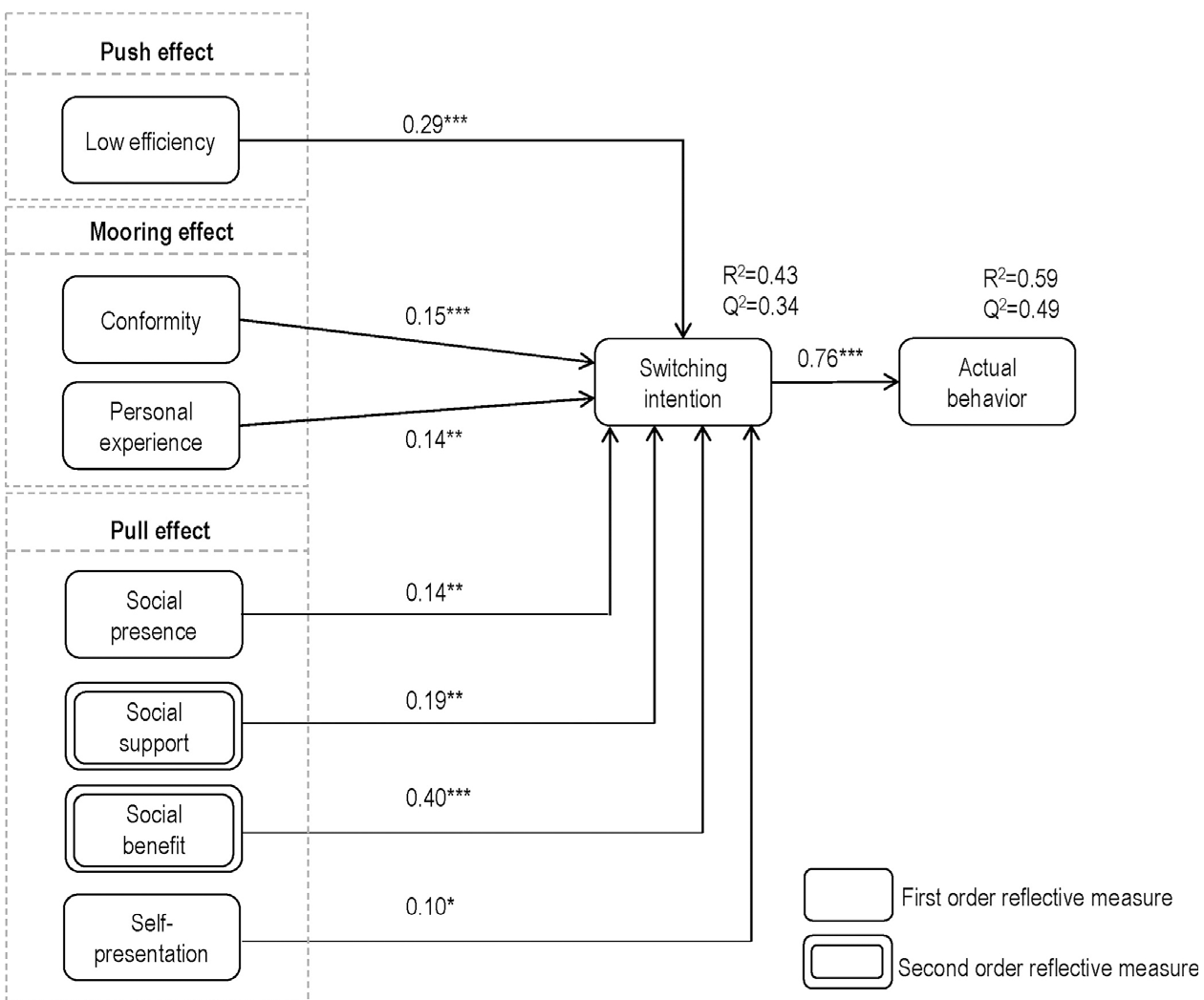 The Research Model: Mapping the interaction between Push, Pull, and Mooring effects.
Key Insights from the Data
The analysis, performed using Partial Least Squares (PLS), yielded several high-impact findings:
- Social Benefit is King: With a path coefficient of 0.40, the psychological feeling of intimacy and familiarity is the strongest reason users move to social commerce.
- The Efficiency Trap: Traditional e-commerce sites that fail to maintain high transaction speed (low efficiency) effectively "evict" their users (β=0.29).
- The Moderating Role of Conformity: For individuals who care about group norms (high conformity), the pull of social presence and support is significantly amplified. They switch not because they have to, but because "everyone else is there."
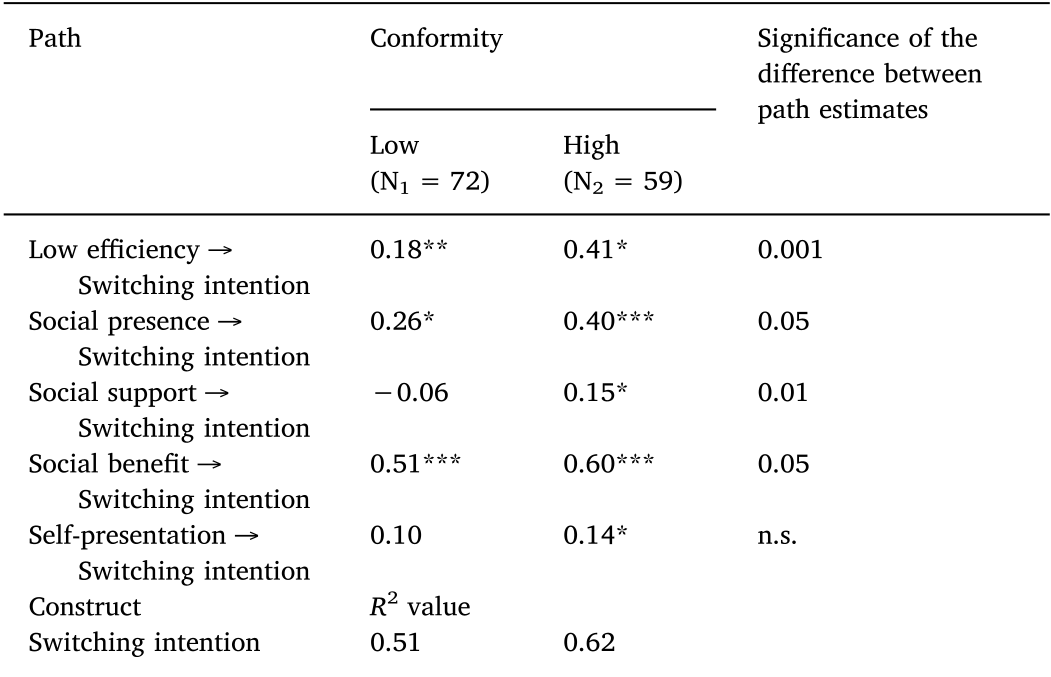 Table showing how Conformity splits the user base: High-conformity users are much more sensitive to social pulls.
Critical Analysis: Is E-Commerce Dead?
The study objectively points out that e-commerce and social commerce satisfy different Product Categories.
- Convenience Goods: Standardized products still thrive in high-efficiency e-commerce.
- Experience Goods: Products requiring reviews and social validation (like parenting supplies) are naturally migrating to social commerce.
Limitations: The study relies on self-reported data from a 3-month window. It doesn't account for "Negative Community Experiences" (e.g., social toxicity or misinformation) which might act as a "Push" factor away from social commerce—a potential area for future "Reverse Migration" studies.
Future Outlook
For retailers, the takeaway is binary:
- If you stay in traditional e-commerce, your only defense is absolute transaction efficiency (AI searches, 1-click logistics).
- If you move to social commerce, your "Thumbs-Up" is your currency. You aren't just selling a product; you are selling Social Support.
Ultimately, the "power of a thumbs-up" lies in its ability to transform a cold transaction into a warm, human interaction.