
HealthNet: Bridging the "Information Asymmetry" in Healthcare via Social Recommenders
Power to the patients: The HealthNetsocial network
This paper introduces HealthNet (HN), an innovative social network platform designed to empower patients by connecting them with similar peers and providing personalized recommendations for doctors and health facilities. The system integrates Natural Language Processing (NLP) to map user-described health statuses to medical specialties, achieving high precision in doctor suggestions through a hybrid recommendation engine.
TL;DR
HealthNet is a specialized social network that transforms patient-shared experiences into actionable medical recommendations. By leveraging NLP to interpret natural language health descriptions and a hybrid similarity engine to find "peer patients," it suggests doctors and hospitals with an expert-validated precision of over 85%.
The Problem: The "Doctor-Patient" Knowledge Gap
Patients facing a new diagnosis often fall into two traps: the isolation of not knowing who the "best" specialist is, and the "Cyberchondria" triggered by unguided web searches. While platforms like PatientsLikeMe have pioneered peer-to-peer data sharing, they often lack a structured way to turn those stories into professional referrals.
The authors identify a core problem: Information Asymmetry. Patients know their symptoms but not the medical terminology; doctors have the expertise but are hard to rank objectively. HealthNet aims to be the "intelligent middleware" that solves this.
Methodology: How HealthNet Connects the Dots
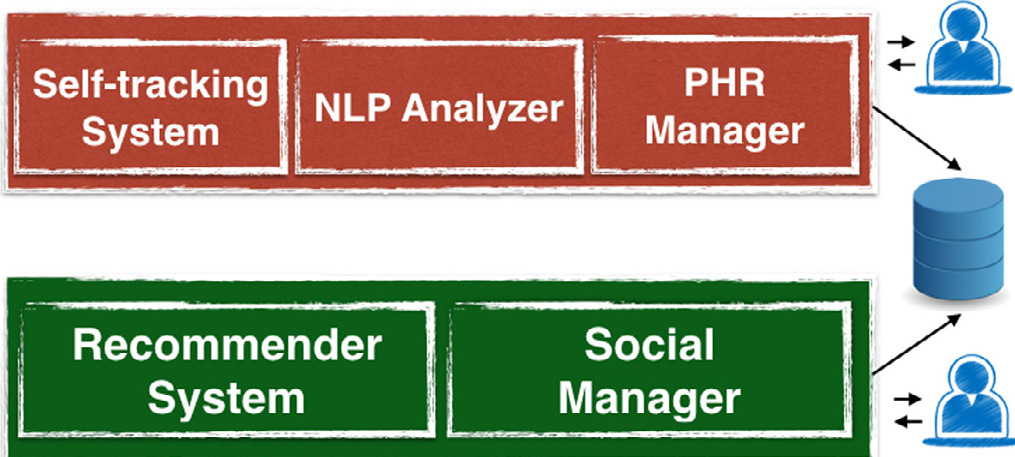
The system's intelligence is distributed across several key modules, but the magic happens in the interplay between NLP and Recommendation.
1. NLP-Driven Specialty Mapping
Instead of forcing users to navigate complex medical hierarchies, HealthNet allows them to type: "I have shortness of breath and chest pain." The NLP Analyzer then maps this to "Cardiology."
- Finding: Simple Logistic Regression (LR) on raw patient posts outperformed complex Random Forests, proving that for short health descriptions, linear models are robust.
2. The Patient Similarity Engine
The core innovation is how HealthNet defines "Similarity." It isn't just about common words; it’s a weighted formula:
- Conditions are compared using the shortest path in the ICD-10 disease hierarchy.
- Treatments and Symptoms are compared using the Jaccard Index.
Experiments: What Actually Works?
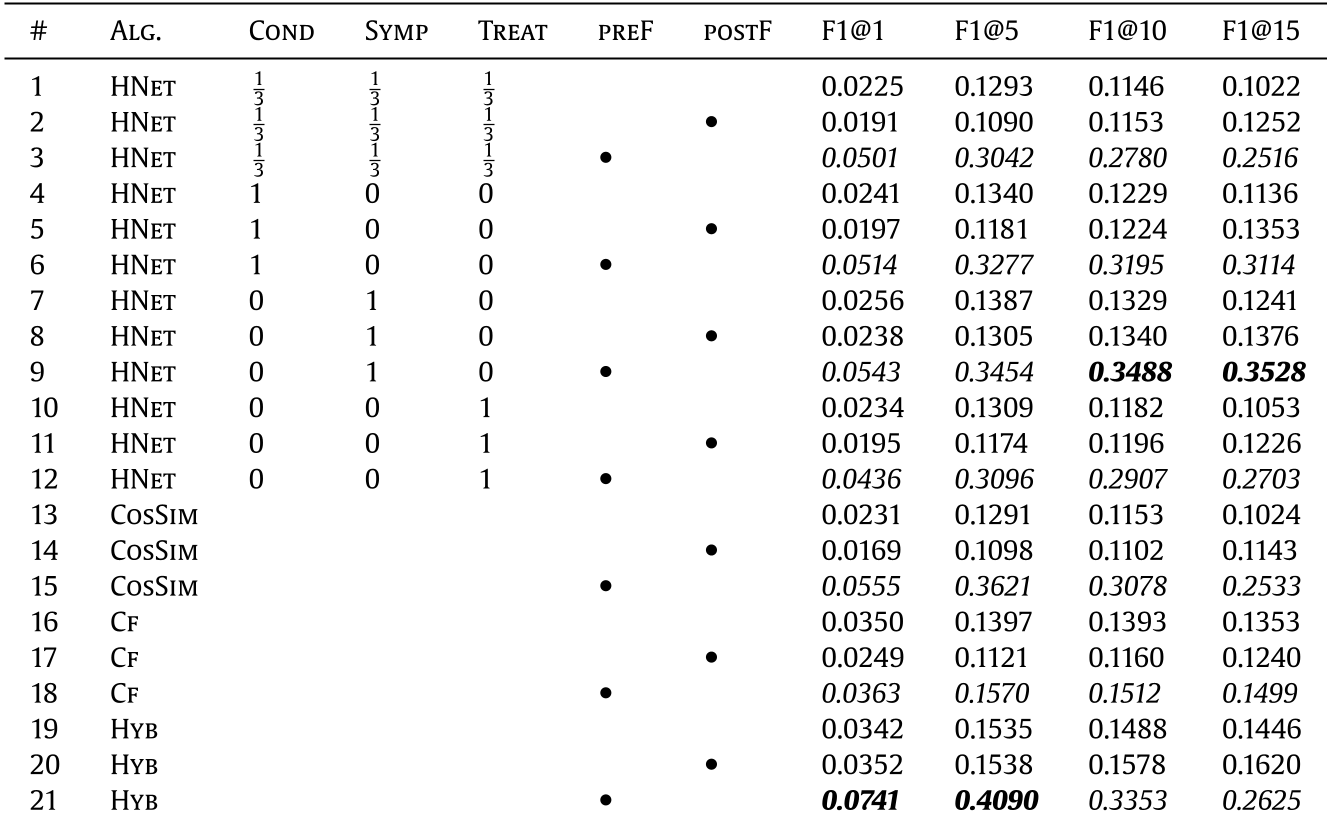
The authors conducted a dual-phase evaluation: "In-vitro" (on a massive dataset of 450k+ consultation requests) and "In-vivo" (human expert review).
The Power of Pre-Filtering
The most significant discovery was that Pre-Filtering (PREF)—restricting the search for similar patients to only those within the same medical specialty identified by NLP—exponentially increased recommendation quality.
- HNet + PREF (F1@5: 0.345) significantly outperformed generic Collaborative Filtering (F1@5: 0.139).
Expert Validation
To ensure the "In-vitro" results weren't just mathematical artifacts, five doctors reviewed the recommended lists. The results were stellar: an 86.1% average precision, with several areas like Neurology and Oncology achieving a perfect 100%.
Critical Insight: Why This Matters
HealthNet moves the needle from "Social Networking" to "Social Medicine." By integrating official health ministry quality indicators with community-driven peer ratings, it creates a balanced trust model.
Limitations: Currently, the system is optimized for Italian. Its performance in "General Medicine" (the lowest-scoring category at ~24% precision) suggests that the system struggles with vague, multi-symptom descriptions that don't fit neatly into a single bucket.
Conclusion
The success of HealthNet demonstrates that the future of e-health is not just in "Big Data," but in Semantic Data. By understanding the intent behind a patient's natural language and grounding it in existing medical hierarchies (ICD-10), we can build tools that truly empower patients to make informed, life-changing decisions.