
PowerQuest: Unleashing Machine Learning for Zero-Overhead Power Optimization
PowerQuest: Trace Driven Data Mining for Power Optimization
This paper introduces PowerQuest, a machine-learning-driven framework that extracts "dynamic invariants" from simulation traces to optimize circuit power. By utilizing the Extension Matrix Approach (EMA), it identifies gating conditions like Observable Don't Cares (ODC) to implement superior clock gating and operand isolation, achieving up to 22.7% power reduction compared to traditional methods.
Executive Summary
TL;DR: PowerQuest is a pioneering framework that bridges the gap between machine learning and Electronic Design Automation (EDA). By mining simulation traces, it discovers hidden "dynamic invariants"—logical conditions where parts of a chip are unused—and uses them to shut down logic. It achieves up to 22.7% power savings while paradoxically improving timing by 31.7%, a feat traditional static tools cannot match.
Background Positioning: Published at DATE 2007, this work is a seminal example of using data-driven insights for RTL optimization. It moves beyond "static" logic gates, looking instead at how the chip actually behaves during real software execution.
The Pain Point: The "Logic Duplication" Tax
In modern VLSI design, Dynamic Power Management (DPM) is the standard for saving energy. The most common method is Clock Gating: if a register's output isn't needed (the "Observable Don't Care" or ODC condition), we shut off its clock.
However, traditional tools face a Catch-22:
- Complexity: Detecting ODC conditions statically is NP-hard.
- Timing Overhead: To gate a clock "just in time," you often have to duplicate the logic that calculates the gating condition, adding area and slowing down the frequency.
- Local vs. Global: Most tools only look at the logic immediately surrounding a register, missing global opportunities.
Methodology: Mining the "Common Case"
PowerQuest shifts the paradigm from Topological Analysis to Observation. It treats the design as a black box that produces simulation traces (Big Data).
1. Data Mining with EMA
The core engine uses the Extension Matrix Approach (EMA). It labels every clock cycle in a simulation trace as either a "Positive Example" (where the logic is idle) or a "Negative Example" (where it's busy). EMA then learns a Boolean function that perfectly separates these two states.
2. The "Signal Substitution" Insight
This is PowerQuest's most deviant—and brilliant—insight. Instead of synthesizing a brand-new circuit to represent the gating condition, it searches the existing design for a "pre-existing" signal that behaves almost exactly like the ideal gating condition.
 Figure: By identifying existing signals (t) within the logic cone that correlate with idleness, PowerQuest avoids adding extra gating logic.
Experiments & Results: Beyond Power Savings
The authors tested PowerQuest on ITC99 benchmarks and high-performance floating-point multipliers. The results were startling because they broke the "Area-Power-Delay" trade-off.
- Power: Saved up to 22.7%.
- Area: Actually reduced cell counts by up to 30.6% compared to other ODC methods.
- Delay: Improved critical path timing by up to 31.7%.
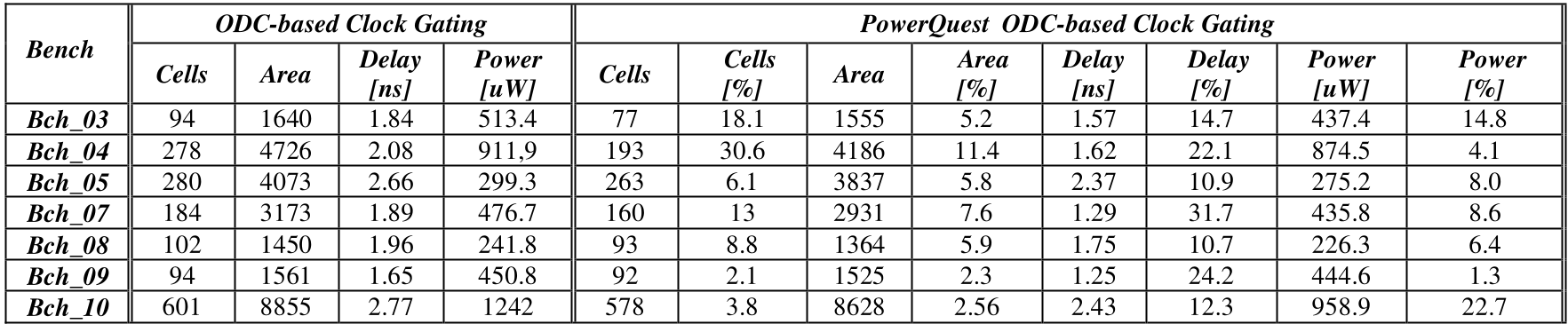 Table: Comparison shows PowerQuest (right) consistently beating standard ODC-based clock gating across all metrics.
Why did timing improve? Traditionally, adding gating logic adds "gate delay" to the clock path. PowerQuest, by finding existing signals that already existed in the logic, effectively "recycles" the design's own logic for power management, streamlining the netlist.
Critical Insight & Future Outlook
The genius of PowerQuest lies in its realization that logic designs are often redundant. There are signals buried in the "logic soup" of a CPU that accidentally correlate with complex power-saving conditions. Machine learning is the only tool powerful enough to find those correlations.
Limitations: The primary hurdle is Formal Verification. Because these invariants are mined from traces (which are never exhaustive), a design optimized by PowerQuest must be passed through a Formal Verification tool to ensure that the learned gating condition doesn't accidentally shut off the clock during a rare but vital operation.
Summary: PowerQuest proved that the future of EDA isn't just better graph algorithms—it's about treating the chip as a data-generating entity and using ML to find the "hidden logic" that static analysis remains blind to.