
PoX: Reclaiming Digital Sovereignty from Malicious Social Apps
PoX: Protecting users from malicious Facebook applications
This paper introduces PoX (Proxy On the Client-Side), a decentralized extension for Facebook that enforces fine-grained access control over profile data requested by third-party applications. By utilizing a browser-based proxy and a custom server-side library, PoX makes all data requests explicit to the user without requiring trust in additional third parties or modifications from Facebook itself.
TL;DR
Social networks like Facebook have long struggled with "leaky" third-party ecosystems where installing a simple quiz app might expose your entire friends list to unknown marketers. PoX (Proxy On the Client-Side) is a research-driven response that places a security "firewall" directly in the user's browser. It strips applications of their ability to talk to Facebook behind your back, forcing every data request to pass through a local, user-controlled filter.
Background: The Illusion of Privacy
In the legacy Facebook architecture, once you authorize an app, it receives a session secret. This secret is a "golden ticket" that allows the application server to query Facebook’s API directly. The user is completely bypassed during this exchange. If an app claims it only needs your birthday but actually scrapes your entire profile, there is no technical mechanism on the client side to stop it.
The authors argue that we cannot wait for platforms (whose business models often rely on data sharing) to fix this. We need a solution that is:
- Fine-grained: Control individual fields (e.g., allow "Name" but deny "Friends").
- Deployable: Works today without Facebook's permission.
- Zero-Trust: Does not involve a middleman server that could become a new point of failure.
Methodology: The Browser as a Reference Monitor
The core innovation of PoX is moving the "Reference Monitor"—the component that decides who gets access to what—from the Facebook server to the user's browser.
1. Stripping the "Golden Ticket"
The PoX browser plug-in (Interent Explorer/Firefox) monitors the HTTP stream. When it detects a session secret being sent to a third-party app, it strips it. Without this secret, the application's server is "blind" and cannot call Facebook's APIs directly.
2. The Transparent Proxy
To stay functional, the app must now "ask" the user's browser for data. PoX uses a technique called Long Polling. The application server opens a request to the client-side proxy and waits. When the proxy receives a request, it checks the user's Access Control List (ACL). If the user has allowed "Birthday" but the app asks for "Location," the proxy denies the request locally.
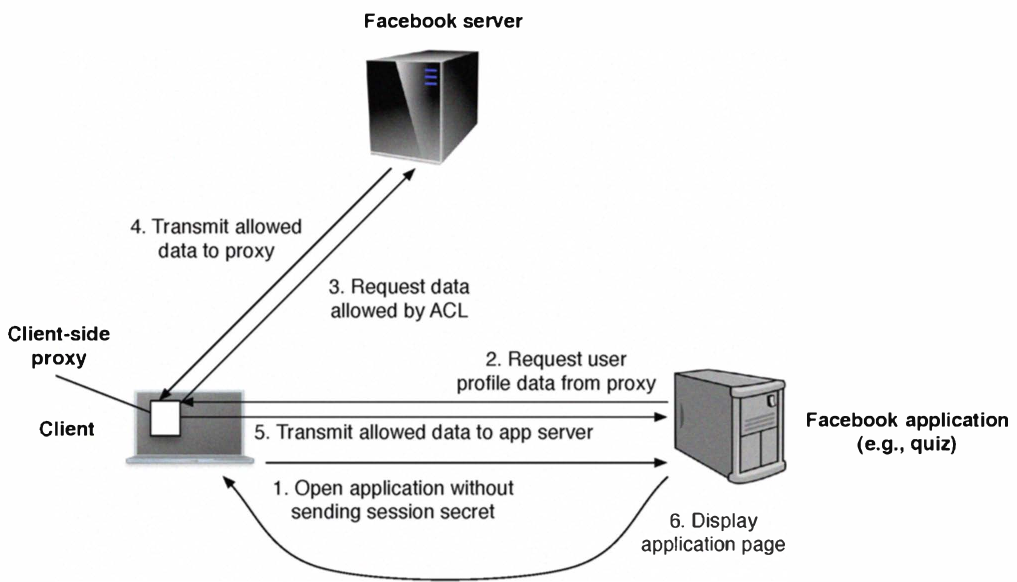
The PoX architecture forces the data flow through the user's local environment, ensuring mediation.
Performance: Privacy Without the Penalty
A common critique of proxy-based systems is the latency overhead. The authors conducted "stress tests" simulating 60 concurrent users to see if the long-polling mechanism could scale.
Interestingly, while the initial request is slower (due to loading the proxy scripts), subsequent requests using PoX actually outperformed the standard Facebook library. This is because the PoX proxy maintains a persistent HTTP connection, whereas traditional PHP-based libraries often initiate new connections for every script execution.
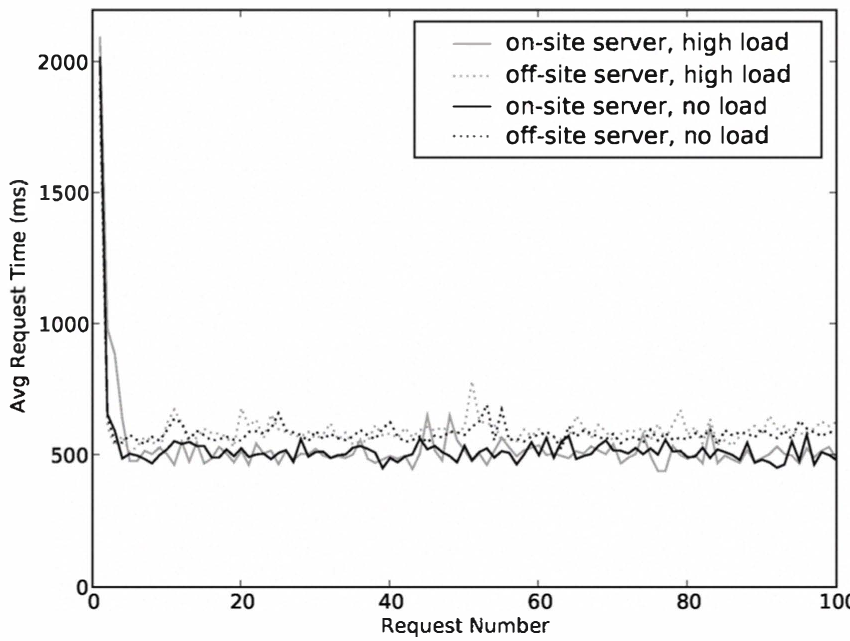
Comparison of request times: PoX shows a higher initial cost but levels out to competitive performance.
Critical Analysis & Conclusion
PoX represents a significant shift in thinking about OSN privacy. Instead of pleading for better TOS (Terms of Service) enforcement, it uses architectural constraints to protect users.
Limitations
- Cat-and-Mouse Game: If platforms change their API protocols radically (e.g., moving to proprietary binary streams), the browser plug-in must be updated.
- User Burden: Fine-grained control requires the user to actually make decisions, which can lead to "decision fatigue."
Future Outlook
The concept of a "Client-Side Proxy" is more relevant than ever in the age of AI agents and mobile apps. As we move toward more integrated web experiences, the ability to intercept and mediate API calls locally—ensuring that data is "pulled" by the user rather than "pushed" to the cloud—remains a gold standard for digital privacy.
PoX proves that we don't need to choose between social features and privacy; we just need to move the gatekeeper's key into the user's pocket.