
PPS: Solving the Privacy-Efficiency Trilemma in Spectrum Auctions
PPS: Privacy-Preserving Strategyproof Social-Efficient Spectrum Auction Mechanisms
The paper proposes PPS, a Privacy-Preserving Strategyproof spectrum auction framework designed for both Single-Unit (SUA) and Multi-Unit (MUA) models. It leverages Paillier homomorphic encryption and a semi-trusted agent to achieve social efficiency with approximation factors of (1+ε) for SUA and 32 for MUA while protecting bid privacy.
TL;DR
Spectrum auctions are critical for 5G/6G resource management, but they face a "trilemma": achieving Strategyproofness, Social Efficiency, and Bid Privacy simultaneously. The PPS framework (Privacy-Preserving Strategyproof) breaks this by combining Homomorphic Encryption (HE) with approximation algorithms (PTAS). It ensures that no single party—neither the auctioneer nor a third-party agent—can uncover the true bids of participants while maintaining near-optimal spectrum allocation.
Background: The Trust Deficit in Spectrum Markets
In a typical spectrum auction, secondary users (bidders) submit valuations to a primary user (auctioneer). To be strategyproof, the auction must ensure that "truth-telling" is the best strategy. To be socially efficient, the spectrum must go to those who value it most. However, if the auctioneer is corrupt, bid privacy is lost. Existing works either focus on privacy without performance guarantees or performance without privacy. PPS aims to solve all three.
The PPS Framework: Architecture of Neutrality
The core innovation of PPS is its two-party architecture:
- The Auctioneer: Holds the decryption key (DK) but never sees raw bids or their original IDs.
- The Agent: Receives encrypted bids, performs homomorphic computations, masks results with random values, and shuffles IDs.
By using Paillier’s Homomorphic Encryption, the agent can sum encrypted bids (e.g., to find the total value of an independent set of bidders) without knowing the underlying numbers.
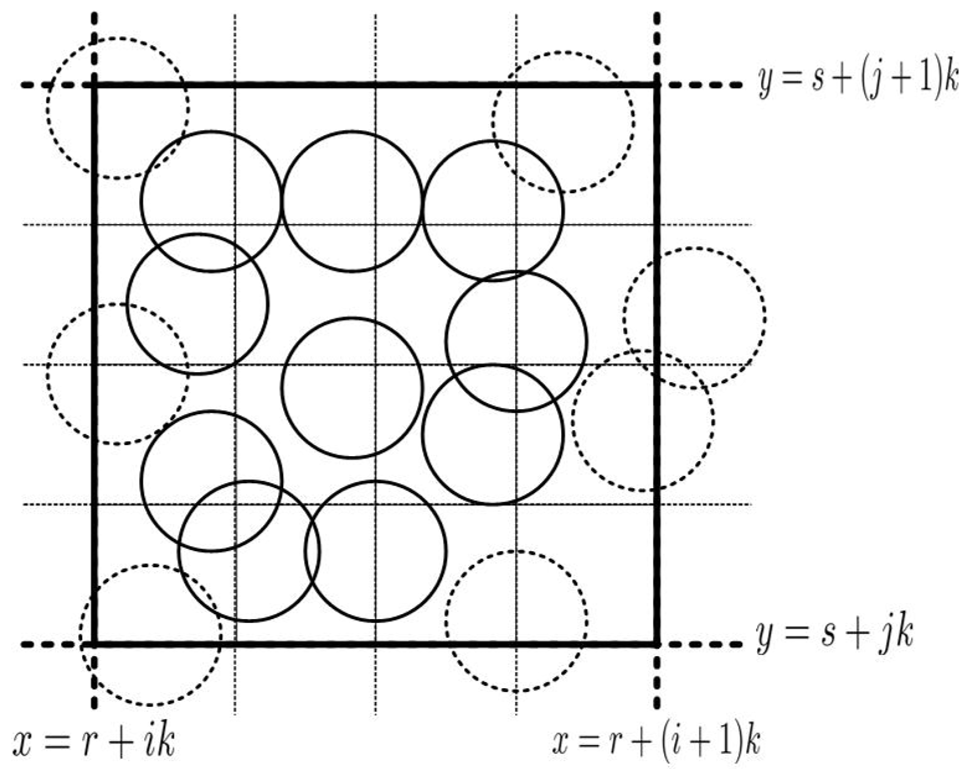 Figure 1: Shifting strategy for SUA, dividing the plane into grids to solve local MWIS problems.
Methodology: From NP-Hardness to PTAS
Spectrum allocation is essentially a Maximum Weighted Independent Set (MWIS) problem on unit disks (since users within an interference radius cannot share a channel), which is NP-hard.
1. Single-Unit Auction (SUA)
PPS-SUA uses a Polynomial Time Approximation Scheme (PTAS) based on a shifting strategy. The plane is subdivided into grids. The agent calculates the encrypted sum of weights for all possible independent sets in a grid and asks the auctioneer to compare them. The auctioneer sees only masked values, preserving privacy.
2. Multi-Unit Auction (MUA)
MUA is more complex, supporting multi-channel requests. PPS-MUA uses a grid subdivision (2x2 and 1x1 grids) and a greedy approach (sorting by per-unit price). PPS-EMUA (Extended MUA) improves this by re-incorporating "losers" from the initial greedy pass into vacant slots, significantly boosting average-case social efficiency.
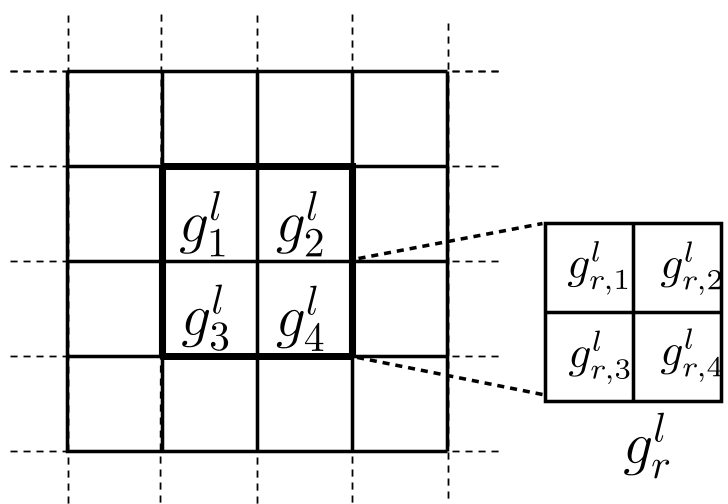 Figure 2: Grid types used in the MUA model to handle interference and channel demands.
Evaluation: Efficiency vs. Overhead
The authors validated PPS through extensive simulations. Key findings include:
- Social Efficiency: SUA maintains high efficiency near 1, and PPS-EMUA significantly outperforms the baseline PPS-MUA.
- Computation: The auctioneer carries the heaviest load due to decryption operations, but the total time for 300 bidders remains within feasible limits for non-real-time auctions.
- Communication: Bandwidth scales linearly with the number of bidders, making it practical for modern wireless infrastructures.
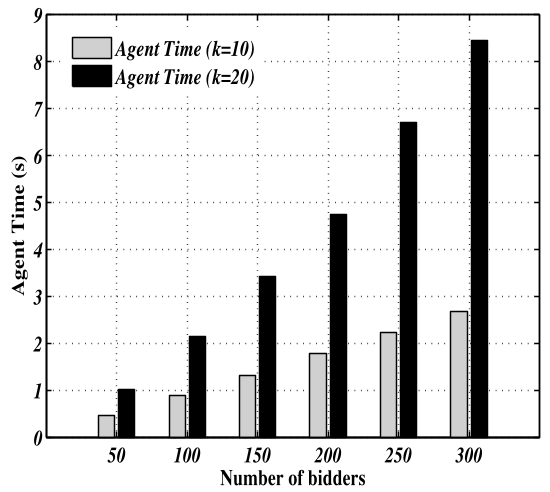 Figure 3: Social Efficiency Ratio for SUA and MUA variants.
Critical Insight & Future Outlook
The brilliance of PPS lies in how it handles Critical Value Calculation. In strategyproof auctions, the winner pays the minimum amount they would have needed to bid to win. Calculating this on encrypted, masked data across multiple "shifted" grids is non-trivial. PPS manages this by having the agent generate several "what-if" encrypted payments for the auctioneer to compare.
Limitations: The model assumes the agent and auctioneer do not collude. If they share their private metadata, bid privacy vanishes.
Future Directions: Future research could look into removing the "Agent" entirely by using Threshold Cryptography or Blockchain, potentially creating a fully decentralized and trustless spectrum market.
Conclusion
PPS demonstrates that privacy does not have to come at the cost of economic efficiency. By marrying approximation algorithms with homomorphic encryption, it provides a robust blueprint for the next generation of secure, fair, and efficient spectrum management.