
Efficient Privacy-Preserving Group Matching: Moving Beyond Cryptographic Overload
A practical group matching scheme for privacy-aware users in mobile social networks
The paper proposes a lightweight, privacy-preserving group matching scheme for Mobile Social Networks (MSNs) that eliminates the Need for a Trusted Third Party (TTP). It utilizes a novel fuzzy matrix algorithm for authority generation and the Ochiai similarity coefficient to enable asynchronous matching, allowing a stranger to join a group even if only one member is online.
TL;DR
Joining a private group in a Mobile Social Network (MSN) usually requires complex handshakes or a trusted intermediary. This paper introduces a Practical Group Matching Scheme that leverages a fuzzy matrix algorithm and the Ochiai similarity coefficient. By avoiding heavy cryptographic operations like homomorphic encryption, the scheme allows for asynchronous matching—where only one member needs to be online—while reducing energy consumption on mobile devices by several orders of magnitude.
The "Group Joining" Dilemma
In the context of MSNs, privacy is a zero-sum game: users want to find like-minded groups but fear leaking sensitive attributes (interests, health status, religion) to strangers or untrusted servers.
Current SOTA solutions face a tripartite problem:
- TTP Dependency: Relying on a Trusted Third Party creates a single point of failure.
- Synchronicity Constraints: Requiring all members to be online for a "voting" process is a UX nightmare.
- Computational Bloat: Using tools like Shamir Secret Sharing or Bilinear Pairings drains smartphone batteries instantly.
The authors argue that the "Voting Right" should be persistent and verifiable without constant active participation.
Methodology: The Power of Fuzzy Matrices
Instead of encrypting each bit of a user's interest vector, the authors propose a Privacy-Preserving Scalar Product Computation (PPSPC) approach based on fuzzy matrices.
1. Authority Generation
Each group member transforms their binary interest vector into an authorization vector . This involves large primes and , and a series of random numbers and that act as confusion factors.
- If a hobby exists:
- If it doesn't:
2. The Public Set & Asynchronous Matching
These vectors are aggregated into a Group Authority Matrix. This matrix is stored in a "Public Set." When a stranger (Alice) wants to join, she downloads this matrix, applies her own noise-injected vector, and produces a result that only the group can decode to find the similarity score.
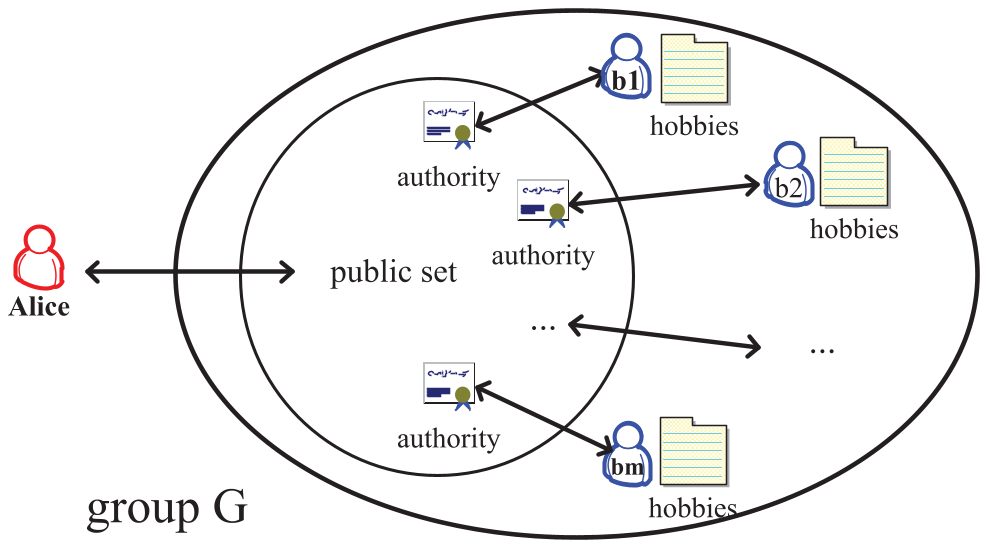 Figure 1: The proposed MSN matching architecture without a TTP.
Mathematical Intuition
The core of the "magic" lies in the modulo operation . Because the noise parameters are carefully bounded (), the high-order bits of the result naturally represent the scalar product of the two vectors (the number of common interests), while the lower bits contain the noise that protects individual privacy.
Ochiai Similarity
The scheme uses the Ochiai coefficient: . Unlike simple counts, this accounts for the "density" of a user's profile, preventing attackers from gaining entry by simply claiming they like "everything."
Performance: A Stark Contrast
The most striking part of this research is the efficiency gain. The authors compared their scheme against Wang's Gmatch and Zhang's Fine-grained matching.
- Energy Consumption: On a smartphone, the stranger's side consumes only 4.90J (n=200), whereas cryptographic-based schemes like Wang's consume 1321.2J.
- Computation Speed: By converting the problem into simple multiplications and additions, the execution time remains linear and low even as interest sets (n) and group sizes (m) scale to 200.
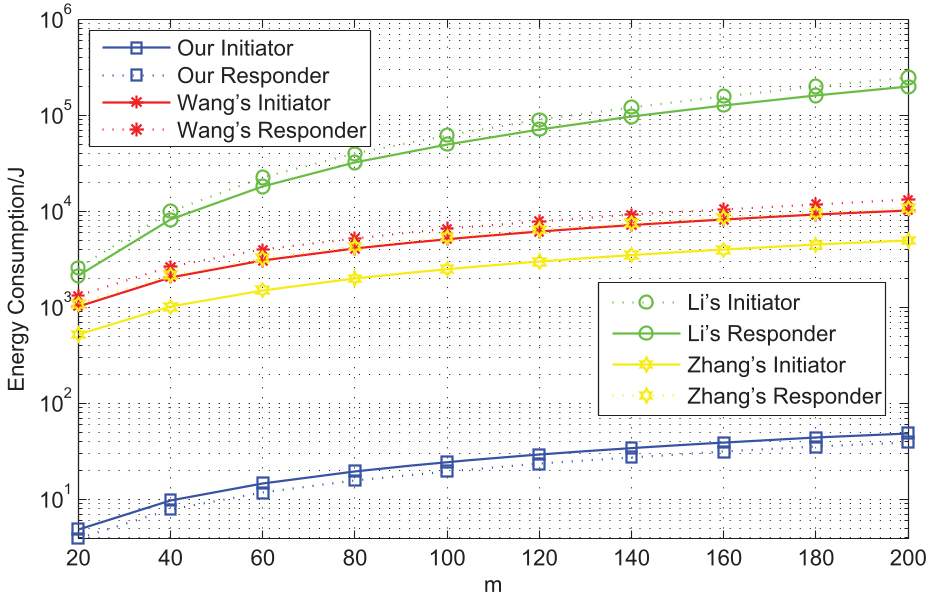 Figure 2: Energy consumption on smartphones. Note the massive gap between "Ours" and competitive cryptographic methods.
Critical Insight & Future Work
The beauty of this scheme is its asynchronous nature. By pre-uploading "authorities," the group members "delegate" their privacy policy to a mathematical structure.
Limitations: The current model assumes an "Honest-But-Curious" adversary. In a fully malicious environment where members might collude to spoof the "Public Set," additional verification (perhaps via a lightweight blockchain or TEE) might be necessary.
Future Outlook: The authors plan to integrate "Influence Factors." Not all group members are equal; a group founder's similarity score might carry more weight than a new member's. Applying weighted matrices to this fuzzy logic could revolutionize how DAOs (Decentralized Autonomous Organizations) handle membership filtering.
Conclusion
This paper serves as a reminder that security doesn't always require heavy math. By using fuzzy matrices and the physical intuition of bit-shifting via modulo arithmetic, we can build social networks that are both private and highly responsive.