
Decentralized Intelligence: Solving Team Formation in Non-Cooperative Social Networks
A Practical Negotiation-Based Team Formation Model for Non-cooperative Social Networks
The paper introduces a decentralized, negotiation-based team formation model tailored for non-cooperative Social Networks (SNs). It leverages a distributed multiagent-based protocol to recruit professional team members while minimizing communication overhead and working costs, achieving 80% of the social welfare of centralized benchmarks.
TL;DR
Building an expert team in a social network usually requires a centralized "overlord" to optimize costs. This paper flips the script by introducing a Negotiation-Based Team Formation Model where self-interested agents bargain to form teams. It achieves near-optimal social welfare while slashing formation time, making it ideal for real-world, time-sensitive applications like crowdsourcing.
Background: The Myth of the Cooperative Agent
Most academic models of team formation assume a "God-mode" controller (centralized) and perfectly obedient participants (cooperative). In the real world, LinkedIn or Facebook users don't join teams because a central algorithm told them to; they join because the pay is right. Furthermore, communication overhead—like transportation fees or coordination lag—varies based on the social graph's distance. This paper tackles the dual challenge of Non-Cooperative behavior and Decentralized execution.
Problem & Motivation
Current SOTA methods face two "shackles":
- Centralization: They assume a controller has global knowledge of everyone's skills and costs.
- Altruism Bias: They ignore that individuals prioritize their own financial remuneration over global optimization.
The authors' insight? By modeling individuals as autonomous agents and using a specialized negotiation mechanism, we can simulate a marketplace that naturally gravitates toward efficient, cost-effective teams without needing a central authority.
Methodology: The Core Mechanism
The model relies on three agent roles: Manager (job initiator), Contractor (teammate), and Freelancer (potential recruit).
1. The Optimization Strategy (Algorithm 2)
Managers face an NP-hard problem: which combination of a freelancer's skills yields the best profit? Instead of exhaustive searching, the authors propose a Greedy Polynomial Algorithm. It ranks skills by cost and evaluates them sequentially, proving that under certain conditions (non-overlapping skills), it achieves the theoretical optimum.
2. The Negotiation Protocol
The process follows an "Offer-Response-Confirm" cycle:
- Offer: Manager proposes a skill contribution set based on expected job value and agent costs.
- Response: The freelancer calculates their Expected Remuneration per unit time. If the new job pays better than their current "tentative" contract, they switch.
- Confirm: A tentative agreement is reached, becoming final only when the team is complete.
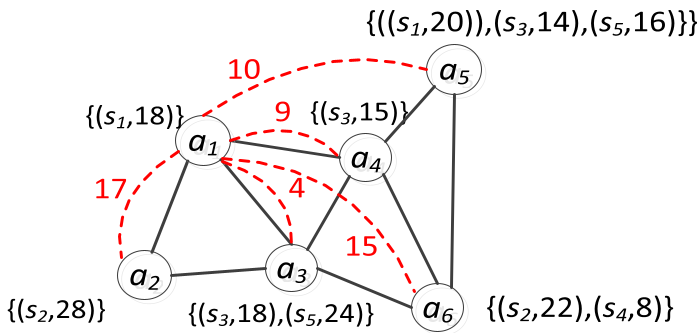 Fig 1: A visualization of a social network where nodes possess specific skills and edges represent communication costs.
Experiments & Results
The authors compared their model against an Optimal Centralized (OPT) model, a Simple Contract Net (SCN), and a Complex Bilateral Bargaining (CBB) model.
Performance Metrics
- Social Welfare: Our model consistently achieves 80% of the OPT's welfare, significantly outperforming SCN and CBB across different job arrival rates and network degrees.
- Efficiency: As shown in Fig 3, the team formation time is dramatically lower than the CBB model. While CBB wastes time in multi-round bargaining, this model's single-round decision-making is optimized for speed.
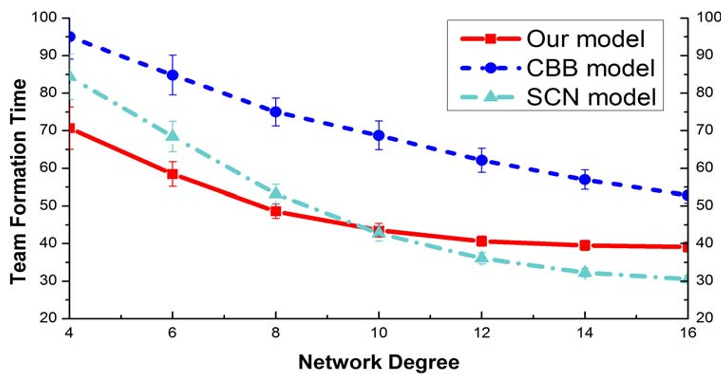 Fig 2: Comparison of Team Formation Time. Note how CBB (top line) scales poorly compared to the proposed model.
Critical Analysis & Conclusion
Takeaway
The beauty of this model lies in its practicability. By acknowledging that agents are self-interested, it creates a robust system where "synergy" (represented by connected subgraphs) arises naturally through social interactions rather than being forced by a controller.
Limitations & Future Work
The current model allows agents to "decommit" (break contracts) arbitrarily. In a more realistic setting, this would involve monetary penalties or reputation loss. The authors aim to incorporate a "compensatory decommitment strategy" in future iterations to prevent chaotic switching in high-stakes environments.
Closing Thought
As we move toward a more fragmented, gig-economy-driven world, decentralized protocols like this will be the backbone of automated labor markets, transforming how we "team up" in the digital age.