
Practical Privacy in IoT Healthcare: Balancing Security and Utility in the kHealth Era
Towards Practical Privacy-Preserving Analytics for IoT and Cloud Based Healthcare Systems
The paper formalizes a framework for practical privacy-preserving analytics in IoT and cloud-based healthcare systems using the kHealth project as a case study. It proposes a taxonomy of privacy assets and evaluates various cryptographic and perturbation methods to balance the trade-off between data utility, computational efficiency, and security strength.
TL;DR
As healthcare shifts toward IoT-driven remote monitoring, the conflict between data privacy and analytical utility has reached a breaking point. This paper explores the kHealth framework, demonstrating how to build predictive models for asthma management without exposing raw patient data. By strategically combining Additive Homomorphic Encryption (AHE), Data Perturbation, and a multi-party architecture, the authors show that practical privacy-preserving healthcare is achievable even when using "honest-but-curious" cloud providers.
The "Privacy-Utility" Deadlock
The modern healthcare mesh is a data-hungry ecosystem. Systems like kHealth ingest everything from a patient's heart rate and activity level to local air quality and humidity. While this allows for life-saving early diagnosis of asthma outbreaks, it creates a "privacy nightmare."
The core challenge is the Computational Paradox:
- High Security (AES/RSA): Encrypts data effectively but makes it "mathematically inert"—you cannot perform analytics on it without decrypting it first.
- High Utility (Anonymization): Keeps data usable but is highly susceptible to "background knowledge attacks" where an adversary cross-references public records to re-identify patients.
The authors argue that we must move beyond these binary choices to find a "middle ground" of practical privacy.
Architecture: The Involved Parties
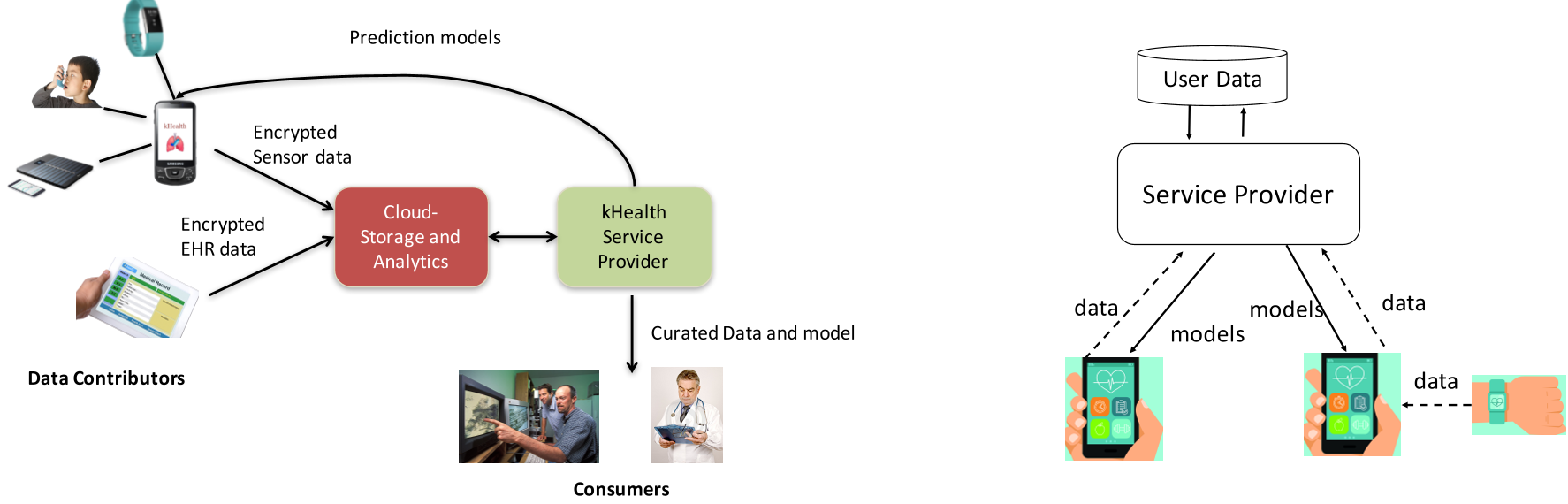
To solve the deadlock, the paper identifies five critical actors in the healthcare data lifecycle. The innovation lies in how these parties interact:
- The Patient: The data source, often using resource-constrained IoT sensors.
- Service Provider (SP): The entity generating models (e.g., kHealth).
- Cloud Provider: Offers the muscle for computations but is considered "honest-but-curious."
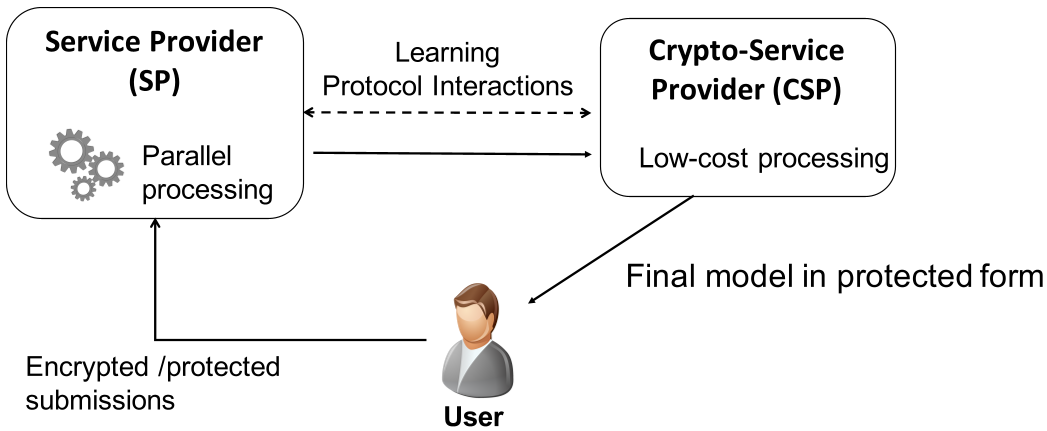
- Crypto-Service Provider (CSP): A critical third party that manages keys and assists in decrypting intermediate results without seeing the raw data.
Methodology: The Privacy Building Blocks
The paper provides a masterclass in selecting the right tool for the right job, categorizing methods based on their Expressiveness vs. Efficiency.
1. Outsourced Computation (The Cloud Challenge)
How do you run a machine learning model on a server you don't fully trust?
- Fully Homomorphic Encryption (FHE): Technically allows any calculation on encrypted data, but the "noise" it generates makes it 1,000x too slow for real-world IoT.
- Random Space Perturbation (RASP): The authors' preferred efficiency champion. It uses geometric transformations (rotation, scaling) to "mask" data. It's fast and allows most existing DM algorithms to run directly on the obfuscated data.
- Paillier (AHE): Used for specific tasks (like summing data). While efficient, it requires one operand to be unencrypted, necessitating a noise-injection mechanism to prevent leakage.
2. Information Sharing (The Researcher Challenge)
How do you share clinical findings with the broader medical community?
- Differential Privacy (DP): The gold standard for statistical queries. By adding "noise" to the output of a query, it ensures that an individual's presence in a dataset cannot be confirmed.
- Secure Multiparty Computation (SMC): Useful for when two hospitals want to combine their datasets to build a better model without either hospital ever "seeing" the other’s raw records.
Critical Insight: The "Practicality" Threshold
The most profound takeaway is the authors' focus on Workload Allocation. In a privacy-preserving IoT system, the device (sensor) must perform the lightest encryption tasks, the SP manages the logic, and the Cloud handles the heavy-duty parallel processing.
If a privacy technique, like Yao’s Garbled Circuits, requires massive communication overhead for every "gate" in a logical circuit, it fails the practicality test for healthcare. Instead, they advocate for Ensemble Learning and Spectral Analysis using optimized AHE, where the heavy lifting happens in the cloud and the recovery happens at the SP level.
Conclusion and Future Outlook
The kHealth case study proves that we don't need to wait for "perfect" encryption to start protecting patient privacy. By:
- Identifying Private Assets (User Data, Models, Intermediate Results).
- Using Perturbation for high-efficiency analytics.
- Introducing a CSP to split trust.
...we can deploy digital health systems that are both smarter and safer. The future of healthcare informatics lies not in more data, but in distributed trust.
Final Takeaway
There is no "silver bullet" for healthcare privacy. The choice between Paillier, RASP, or Differential Privacy depends entirely on whether you are doing real-time monitoring (Efficiency prioritised) or long-term epidemiological research (Utility prioritised).