
Securing the Social Fabric: A Practical Security Framework for P2P Social Networks
Practical security in p2p-based social networks
This paper presents a security framework for peer-to-peer (P2P) social networks, addressing the decentralized challenges of registration, authentication, and fine-grained access control. The authors implement a modular, plugin-based architecture using a hybrid encryption scheme that leverages RSA and AES to ensure secure communication and data privacy without relying on central authorities.
TL;DR
As centralized social media giants face scrutiny over data privacy and infrastructure costs, Decentralized Social Networks (DSNs) offer a compelling alternative. This paper introduces a practical, lightweight security framework that solves the "Triple Threat" of P2P systems: Decentralized Registration, Fine-Grained Access Control, and Secure Messaging. By repurposing Public Keys as User IDs, the authors create a self-sustaining trust ecosystem without needing a single central server.
Background: Why Centralization is the Problem
Current social platforms like Facebook or X handle millions of users but at a massive cost—both financially (server maintenance) and ethically (data silos). Moving to a Peer-to-Peer (P2P) model shifts the burden of storage and bandwidth to the users. However, without a central "referee," how do you keep your private photos private? How do you ensure the person messaging you is who they claim to be?
The Intuition: Your Key is Your Identity
The core insight of this research is the elimination of the Certificate Authority (CA).
- Identity = Public Key: When a user registers, they generate an RSA key pair. Their
userIDis simply the numeric representation of theirPublicKey. - Self-Authenticating Login: Login isn't a password check on a server; it's a demonstration of the possession of the
PrivateKey. - Zero-Trust Storage: Since data is stored on arbitrary peers, the framework assumes the storage nodes are untrusted. Security is moved from the container (the server) to the content (the data itself).
Methodology: The "CryptedItem" Architecture
The framework relies on a hybrid encryption strategy to balance performance and security. Instead of encrypting a large file (like a photo) multiple times for multiple friends, the system uses a tiered approach:
- Content Encryption: The
SharedItem(e.g., a post) is encrypted once using a fast, symmetric AES key. - Access Control List (ACL): The AES key is then "wrapped" (encrypted) individually using the Public Keys of every authorized friend.
- The Package: The encrypted content + the list of wrapped keys + a digital signature = a CryptedItem.
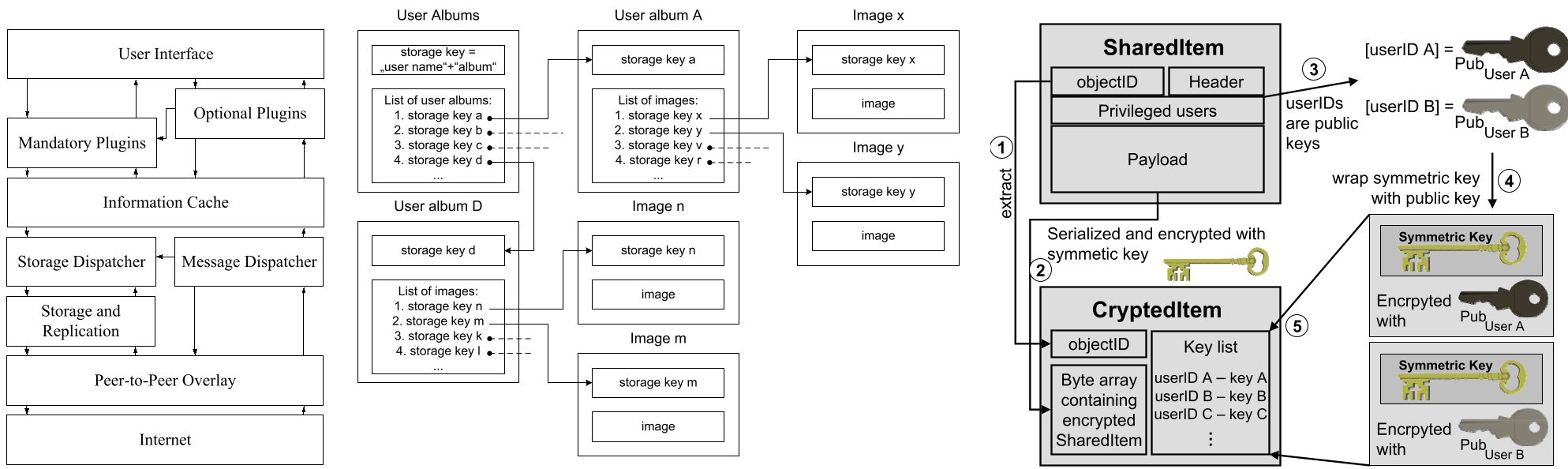 Figure 1: The modular architecture allows security plugins to interact with the Information Cache and DHT storage layer.
This design is particularly clever for Group Access. By using a shared "Group Key," the overhead for sharing data with thousands of members remains manageable, as the author only needs to manage the group's symmetric key.
Performance: Is Privacy Slow?
A common critique of P2P security is that it's too "heavy" for mobile or consumer hardware. The authors' testbed results on FreePastry debunk this:
- Message Latency: Encrypting and signing a message takes roughly 10-14ms, which is imperceptible in a chat application.
- Storage Overhead: For a standard 346 KB photo, adding 10 friends adds only ~1.5% in data size. Even at 200 friends, the overhead is ~24%, a reasonable trade-off for total privacy.
 Table 1: Impact of the number of privileged users on encryption time and data overhead.
Critical Insight & Future Outlook
The beauty of this framework lies in its Inductive Bias toward decentralization. By binding the identity to the cryptographic key, the system becomes "platform agnostic." Your identity exists as long as your key exists, not as long as a company's database is online.
Limitations:
- Key Management: If a user loses their passphrase (and thus their Private Key), they lose their identity and access to all their data. There's no "Forgot Password" link in a pure P2P world.
- Revocation: Removing a friend from an ACL requires re-encrypting the symmetric key, which can be computationally expensive if done frequently for large groups.
Conclusion
This paper provides a blueprint for what we now commonly refer to as "Local-First" or "Web3" social applications. It proves that with smart cryptographic choices, we can enjoy the social connectivity of the modern web without the baggage of central surveillance.