
Cultural Dimensions in UI: Moving Beyond Simple Translation to Global Experience
A Practical Set of Culture Dimensions for Global User-Interface Development
This paper presents a prioritized framework of cultural dimensions for global User-Interface (UI) development, synthesizing 29 dimensions from 9 anthropologists. By surveying over 50 international UI experts, the authors identify a core set of 5-6 critical dimensions—led by Context and Technological Development—to streamline the localization process.
TL;DR
Localization is more than just translating text; it’s about aligning with a user's world view. This paper synthesizes decades of anthropological research into a Practical Set of Cultural Dimensions, identifying that Context, Technology Experience, and Uncertainty Avoidance are the most critical factors for successful global UI design.
The Motivation: Why Localization Fails
Most companies treat localization as a "Content Management" problem—swapping strings and changing currency formats. However, users in Tokyo interact with data differently than users in Berlin or Silicon Valley.
The authors argue that "Subjective Culture" (values and behavioral systems) is often ignored because it is hard to quantify. Prior work by Geert Hofstede provided a foundation, but UI designers struggled to apply broad sociological theories to specific interface elements like navigation bars or icons. This paper bridges that gap by asking experts: "Which of these dimensions actually matter when you're building a product?"
Methodology: Mining Expert Intuition
The research team distilled 29 dimensions from 9 leading scholars (including Hall, Hofstede, and Trompenaars). They then surveyed 57 experts from 21 countries to rank these dimensions via a Likert scale.
The "Practical Set" Framework
The experts highighted that not all dimensions are created equal. They identified a hierarchy of importance to help project managers allocate resources.
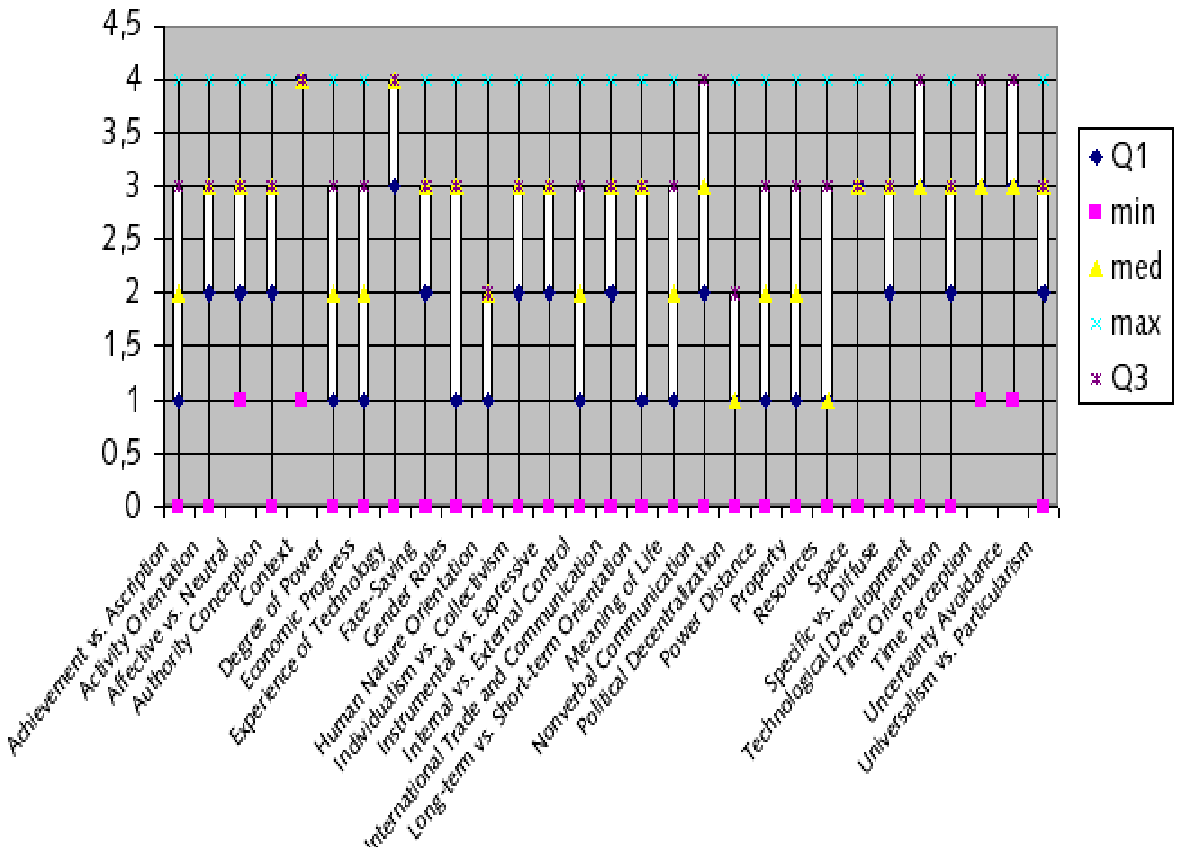
The boxplot above illustrates the high consensus on dimensions like "Context" and "Technological Development" compared to more polarized or lower-ranked dimensions.
The Core Five: What to Target First
The study filtered out the five most critical dimensions that should drive UI design decisions:
- Context: High-context cultures (e.g., Japan) prefer implicit communication and visual cues, while low-context cultures (e.g., Germany) demand explicit, direct information.
- Technological Development: A user's familiarity with tech infrastructure dictates the complexity of the mental models they can navigate.
- Uncertainty Avoidance: How much does the user need "hand-holding"? High-avoidance cultures need clear paths, error prevention, and structural stability.
- Time Perception: Is time linear (monochronic) or fluid (polychronic)? This affects how users perceive progress bars, deadlines, and multi-tasking interfaces.
- Authority Conception: Influences how "Help" menus, hierarchies, and security permissions are presented.
Experimental Insight: The Power of Grouping
The researchers didn't just list dimensions; they grouped them into logical clusters to assist in building a "Culturebase"—a hypothetical database for semi-automated UI adaptation.
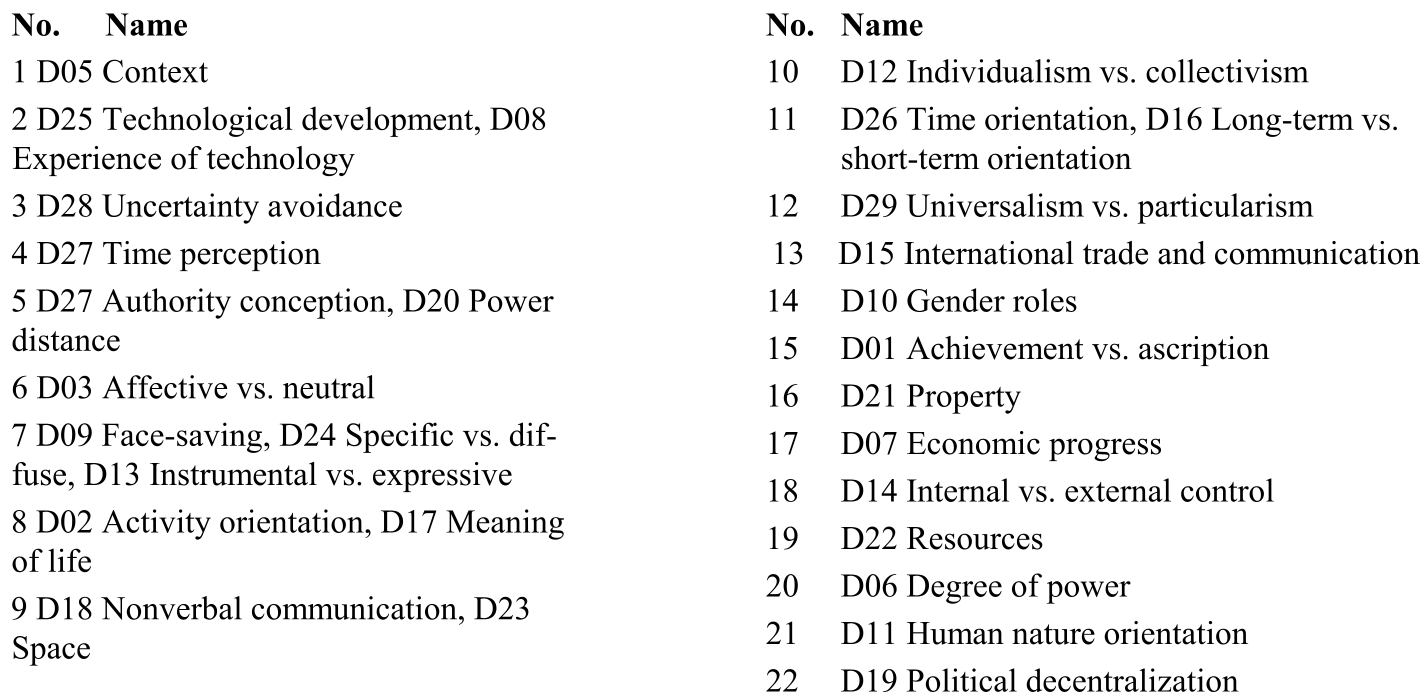
By looking at these clusters, a designer can see that Face-saving and Specific vs. Diffuse relationships both impact Interaction Design, suggesting that social community tools must be built differently for individualistic versus collectivist markets.
Critical Analysis & Conclusion
The paper's greatest value lies in its pragmatism. It acknowledges that designers cannot account for 29 different variables simultaneously. By narrowing the field to a "7±2" set, it makes cultural theory actionable.
Limitations
- Domain Sensitivity: As the experts noted, "everything depends" on the domain. A medical interface for a surgeon has different cultural constraints than a mobile game.
- Expert Bias: 82% of participants were from North America or Europe, potentially skewing the results toward Western perspectives on what is "important" for the Rest of the World.
Future Outlook
The authors propose a "Star Chart" tool to visualize cultural gaps between a source and target market. In the future, this could evolve into AI-driven UI generators that dynamically adjust the "Power Distance" or "Context" level of a website based on a user's locale and behavior.
Takeaway: If you are localizing a product today, start with Context and Uncertainty Avoidance. If your interface doesn't respect how a culture handles ambiguity and implicit messaging, no amount of perfect translation will save the user experience.