
Unlocking the Replicator: How the Pre-Initiation Complex Reshapes DNA Replication
Structure of the Pre-Initiation Complex Explains CMGE Biogenesis
This study reconstitutes the yeast pre-initiation complex (pre-IC) and uses cryo-EM to reveal the structural basis of CMGE (Cdc45–MCM–GINS–Pol ε) helicase biogenesis. The researchers identify how firing factors like Sld3, Sld2, and Dpb11 coordinate to transform the inactive MCM double hexamer into active replication forks, achieving SOTA structural insights into eukaryotic DNA replication initiation.
TL;DR
Published in Nature, Pühringer et al. have finally visualized the "missing link" of DNA replication: the Pre-Initiation Complex (pre-IC). By trapping the yeast replisome in an ATP-free state, the team used high-resolution cryo-EM to show how firing factors like Sld2 and Dpb11 physically pry apart the inactive MCM double hexamer, maturing it into two active CMGE helicases. This work redefines the role of Sld2—not just as a recruiter, but as a mechanical "wedge" essential for lagging-strand ejection.
The "Lego" Problem of Life
Every time a cell divides, it must unzip its DNA. This task falls to the CMG helicase. However, the motor of this helicase (MCM) is loaded onto DNA in a "safe mode"—an inactive double hexamer (DH). Transforming this "safe" double ring into two active, divergent motors is the central challenge of S-phase initiation.
The field has long known that kinases (DDK and CDK) trigger this process, but the actual "handshake" between these kinases and the physical architecture of the motor remained blurry.
Methodology: Trapping a Transient Giant
The authors hypothesized that ATP binding is the trigger for firing factor ejection. By reconstituting the system with purified yeast proteins in a buffer lacking ATP, they successfully "caught" the firing factors in the act.
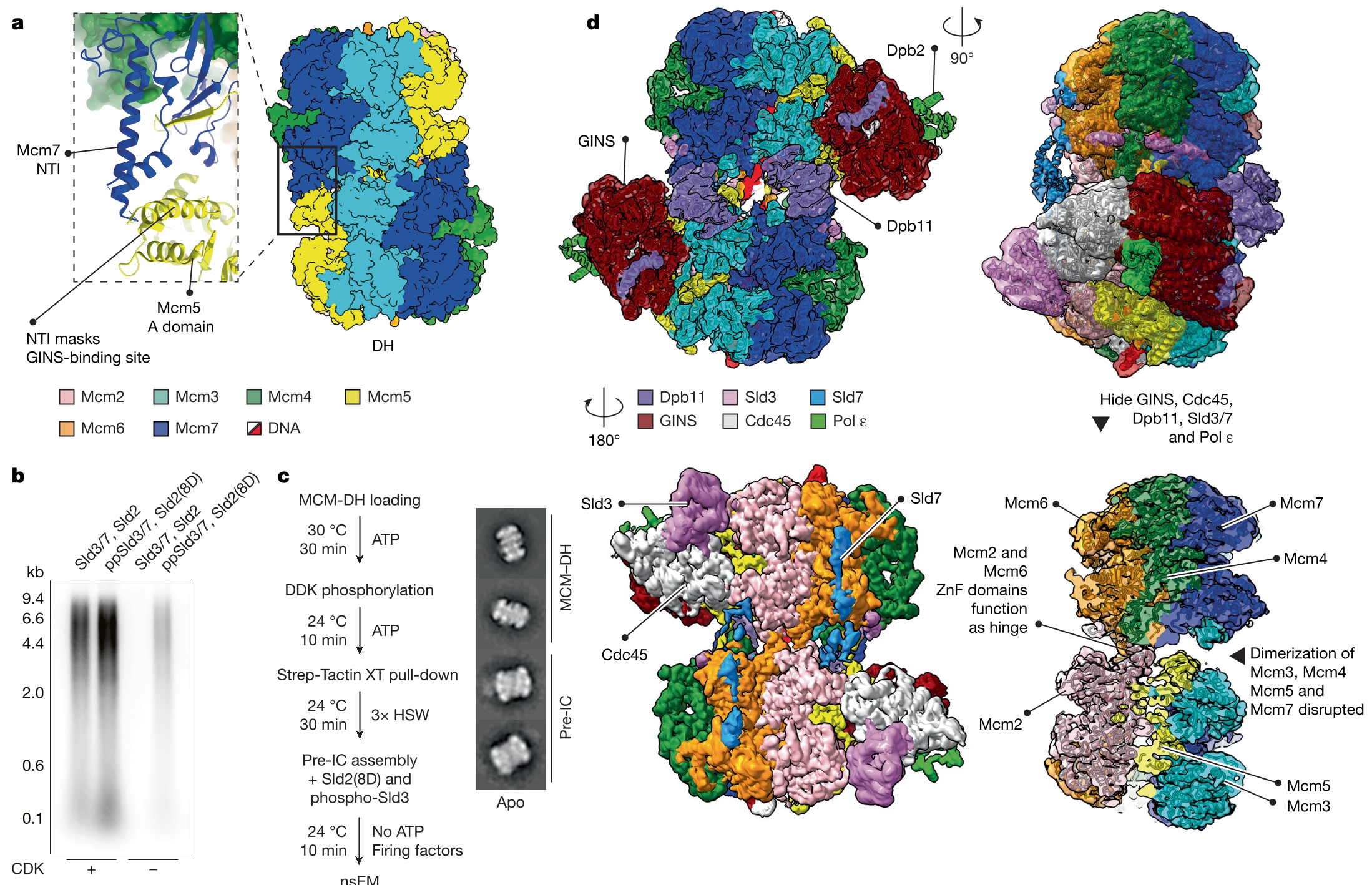 Fig 1: The transition from the inactive Double Hexamer (left) to the assembled Pre-IC (right). Note the splaying of the two rings.
Key Insights: Selective Engagement and Ejection
1. Sld3: The Phospho-Switch Reader
The structure reveals that Sld3 doesn't just bind MCM; it specifically targets the A4 site on Mcm4 that is only exposed after DDK phosphorylation. This confirms a "lock-and-key" mechanism where phosphorylation isn't just a signal, but a structural unmasking.
2. Dpb11: The Multi-Tasking Bridge
Dpb11 was found to act as a symmetry-breaker. It wedges between Mcm3 and Mcm7 across the two rings, sequestering the Mcm7 element that normally keeps the rings closed. This "opens the gate" for GINS to bind.
3. Sld2: The Master of the Lagging Strand
Perhaps the most significant finding concerns Sld2. Traditionally viewed as a mere recruitment factor for GINS, deletion experiments showed that without Sld2, the helicase cannot split correctly.
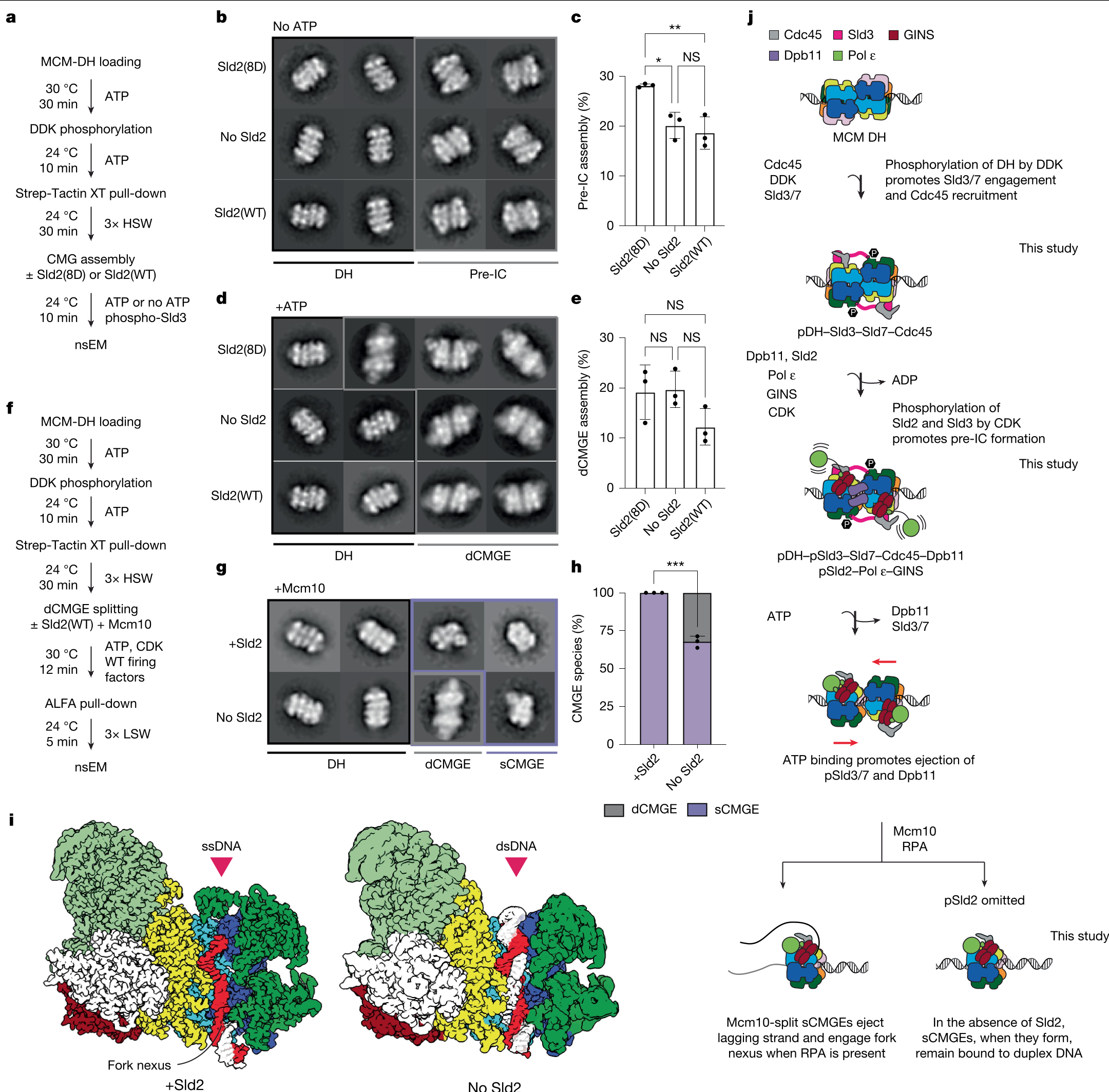 Fig 2: Biochemical assays showing that while sCMGE can form without Sld2, they remain stuck on duplex DNA, failing to eject the lagging strand.
Experimental Results & Quantitative Impact
The cryo-EM data (3.2 Å) allowed for precise atomic modeling:
- Replication Efficiency: While "CDK-bypass" variants (Sld3/7 and Sld2 8D) restored replication, the absence of Sld2 strictly blocked the transition of sCMGE from duplex DNA to single-stranded DNA.
- Mechanism of Ejection: The team demonstrated that ATP binding at the Mcm2-5 gate causes a steric clash between Pol ε and Sld3, providing a beautiful mechanical explanation for how the firing factors are "kicked off" once the motor starts.
Why This Matters
This study bridges the gap between yeast and human biology. The human orthologue of Sld2 is RECQL4, a protein mutated in Rothmund–Thomson syndrome (causing skin rash, thinning hair, and bone defects).
By proving Sld2 is essential for lagging-strand ejection, this paper offers a direct structural blueprint for understanding why RECQL4 mutations lead to genome instability and disease. It moves the field from "what" factors are involved to "how" they physically manipulate the DNA template.
Conclusion
The biogenesis of the replication fork is no longer a "black box." The pre-IC structure defines a stepwise pathway of activation:
- Unmasking: DDK uncovers the A4 site for Sld3.
- Bridging: Dpb11 holds the rings apart.
- Ejection: Sld2 ensures the lagging strand is kicked out as ATP ignites the motor.
Perspective: Future studies will likely look at how DONSON (lost in yeast but present in humans) integrates into this newly defined architecture.