
ResNet-50 vs. Orchards: Redefining Date Classification with Transfer Learning
Employment of Pre-trained Deep Learning Models for Date Classification: A Comparative Study
This paper presents a comparative study of pre-trained Deep Learning models for the classification of five date fruit varieties in an orchard environment. By fine-tuning architectures like ResNet-50, DenseNet, GoogleNet, and AlexNet, the authors achieved a SOTA accuracy of 97.37% and an F1-score of 98.14%, significantly outperforming traditional machine learning methods.
Executive Summary
The automation of date harvesting is a high-stakes challenge in agricultural robotics. This paper investigates how pre-trained Convolutional Neural Networks (CNNs) can be adapted to classify date varieties directly in the harsh, unstructured environment of an orchard. By benchmarking four iconic architectures—ResNet-50, DenseNet, GoogleNet, and AlexNet—the study demonstrates that ResNet-50 delivers a state-of-the-art accuracy of 97.37%, providing a robust vision backbone for future robotic harvesters.
Problem & Motivation: The Orchard Complexity
Most existing date classification research focuses on "clean" data—single-date images taken after harvest with controlled lighting and sterile backgrounds. However, a harvesting robot faces a chaotic reality:
- Environmental Variability: Intense shadows and fluctuating illumination in open fields.
- Visual Similarity: Different date varieties often look nearly identical during early maturity stages.
- Obstructions: The use of net bags to protect date bunches distorts visual features.
Traditional methods using handcrafted features like the Gray-Level Co-occurrence Matrix (GLCM) or RGB histograms fail to capture the high-level semantic nuances required to distinguish these varieties under such noise.
Methodology: The Power of Transfer Learning
The authors argue that training a deep CNN from scratch requires massive datasets which are often unavailable in niche agricultural sectors. To solve this, they employ Transfer Learning.
Model Selection
- AlexNet: The 2012 pioneer that utilized multi-level transportation.
- GoogleNet: Introduced the "Inception" module to capture information at multiple scales while reducing computational costs.
- ResNet-50: Utilizes Skip Connections (Residual blocks) to allow gradients to flow through 50 layers without vanishing.
- DenseNet: Connects every layer to every other layer to ensure maximum information flow.
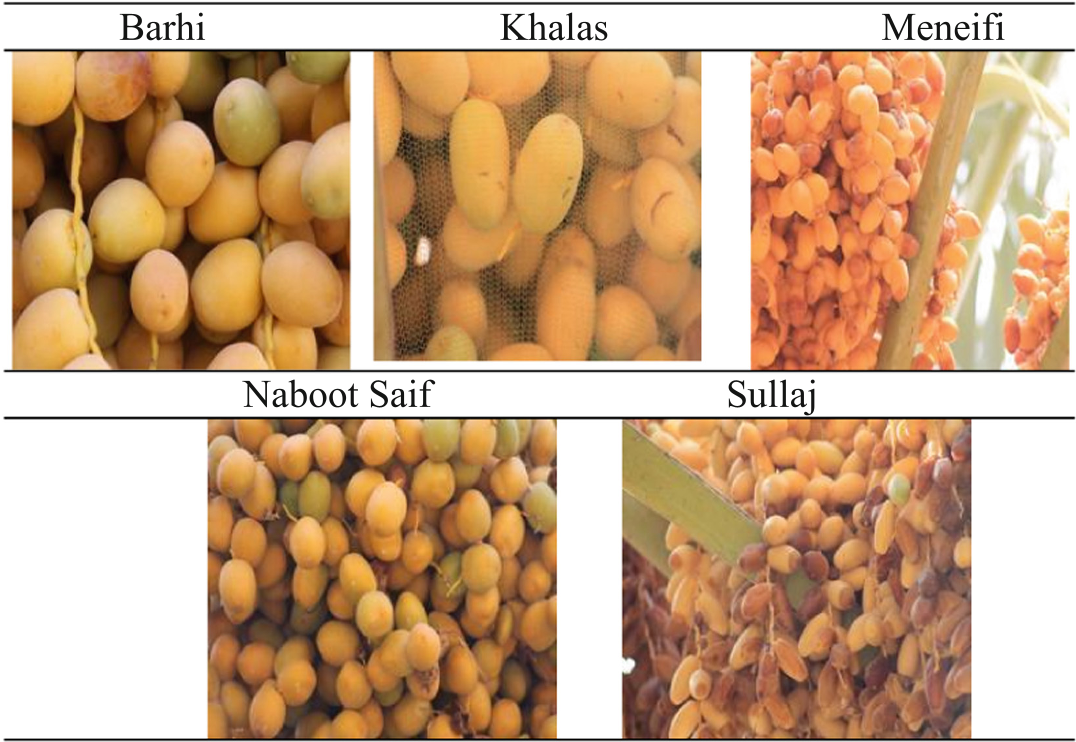 Figure 1: Examples of Sullaj, Meneifi, Barhi, Khalas, and Naboot Saif varieties.
By fine-tuning these models—originally trained on the 1,000-class ImageNet dataset—the researchers repurposed the "low-level" feature detectors (edges, textures) and optimized the "high-level" layers for date-specific morphology.
Experiments & Results
The experimental design involved a 70/30 train-test split on a dataset of over 8,000 images, including both bagged and un-bagged bunches.
Performance Comparison
The results (Table 1) show a clear hierarchy in performance:
- ResNet-50: 97.37% Accuracy / 98.14% F1-Score
- DenseNet: 91.30% Accuracy
- AlexNet: 85.71% Accuracy
- GoogleNet: 83.23% Accuracy
 Figure 2: ResNet-50 outperform traditional methods and prior deep learning attempts.
The superiority of ResNet-50 is attributed to its Residual Learning framework. In an orchard environment where features are often distorted or obscured, the identity mapping in residual blocks allows the network to preserve essential visual information across deep layers, preventing the "accuracy saturation" seen in shallower or traditionally stacked models like AlexNet.
Critical Analysis & Conclusion
Takeaways
The study confirms that the "feature-representation" capability of deep CNNs is vastly superior to handcrafted descriptors for agricultural tasks. Even though the models were pre-trained on general objects (dogs, cars, etc.), the learned filters are surprisingly effective at identifying the subtle textures of date skins.
Limitations & Future Work
- Inference Speed: While ResNet-50 is accurate, the paper does not deeply explore the inference latency on edge devices (low-power chips found on robots).
- Diversity: The current model focuses on healthy dates. The authors plan to extend this to disease detection, which is a critical pain point for orchard management.
In conclusion, ResNet-50 stands as the most viable candidate for integrating computer vision into robotic date harvesters, pushing the boundaries of precision agriculture in the Middle East and beyond.