
Decoupling the Smart City: A Precept-Based Framework for Crowdsourced IoT
Precept-Based Framework for Using Crowdsourcing in IoT-Based Systems
This paper introduces a novel software development framework for IoT-based systems that integrates "Precepts"—a declarative design paradigm—with crowdsourcing. By externalizing complex control logic from imperatively programmed classes into rule-based components, the framework enables a sustainable, adaptive architecture suitable for Smart City applications.
TL;DR
Building a "Smart City" is as much a software engineering challenge as it is a hardware one. This paper introduces a Precept-based framework that combines declarative design with crowdsourcing to solve the problem of software aging. By moving control logic out of rigid code and into flexible "Precept" rule-sets, the authors achieved an over 60% reduction in complexity during system evolution.
The Problem: The "Spaghetti" at the Edge
In standard Object-Oriented programming, "Control Classes" act as the brain of an activity, calling various methods to get a job done. The issue? They become highly coupled. When you change a single business rule—say, how a smart street light responds to a specific sensor—you often have to bridge multiple classes, leading to side effects.
In IoT, where thousands of sensors and crowd-contributed apps need to talk to each other, this rigid coupling causes the architecture to "erode" over time, making it nearly impossible to update without breaking something else.
Methodology: What are Precepts?
The authors propose a shift from Imperative (how to do it) to Declarative (what to do) logic.
A Precept is a standalone rule-set for a specific activity. It:
- Prohibits computational responsibilities (it only directs traffic).
- Minimizes coupling by being declarative.
- Allows for "hot-swapping" rules without rewriting the underlying application components.
The IoT Ecosystem Architecture
The framework divides the world into three spaces: the Sensor/End User Space, the Crowd Contribution Space, and the Metadata Subsystem (the control center).
 Figure: The proposed IoT Ecosystem integrating Precept Engines and Crowd Contributions.
Why Crowdsourcing?
Why let "the crowd" contribute to critical infrastructure? The authors argue that a sustainable IoT system needs the agility of the crowd to keep up with technological upgrades. By using the Precept Engine as a "Validation Sand-box," the system can accept new analysis code or sensor data streams while ensuring they don't violate privacy laws or corrupt the system core.
Experimental Results: Proving Evolvability
The most compelling evidence comes from the eSangam project. Comparing a traditional OO implementation to a Precept-based one over six major evolutions:
| Metric | OO-based (Final) | Precept-based (Final) |
|---|---|---|
| Complexity Index | 2086 | 796 |
| Modularity Index | 3260 | 1759 |
| Data Coupling | 236 | 170 |
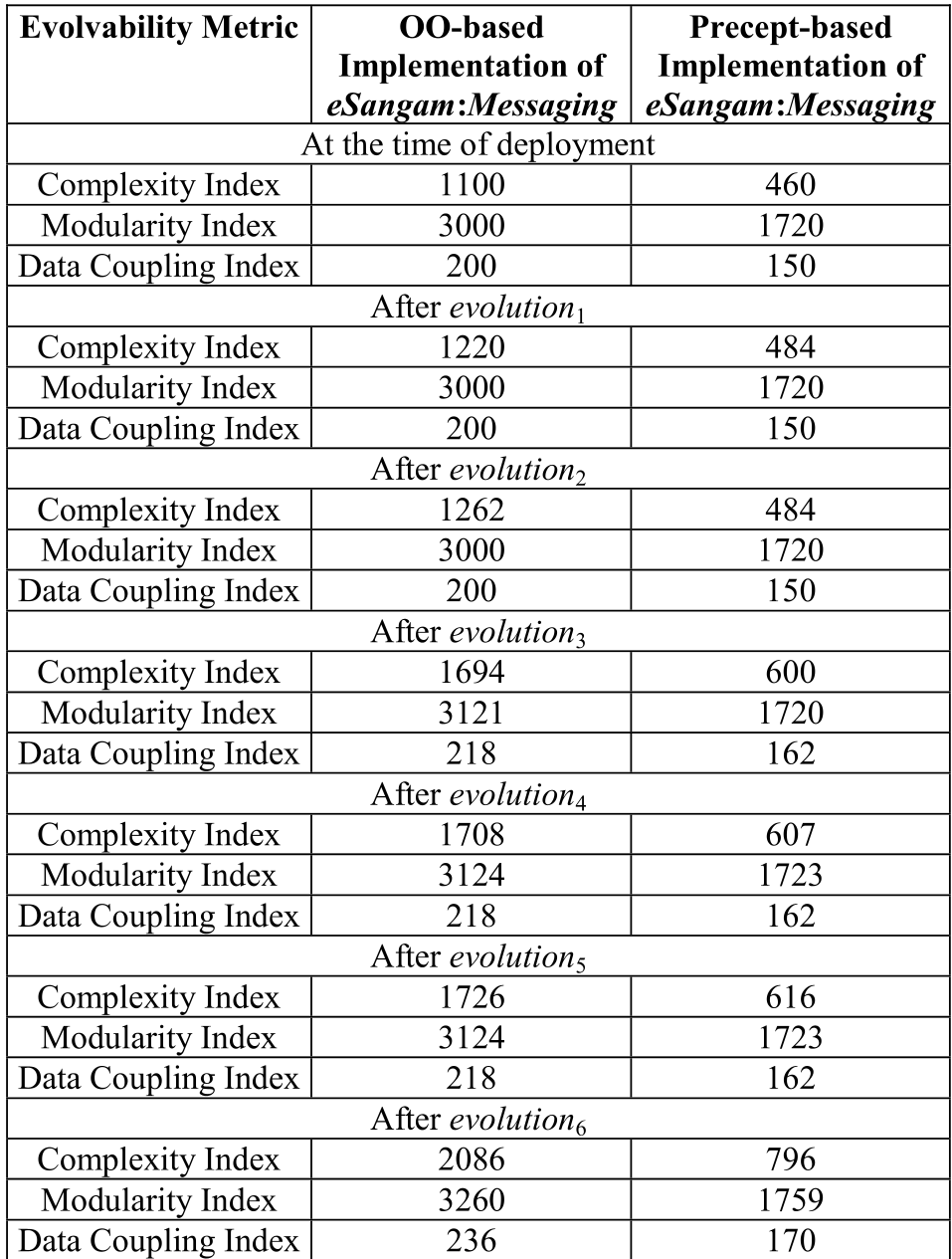 Table: Comparison shows that Precept-based systems stay leaner and more modular even as they grow.
Critical Insight: The Value of Constraints
The genius of this framework isn't just in the "freedom" of crowdsourcing, but in the constraints of the Precept. By restricting what a control component can do (no math, no hardcoded sequence), it forces developers (and crowd contributors) to build a cleaner system.
Limitations & Future Work
While the complexity metrics are impressive, the paper is light on the latency overhead of a declarative engine. In high-frequency IoT applications (like autonomous traffic control), the time taken for a rule-engine to parse and execute might be a bottleneck compared to compiled code.
Conclusion
The "Precept-Based Framework" offers a blueprint for Smart Cities that are self-sustaining. It turns the city into a living platform where the crowd provides the data and applications, but the Precept Engine ensures the city's "digital foundation" never erodes.