
Precision Crowdsourcing: How to Turn Passive Readers into Active Contributors
Precision CrowdSourcing: Closing the Loop to Turn Information Consumers into Information Contributors
This paper introduces "Precision Crowdsourcing," a theoretical framework designed to convert information consumers into active contributors. Through a large-scale field experiment on MovieLens, the authors evaluate how the timing, content, and rhetorical framing of requests influence both immediate compliance and long-term community engagement.
TL;DR
Online communities are facing a "contributor's drought" where the pool of active users is shrinking. This paper introduces a framework called Precision Crowdsourcing to solve this. By experimenting on nearly 3,000 MovieLens users, the researchers found that how and what you ask matters immensely: asking users to tag obscure movies rather than hits, and framing requests through "reciprocity," can boost compliance, though it might accidentally lower their desire to contribute voluntarily later.
Background: The Consumer-Contributor Gap
Most online platforms operate on a 90-9-1 rule: 90% consume, 9% contribute occasionally, and 1% are power users. As platforms like Wikipedia and TripAdvisor mature, they face a paradox: they need more data, but constant "pinging" for reviews or edits can alienate the remaining user base. The authors position this work as a transition from "blind asking" to "precision intervention"—determining the exact person, time, and reason to trigger a contribution.
The Precision Crowdsourcing Framework
The authors propose five dimensions to optimize the lifecycle of a contributor:
- Who: Selecting the right user based on history.
- What: The nature of the task (Difficulty/Complexity).
- When: The timing (Immediate login vs. deep-session).
- How: The rhetorical framing (Self-benefit vs. Altruism).
- Feedback: How the system acknowledges the effort.
Methodology: A Large-Scale Field Experiment
Working within MovieLens, the researchers asked users to provide tags. They manipulated three specific variables:
- What: Tasking users with "Obscure" movies (targeted/harder) vs "Popular" movies (easier/untargeted).
- When: Showing the popup immediately at login vs. after viewing 1, 2, or 3 movie detail pages.
- How: Using three distinct messages:
- Neutral: "Please provide three tags."
- System-reciprocity: "Help MovieLens improve."
- User-reciprocity: "Help other users get information."
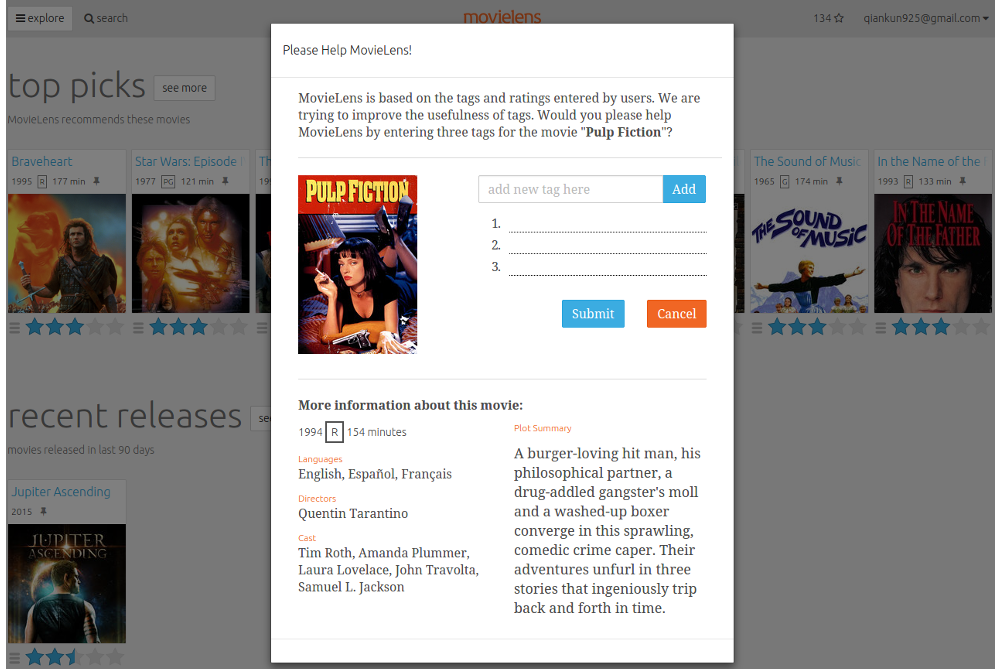 The prompt interface used to solicit tag contributions from MovieLens users.
Key Insights & Results
1. The Power of Obscurity (Uniqueness)
Counter-intuitively, users were more likely to comply when asked to tag obscure movies (30.2% compliance) than popular ones (22.2%).
- Insight: Users feel their contribution is unique and irreplaceable for a rare movie, whereas they feel "Star Wars" already has enough tags.
2. Reciprocity is a Double-Edged Sword
System-based reciprocity ("Help the site") led to the highest immediate compliance (31.1%). However, it also led to the largest drop in voluntary tagging over the next two months.
- Insight: Framing the task as a "favor" to the system might shift the user's mental model from "fun exploration" to "unpaid labor," quenching their intrinsic motivation.
3. The Risk of Scaring Users Away
The study found a significant "interstitial effect." Users prompted immediately upon login were less likely to return for a fourth session compared to the control group.
 Comparison of prompted tags (Immediate) vs. voluntary tags (Short/Long term).
Critical Analysis & Conclusion
This paper provides a sobering look at community management. While we can "nudge" users into becoming contributors, those nudges have a cost.
Takeaway for Product Designers:
- Don't ask for the "easy" stuff: Target tasks where the user’s specific expertise/history makes them feel unique.
- Mind the "Work" framing: If you start asking, you might have to keep asking. Once a user perceives contribution as a requested task rather than a spontaneous act, their voluntary participation may drop.
- The first response is a signal: A user’s compliance with their first request is a powerful predictor of their long-term value. Segment your users based on this initial "Precision Crowdsourcing" test.
Limitations: The study was conducted on a movie-specific site with limited social features; the dynamics of "User-based reciprocity" might be much stronger on platforms like Reddit or StackOverflow where social identity is more prominent.