
Predicting Academic Success: Turning Social Media Traces into Insights with LMNNR
Predicting Academic Performance Based on Learner Traces in a Social Learning Environment
This paper presents a predictive modeling approach for academic performance using student activity logs (traces) from a social learning environment (eMUSE). By applying a novel Large Margin Nearest Neighbor Regression (LMNNR) algorithm, the authors achieve high-accuracy grade predictions based on interactions with wikis, blogs, and microblogging tools.
TL;DR
This research investigates whether a student's "digital footprint" in a social learning environment—specifically blogs, wikis, and Twitter—can predict their final grade. By leveraging a specialized regression algorithm called Large Margin Nearest Neighbor Regression (LMNNR), the authors achieved an impressive feat: 85% of predicted grades were within a single point of the actual result, outperforming standard machine learning baselines.
Background: Beyond the Static LMS
Most educational data mining occurs within traditional Learning Management Systems (LMS). However, modern pedagogy—especially Project-Based Learning (PBL)—is increasingly social. Students collaborate on wikis, reflect in blogs, and communicate via microblogs. The authors argue that these "event-driven" traces are untapped goldmines for understanding student engagement and predicting outcomes.
The Core Challenge: The "Closeness" Problem in Regression
Predicting a grade is a regression task. Standard algorithms like k-Nearest Neighbors (kNN) assume that if two students have similar activity patterns, they should have similar grades. But what defines "similar"? In a high-dimensional space (e.g., number of tweets, blog length, active days), a standard Euclidean distance treats all features equally, which is rarely true in a classroom setting.
Methodology: The Power of LMNNR
The researchers refined the Large Margin Nearest Neighbor Regression (LMNNR) algorithm. Unlike standard regression, LMNNR "learns" a distance metric. It warps the feature space so that:
- Students with similar grades are pulled closer together.
- "Proximity order breaks" (where a student with a very different grade is closer than one with a similar grade) are penalized with a "Large Margin"—a concept borrowed from Support Vector Machines (SVM).
Model Architecture and Convergence
The algorithm minimizes an objective function , where handles attraction and handles the repulsion of dissimilar neighbors.
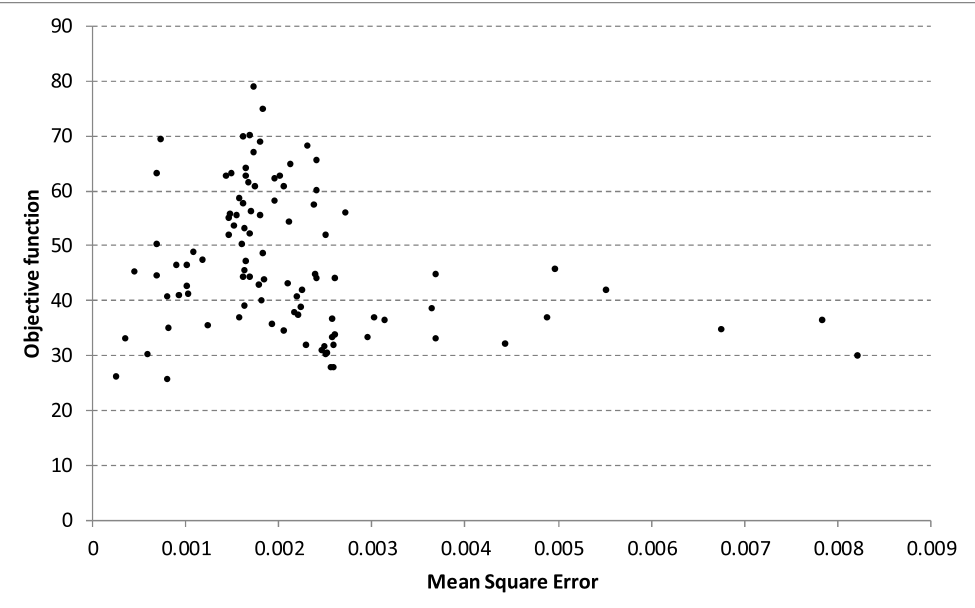 In the figure above, the algorithm demonstrates convergence where lower objective function values () generally correlate with lower Mean Squared Error (MSE), though the landscape remains complex requiring multiple restarts.
Experiments and Results
The study spanned six years and involved 343 students. The features included 14 indicators such as NO_BLOG_POSTS, NO_TWEETS, and NO_ACTIVE_DAYS_WIKI.
Performance vs. Baselines
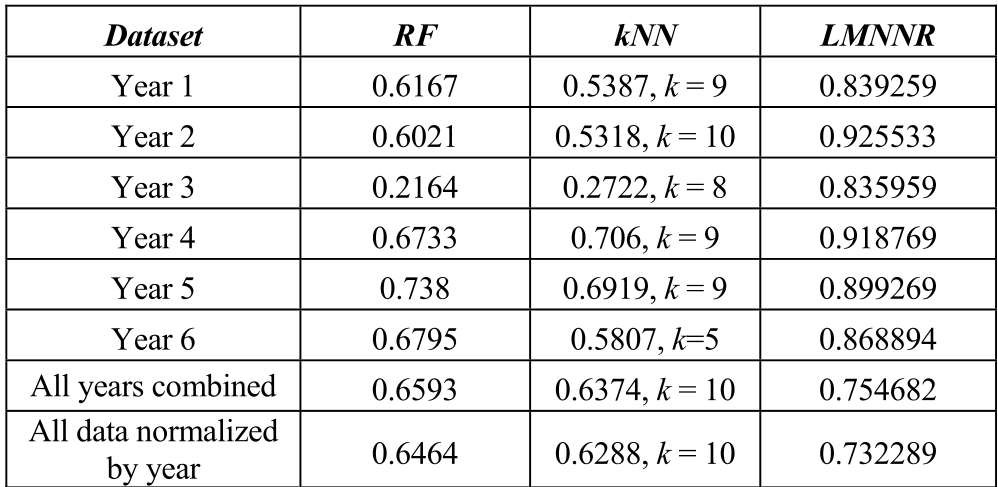
The LMNNR algorithm consistently crushed the competition. While Random Forest (RF) and kNN hovered around correlation coefficients () of 0.60, LMNNR reached values above 0.90 in several cohorts.
Visualizing Accuracy
The distribution of errors follows a tight Gaussian curve. The ability to stay within grade point (on a 1-10 scale) for 85% of the population highlights the model's reliability for real-world pedagogical intervention.
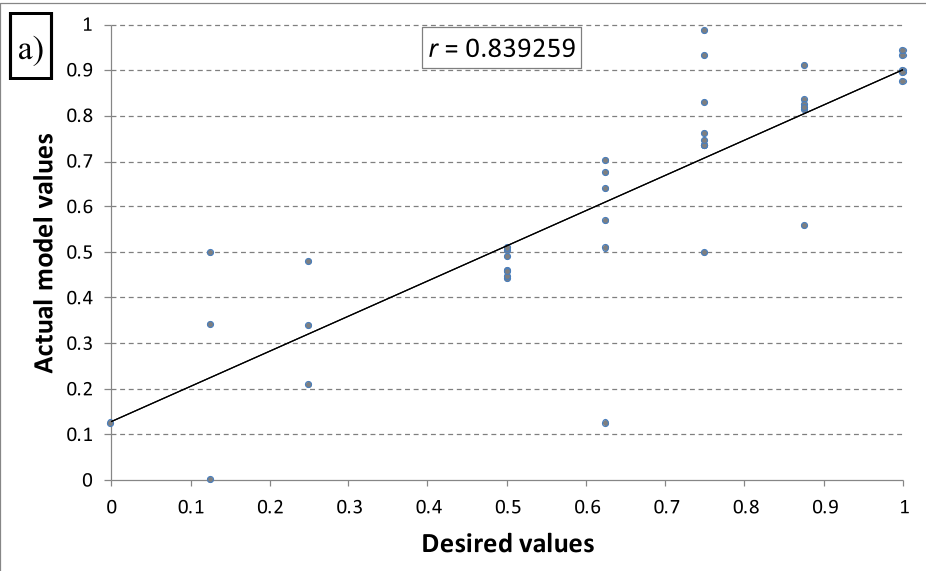 Comparison for Year 1: Part (a) shows normalized data, while (b) shows the final integer grade prediction vs. actual values.
Critical Insights & Future Directions
- Activity is Proxy for Quality: Interestingly, even without analyzing the content (what the students wrote), the quantity and consistency of their actions proved highly predictive.
- The "Yearly" Effect: Training on all years combined yielded lower accuracy than training on individual years. This suggests that "student types" and "class dynamics" shift slightly every year, meaning models should ideally be fine-tuned to specific cohorts.
- Limitations: The research relies on quantitative traces. It doesn't capture off-platform collaboration (e.g., WhatsApp, face-to-face).
Conclusion
This study proves that social media traces in a learning environment are not just noise; they are high-signal indicators of academic trajectory. By using metric learning (LMNNR), we can transcend the limitations of classic algorithms and provide instructors with a high-precision tool for identifying at-risk students long before the final exam.