
Decoding the Digital Mask: Predicting Age and Gender in Social Networks
Predicting age and gender in online social networks
The paper presents a text categorization study for predicting age and gender in online social networks using a corpus of over 1.5 million Flemish Dutch chat posts from Netlog. By employing a Support Vector Machine (SVM) classifier with token-based features, the authors achieved up to 88.8% accuracy in distinguishing adults from adolescents, a crucial step for detecting potential cyber-predators.
TL;DR
Social networks are breeding grounds for identity deception, posing significant risks such as cyber-pedophilia. This study demonstrates that even with "chat speak" messages averaging only 12 words, machine learning (SVM) can accurately distinguish adults from adolescents with up to 88.8% accuracy. By focusing on token unigrams rather than complex grammar, the researchers provide a robust framework for real-time profile monitoring.
Background: The Wild West of Chat Language
In the digital age, "writing as you speak" and "writing as fast as you can" have birthed a new linguistic frontier. On platforms like Netlog, Flemish Dutch chat is a chaotic mix of regional dialects, letter omissions (e.g., "wrm" for "waarom"), and emoticons. For traditional Natural Language Processing (NLP), this is a nightmare. Standard tools like POS-taggers often misread dialectal pronouns as common nouns, and the extreme brevity of posts makes traditional authorship attribution—which usually requires thousands of words—nearly impossible.
The Core Motivation
The authors' primary driver is cyber-pedophilia detection. Since predators often pose as adolescents to "groom" victims, a system that flags age-mismatches is vital. The research asks: Can we build a reliable classifier using only these tiny, noisy fragments of text? And what is the minimum amount of data needed to keep such a system updated as "slang" evolves?
Methodology: Power in Simplicity
Rather than relying on hand-picked dictionaries or fragile linguistic parsers, the team adopted a purely statistical approach.
1. Feature Engineering
They analyzed word n-grams (unigrams, bigrams, trigrams) and character n-grams. Interestingly, Word Unigrams (single tokens including words, emoticons, and punctuation) proved to be the most robust features. This suggests that what words people choose (e.g., "bro" vs. "greetings") is a stronger indicator of age than how they structure their sentences.
2. Architecture and Selection
The study utilized Liblinear (SVM) for classification, combined with Chi-square () feature selection. They tested feature sets ranging from 1,000 to 50,000 dimensions to find the optimal balance between granularity and performance.
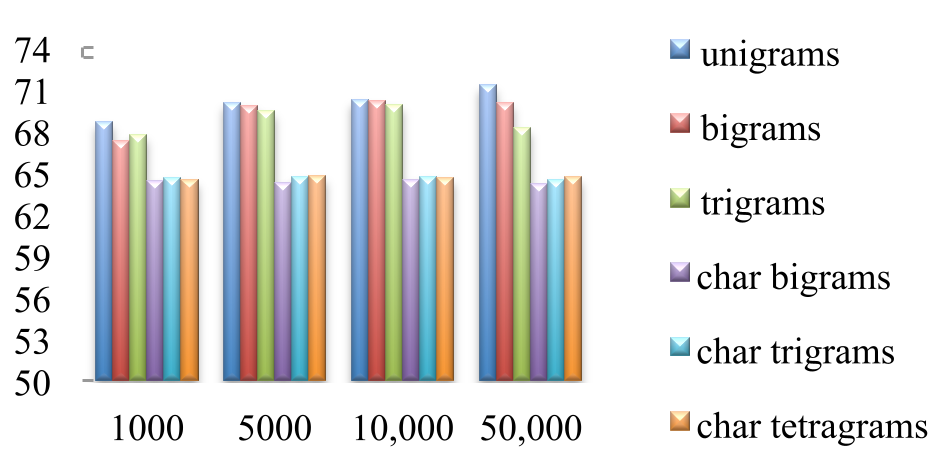 Figure 1: Comparison of accuracy across different feature counts for the Min16 vs. Plus16 task.
Experimental Insights
The research yielded several critical findings regarding identity detection:
- Age Matters More Than Gender: The confusion matrix revealed that language usage varies more significantly across age groups than across genders.
- The Gender Boost: While age group was the primary signal, balancing training data for gender or including gender as a feature improved the F-score for the adult class (Plus25) significantly.
- Efficiency with Small Data: One of the most promising results was that the system didn't "break" when data was scarce. Even with only 1,000 instances per class, the accuracy for detecting adults (Plus25) remained high at 85.6%.
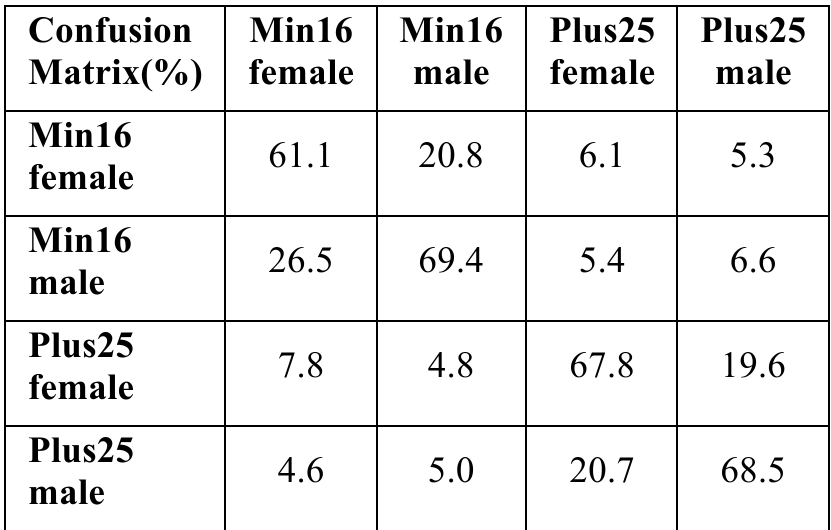 Table 1: Confusion matrix showing limited overlap between adult and adolescent language profiles.
Performance at Scale
As the age gap increases, the "linguistic signature" becomes clearer.
- Min16 vs. Plus16: ~71% Accuracy
- Min16 vs. Plus25: ~88% Accuracy
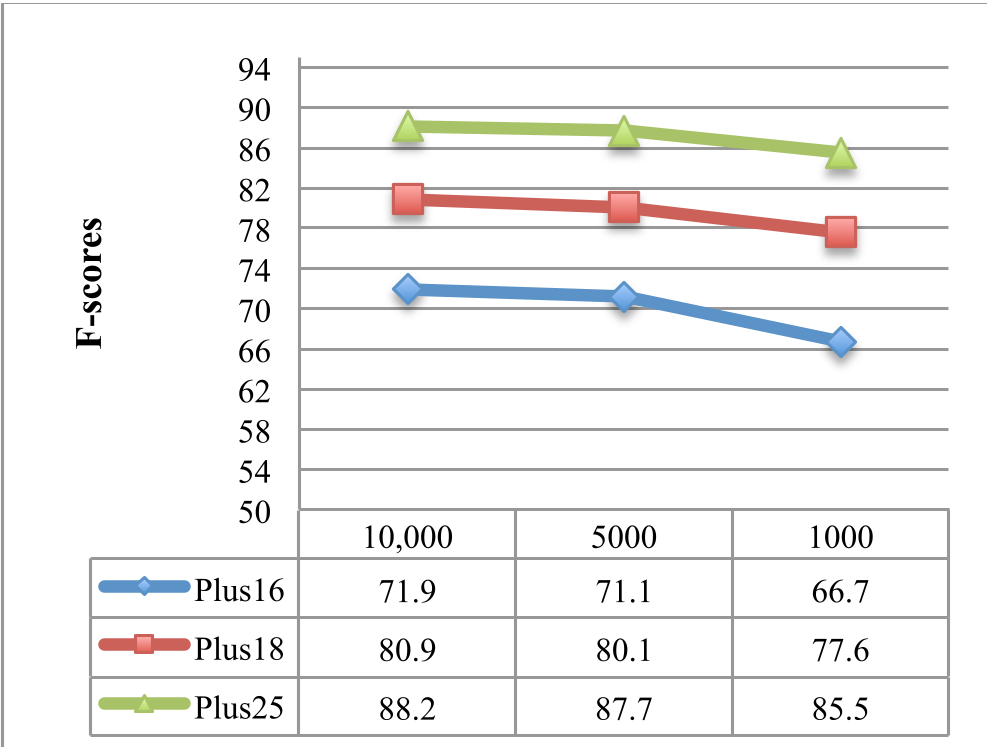 Figure 2: F-scores for the adult class across varying dataset sizes, demonstrating model stability.
Critical Analysis & Conclusion
This paper serves as a vital proof-of-concept for real-world social network moderation. It proves that stylometry does not require long-form prose to be effective; the high-frequency "noise" of chat speak is actually a rich signal of social identity.
Limitations: The study relies on self-reported profile data for training, which likely contains some "noise" from users already lying about their age.
Future Outlook: The next frontier involves testing these models against "adversarial" data—cases where predators are actively trying to mimic adolescent speech. Combining these linguistic features with behavioral metadata (logging times, friend-request patterns) will likely be the gold standard for future safety systems.
Takeaway for Practitioners
If you are building a moderation tool, don't over-engineer. High-dimensional word unigrams combined with a simple linear SVM can outperform complex models when dealing with the extreme brevity and variance of social media chat.