
PSAM: Predicting Collective Behaviors via Continuous-Time Stochastic Processes
Predicting aggregate social activities using continuous-time stochastic process
The paper introduces the Parameterized Social Activity Model (PSAM), a continuous-time stochastic framework designed to predict aggregate social activities (like wall posts or friend requests) in social networks. By leveraging a Wiener Process and time-evolving parameters, it achieves high predictive accuracy across diverse datasets including Facebook and CiteSeer.
TL;DR
While most social network models treat growth as a permanent accumulation of nodes and edges, real-world social dynamics are volatile—users go through periods of intense activity followed by silence. This paper presents the Parameterized Social Activity Model (PSAM), a framework that treats social activity as a continuous-time stochastic process. By adapting the mathematics used in financial option pricing (Wiener Processes), the authors can predict "bursts" in wall posts and friend requests with up to 95% accuracy.
Context: The Fallacy of the Static Sociogram
In traditional network science, we often look at the sociogram—a map of who is friends with whom. However, the authors argue that this is a "biased" view. Two groups can have identical friendship structures, yet one might be a vibrant community of daily interactions while the other is a digital ghost town.
The core insight here is that Social Activity (SA)—categorized into connective (adding friends) and interactive (posting, commenting)—is a better indicator of a network's health and future state than its topology alone.
Methodology: Borrowing from Financial Engineering
To model the inherent randomness and the "drift" of social momentum, the authors turn to the Wiener Process (WP), a fundamental component of Brownian Motion.
1. The Stochastic Differential Equation
The evolution of activity is modeled as:
- The Drift Term (): Represents the predictable growth or shrinkage of the active population.
- The Diffusion Term (): Represents uncertainty and environmental shocks.
- : The random increment of the Wiener Process.
2. Feature-Driven Parameterization
Unlike a standard Wiener Process, PSAM is parameterized. The authors extract 14 key features, ranging from the number of active members () to the average clustering coefficient (). These features "tune" the model in real-time, allowing it to adapt as the community changes its behavior.
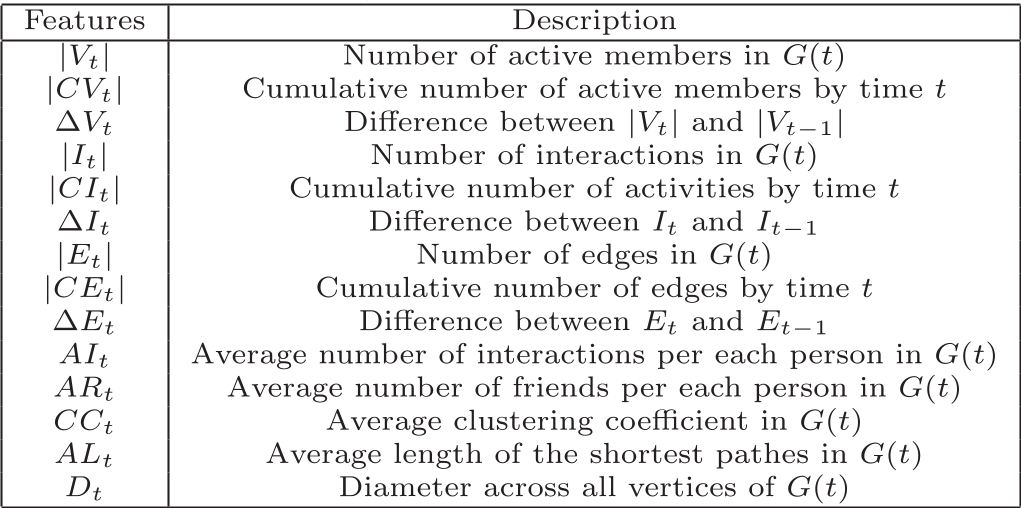 Table 1: The 14 activity features used to refine the stochastic model parameters.
Experiments: Outperforming the Baselines
The model was validated against three distinct datasets: Facebook wall posts, Facebook friend requests, and CiteSeer co-authorship records.
The results reveal a stark contrast between PSAM and traditional methods like Linear Regression (LR) or Average (AVE). While baseline methods often produce "flat" predictions that miss the natural oscillation of social life, PSAM tracks the ups and downs of user interaction closely.
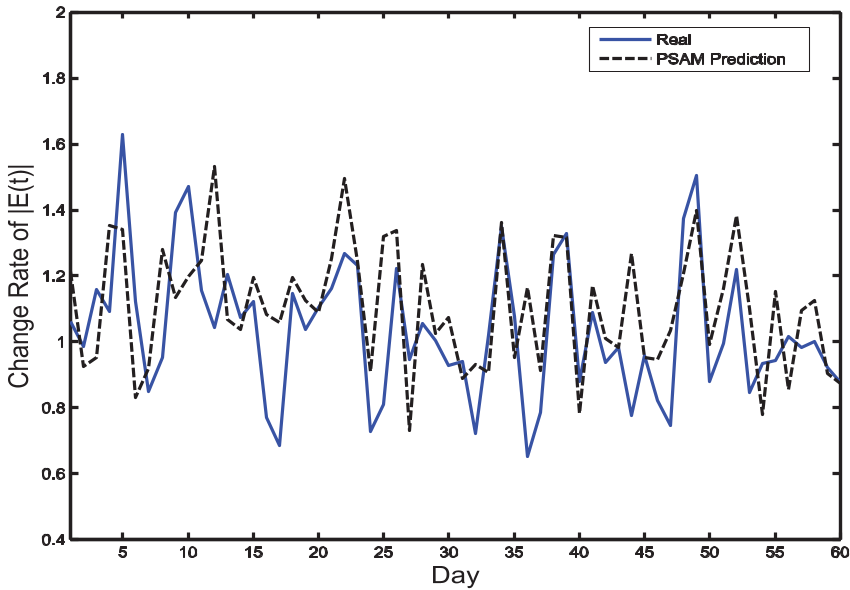 Figure 3: PSAM prediction (a) vs ground truth, and the 90% confidence interval (b) capturing activity bursts on Facebook.
Key Performance Wins:
- Burst Coverage: The model successfully predicts sudden spikes in activity (outliers) that would typically break a linear model.
- Scalability: It performs exceptionally well on "sub-communities" (e.g., the top 3,000 active users), reaching a confidence interval accuracy of 94%.
- Versatility: Whether predicting daily friend requests or yearly scholarly collaborations, the stochastic framework holds firm.
Critical Insight & Conclusion
The true value of this work lies in its philosophy: Social evolution is not just about growth; it is about flux. By quantifying "activeness" as a time-evolving parameter rather than a static attribute, PSAM provides a blueprint for how platforms can anticipate server load, moderate content, or time advertisements more effectively.
Limitations: The model currently relies on individual feature extraction (like PCA). As social data grows more complex (e.g., including multimedia or sentiment), moving toward Neural Stochastic Differential Equations (Neural SDEs) might be the natural next step for this lineage of research.
Takeaway: If you want to know where a social network is going, stop looking at the list of members and start looking at the "heartbeat" of their interactions.